How California Estate Wineries Solve Outage Risks and Unlock Land Opportunities
If you run a rural estate winery in California, you already understand how high power costs and frequent, prolonged outages impact your business operations.
Fermentation temperature control, refrigeration, crush equipment, tasting room operations, event infrastructure, and other business-critical activities rely on a utility line strung through high fire-risk terrain, managed by a corporation that will cut your power whenever wind speeds and temperatures climb.
Meanwhile, increased outage frequency and duration mean that the business case for workarounds like generators no longer holds up. But what happens when you can treat energy resilience as part of your estate infrastructure and business continuity strategy to take back control?
Most California wine regions are in PSPS territory
Many properties across the Santa Ynez Valley, Happy Canyon, Ballard Canyon, Santa Maria Valley, and the Tehachapi Mountains fall within the CPUC's High Fire Threat District — the state's designation for areas with elevated to extreme wildfire risk from utility infrastructure.
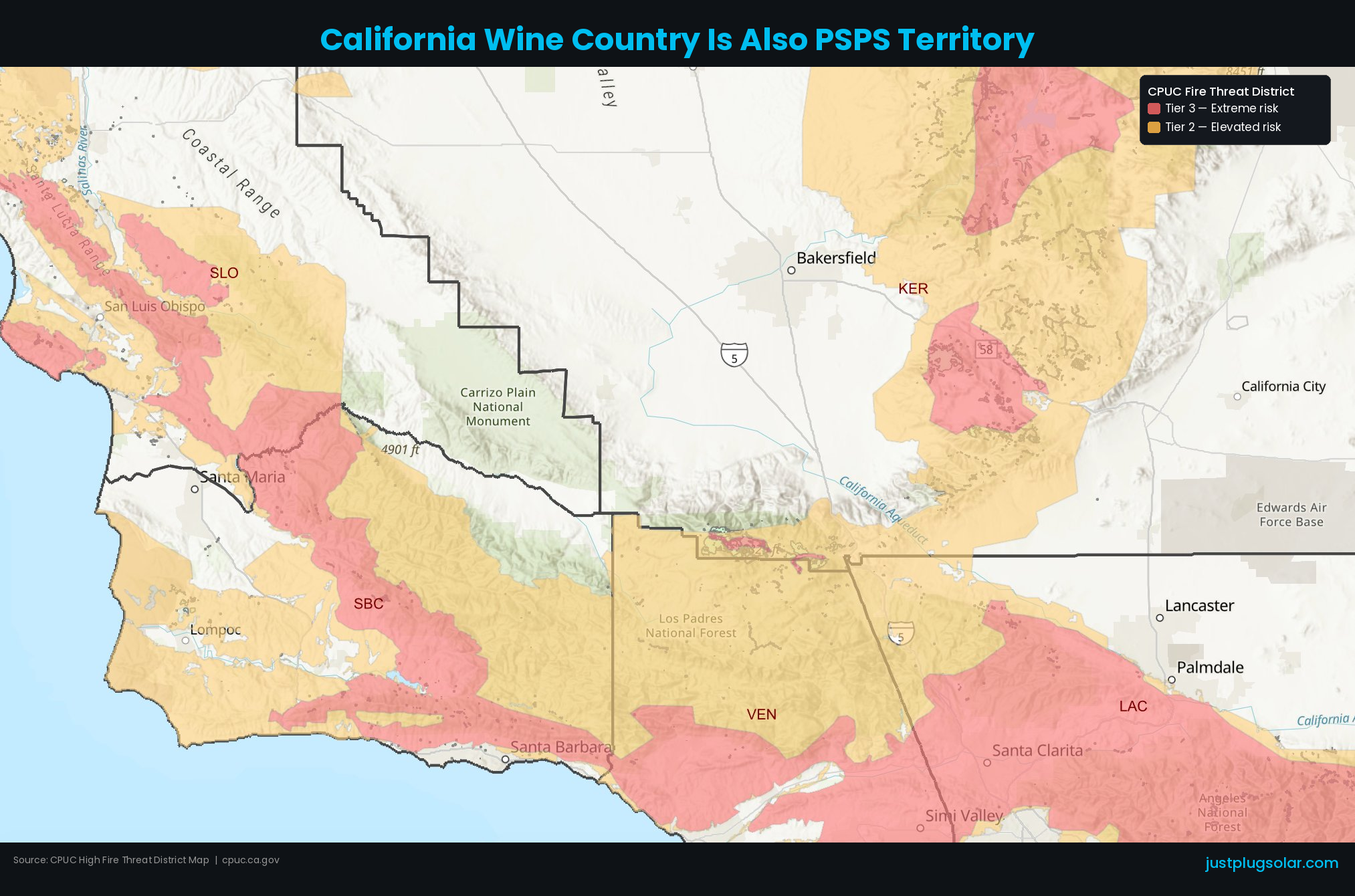
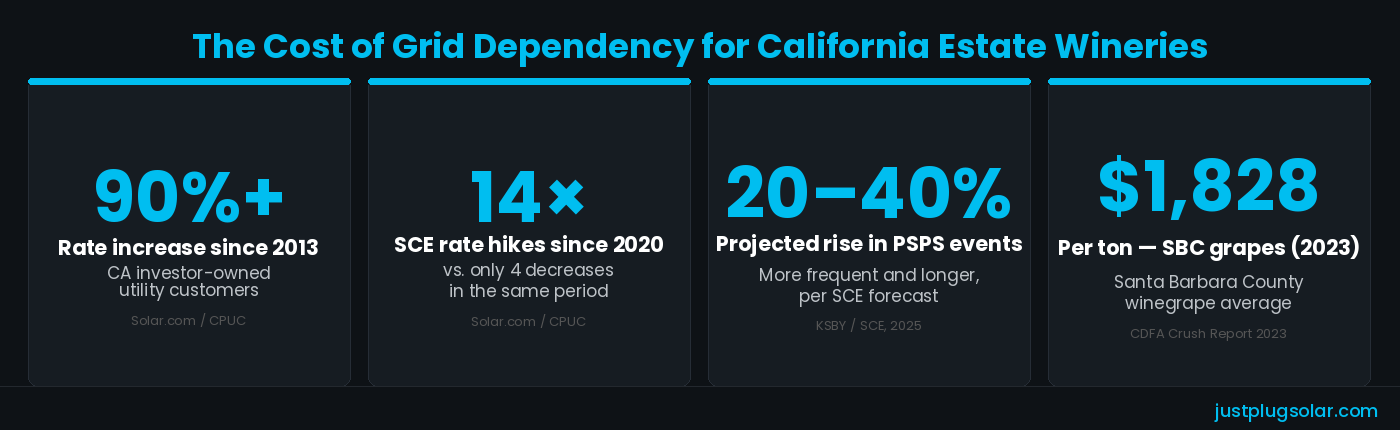
Meanwhile, Southern California Edison (SCE), which serves much of this region, has projected a 20–40% increase in both the frequency and duration of Public Safety Power Shutoff (PSPS) events as fire risk areas expand.
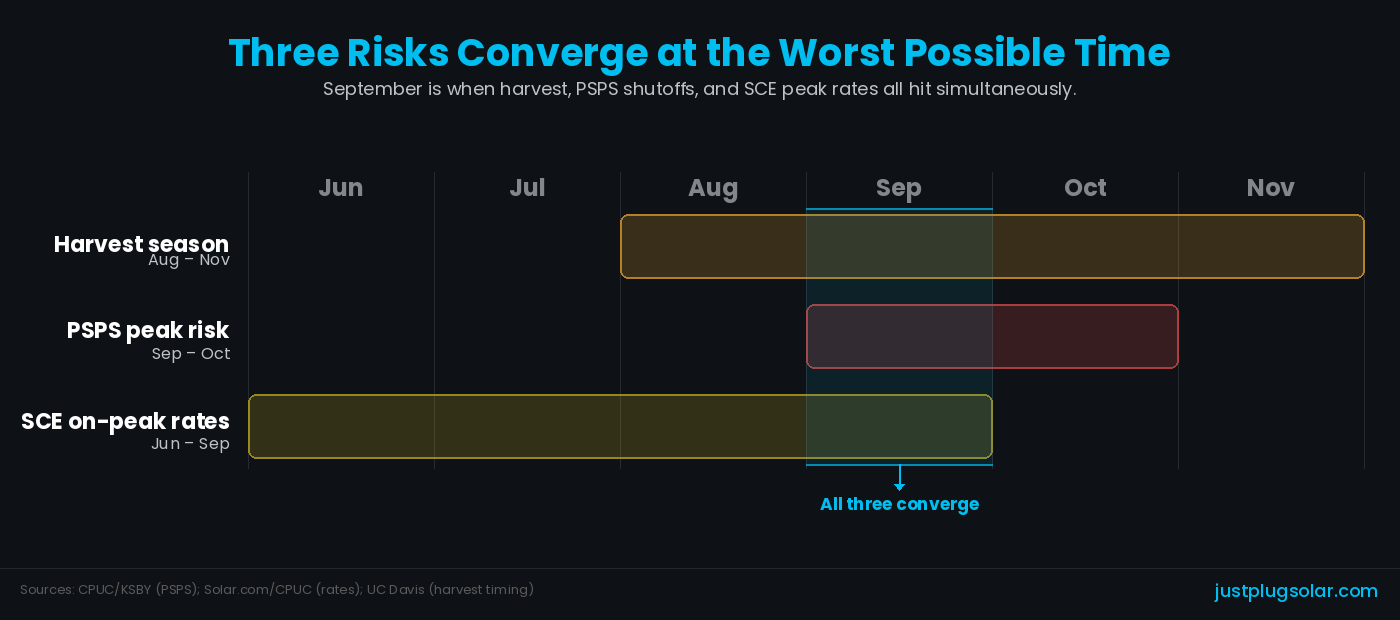
Adding insult to injury, PSPS events peak in September and October — exactly when grapes are coming off the vine, crush is underway, and your tasting room and event calendar are full. For a rural winery in the mountains, that convergence is a seasonal reality, year after year.
The triple whammy: Harvest, PSPS, and high rates
While outages get the headline, paying for grid power when it’s available isn’t worry-free either. SCE rates have increased 14 times since 2020 but decreased just four times over that same period. Since 2013, electricity rates for California's investor-owned utility customers have risen more than 90%. Rate hikes are now partly funding wildfire mitigation costs the utility incurred years ago, and you're paying for the same fire risk that's shutting your power off.
For commercial accounts, the rate structure adds another layer. In addition to per-kWh energy charges, commercial customers on time-of-use (TOU) schedules pay demand charges, calculated on peak usage during the billing period.
For a winery running crush equipment, fermentation control, and refrigeration simultaneously, that demand spike lands squarely in summer on-peak season — June through September, as harvest begins — driving the bills even higher. Between summer on-peak rates and fall PSPS risks, the grid is most expensive and least reliable during the exact months your operation can least afford either.
The high cost of outages during harvest seasons
Wine grapes in Santa Barbara County, for example, averaged $1,828 per ton in 2023. For a modest estate winery moving 50–100 tons through crush, that's $90,000 to $180,000 in raw material value in production within a window of several weeks.
You know what happens when a fermentation process loses temperature control. What's less obvious is how fast the numbers compound: a multi-day outage during peak crush doesn't just compromise one batch. Delays ripple through aging timelines, bottling schedules, and release dates — impacting the entire production calendar.
"Grapes are extremely expensive," Ronald Du Preez of SugarLoaf Crush told Decanter during the 2019 PSPS events, where tens of millions of dollars of wine were at stake.
The tasting room and events side of the equation
The hospitality side takes a hit just as hard. A canceled event or stay means a refund, a scramble to rebook, and a reputational problem. During the 2019 PSPS events, for example, some wineries were forced to close their hospitality operations entirely. The challenge reflects a pattern playing out across rural California vacation rentals and, more broadly, hospitality properties.
The generator workaround is a costly band-aid response
During the 2019 PSPS events in Sonoma County, one custom crush facility spent roughly $10,000 per month renting a generator to keep its operations going. The cost adds up thanks to fuel supply, maintenance, runtime reliability, and the logistics of keeping a generator fed during a multi-day outage. Worse, every dollar spent builds zero equity and solves nothing permanently.
Generators have been the default solution for years because no other economically viable choices were available. But times have changed, and they’re no longer the only option.
Pave a better way forward with grid-independent solar
What if there’s a way to insulate your business from shutoff risk year-round with an on-site energy infrastructure that you own and control? One that builds equity, increases property value, runs regardless of the grid’s status, and produces power to lower utility bills?
Enters grid-independent solar, which uses off-grid solar and batteries as the primary power source. The architecture keeps the grid connection as a fallback for when the solar system experiences issues or you run an exceptionally large load.
We custom-engineer every solution based on a property’s actual usage and expansion plans to help owners maximize their investment — meeting all business-critical requirements without paying for capacity they don’t need.
Most residential clients achieve a payback time of ~5 years with this approach simply from utility bill savings. This timeline will likely be shorter for businesses where ensuring business continuity and protecting their reputation has a hefty price tag.
Already have solar?
Many estate wineries have solar at this point. However, most installations are grid-tied, meaning that when the grid shuts down, the solar system goes down. Converting part or all of your solar setup to a grid-independent solution gives you the resilience you need to weather an outage stress-free.
One step further: Grid independence opens land opportunities
The grid-independence mindset doesn’t just help you preserve business continuity on your existing facilities and operations. Freeing your business from the artificial constraints of grid availability enables you to open new revenue opportunities.
Rural estate wineries typically sit on significant acreage — far more than the production facility and tasting room footprint. Remote sections of that land have hospitality potential, for example, you may develop it into outdoor event spaces, private vineyard tastings, picnic areas, and glamping sites. However, the land remains undeveloped because extending utility lines is costly and disrupts the landscape.
Off-grid solar changes that calculation. It allows wineries to unlock revenue opportunities by offering authentic, secluded experiences that many consumers seek nowadays. For example, the global glamping market was valued at $3.79 billion in 2025 and is projected to double to $7.87 billion by 2033.
A mindset upgrade: Your operation isn’t grid-dependent by necessity
Most winery operators treat the grid as a fixed constraint to manage around, with costly generator rentals, outage-prep protocols, and harvest scheduling, with one eye on the weather and the other on PSPS alerts. It's a lot of time, money, and energy spent accommodating a system that wasn't designed to support your business.
Grid-independent and off-grid solar solutions change the premise. Your production keeps running because it's powered by infrastructure you control. Your tasting room and events stay open because they're not downstream of a utility decision. Moreover, the acreage beyond your utility connection becomes hospitality space you can develop on your terms.
Ready to discover what’s possible? Let’s talk.