The Business Case for Grid-Independent Solar in Rural California Vacation Rentals
Running a vacation rental means your property must be operational 24/7. For rural regions with frequent Public Safety Power Shutoff (PSPS) events and poor service, relying on your utility for business continuity and resilience has become more hope than a strategy.
While residents may drag their feet over to the shed, yank the generator cord (grunt), endure the high fuel cost, tolerate the noise, try not to think about the fire risk, and put up with the inconvenience, vacation rental owners can’t tell their guests to “roll with it.” A grid outage is a business event that can cause poor reviews, lost revenue, and damaged reputation.
What can you do in the face of an increasingly unreliable grid infrastructure? Short answer: Take control of your energy infrastructure. Let’s delve into the long answer.
Rural residential customers are last in line
Utilities build infrastructure for density. Rural customers pay more per kilowatt-hour to maintain lines that serve fewer people and get the least responsive customer service. The economics of rural utility service have always worked against those at the end of the line.
Case in point: the Liberty Utilities situation in the Sierra Nevada is the most visible current example of what happens when a utility prioritizes bigger accounts. In 2027, NV Energy will redirect 75% of Liberty's power supply to data centers. 49,000 rural California residents across seven counties are left waiting on a four-jurisdiction regulatory proceeding with no clear resolution timeline.
This won’t be an isolated event. Rural residential customers are consistently the last consideration in utilities' infrastructure decisions. PSPS programs are managed to protect the broader grid (i.e., their assets and revenue source). Rate increases are approved at the commission level, with little recourse for rural customers who started with higher baseline rates.
What an outage actually costs a host
The grid going down at a vacation rental triggers a cascade of events.
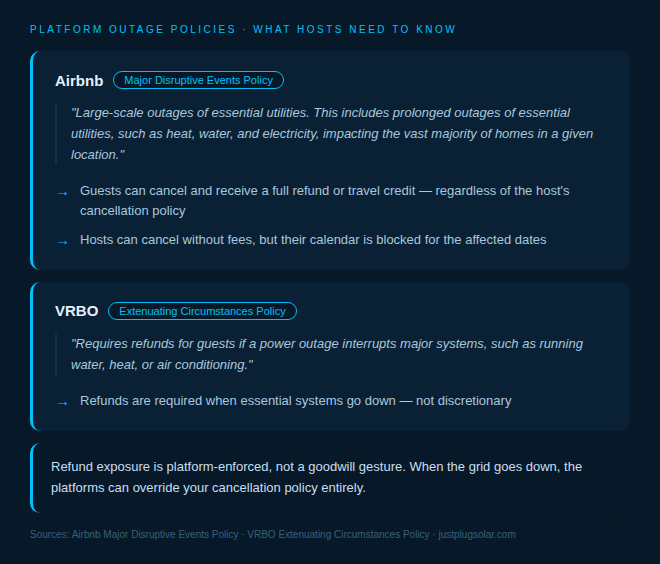
Guests call, and you issue a refund. The stay gets cancelled or cut short, and that cancellation goes on your record with the platform (e.g., Airbnb, VRBO). If the guest bothers to leave a review, it could be about them sitting in a dark cabin for hours. Your ratings and search result rankings drop, making it harder to attract bookings.
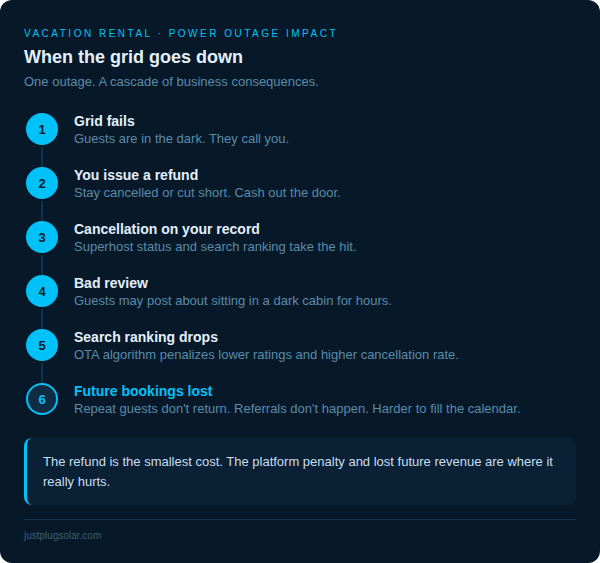
The refund is the smallest cost. The platform record, poor reviews, and lost future revenue hurt your long-term revenue potential. Unlike a one-off maintenance issue, a PSPS event often knocks out the entire market area at once, and guests can't simply move to an alternative accommodation. They leave the area, post reviews, and may never return.
Rate increases throw a monkey wrench into your ROI calculations
SCE documented an 83% rate increase over the past 10 years, equivalent to roughly 6% annual escalation. Rural customers on higher baseline rates often see steeper increases in absolute dollar terms, and the trajectory isn't flattening.
The power company can raise prices whenever and however much they want, and you’re a sitting duck if you depend on the grid to run your business. You don’t have visibility into your operating expenses, and praying that guests don't blast the AC or run the hot tub is not a strategy.
But what if you can turn the payments toward your electricity bills into (1) a fixed cost you can predict and (2) an investment into an asset you will own?
You’re already making the payment… but does it build equity?
The money leaves your bank account each month to buy electricity. With the traditional (utility) model, you pay to maintain someone else’s assets. But if you own the energy infrastructure on your property, you build equity and increase your property’s value. Our grid-independent solar solutions do just that.
<< For folks new to our offerings: our grid-independent solution uses off-grid solar and batteries as the primary power source. Unlike grid-tied solar, it works whether the grid is up or not, helping you lower power bills and build resilience. Additionally, you own the assets outright — there’s no funny business like a PPA or lease that will put you in a bind.>>
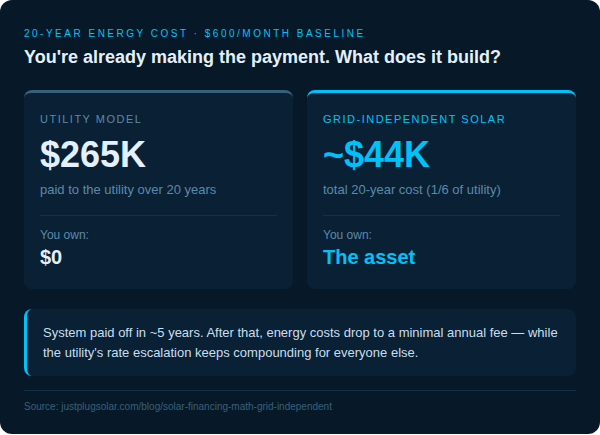
Here’s the math: A rural household spending $600 a month on electricity hands over roughly $265,000 to the utility over 20 years and owns nothing at the end. The same monthly redirected to a loan pays off a grid-independent solar system in about five years, with the total 20-year cost being roughly one-sixth of what the utility collects.
After it’s paid off, your energy cost drops to a minimal annual fee. The utility's rate escalation stops compounding against your margin, while a PSPS notice is just information.
For a vacation rental, the investment case is even sharper. Grid-independent solar doesn’t just reduce operating costs; it protects revenue by keeping the property operational when the grid is down or unstable. It removes a variable you can't price around and adds a documented asset to a property in a market where buyers increasingly factor infrastructure reliability in their decisions.
>> Use our Solar Payback Time Calculator to see how the math works out for you.
The most at-risk properties are actually best situated for solar
Rural vacation rental markets in California have grown significantly over the past decade. Big Bear, Joshua Tree, Palm Springs, the Coachella Valley area, Mammoth Lakes, the Kern County foothills, the Highway 395 corridor (Lone Pine, Bishop, Crowley Lake), Death Valley, Anza-Borrego, and Borrego Springs are remote, premium-rated destinations sitting on utility infrastructure never designed around vacation rental demand.
Guests paying Big Bear or Joshua Tree rates in peak season expect reliable power. They're not calibrating their expectations to the realities of rural infrastructure. These are the markets where the gap between guest expectation and utility reality is most exposed.
Here’s the silver lining: the same remoteness that makes these properties vulnerable to utility neglect also makes them exceptionally well-suited for solar production. Solar irradiance increases by approximately 3-4% for every 1,000 feet of elevation gain — high-altitude properties in Big Bear, Mammoth, and the 395 corridor produce more solar energy than lower-elevation locations.
Meanwhile, desert markets like Joshua Tree, Palm Springs, and Death Valley add more annual sun hours and clear skies to the equation. Less atmospheric pollution in rural areas also means less interference in power generation.
We know these conditions firsthand. Justplug is based in the Sierra foothills and has implemented systems across this terrain. In many cases, properties most exposed to utility risk have the best solar potential in California. This advantage lowers the cost of a solar solution, improving your ROI.
Grid-independent solar as business infrastructure
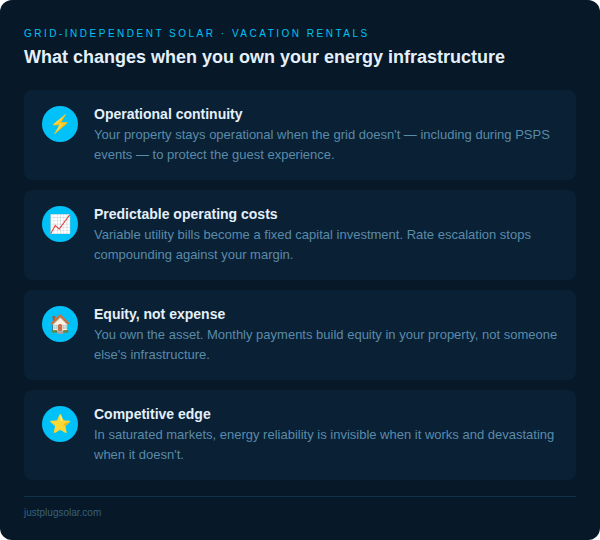
Grid-independent solar changes the equation by removing a variable you can't control. A properly dimensioned system uses solar as the primary load source, drawing from the grid or a backup generator only for high-draw edge cases. Your property stays operational when the grid doesn’t (e.g., during PSPS events) to protect the guest experience.
The energy cost shifts from a variable monthly bill tied to utility decisions you can’t influence to a fixed capital investment you own. Once the system is paid off, ongoing costs are minimal and predictable — a grid connection fee, monitoring, and battery replacement around year ten. The utility's rate escalation is no longer your problem.
A seamless guest experience gives you a competitive edge
Vacation rental markets in rural California are crowded. Big Bear has thousands of active listings. Joshua Tree has become one of the most saturated short-term rental markets in the state. Guests have options. In a saturated market, energy reliability is a quiet differentiator. It shows up as an “absence” in five-star reviews — nothing went wrong, everything worked.
Ready to explore what grid-independent solar looks like for your vacation rental? Let’s talk.