What the Liberty Utilities Crisis Means for Vacation Rental Operators
Liberty Utilities will lose 75% of its power supply by May 2027 as NV Energy redirects capacity to data centers, impacting customers in Placer, El Dorado, Nevada, Sierra, Plumas, Mono, and Alpine counties. (We cover the implications and regulatory picture in this post.)
If you’re running a vacation rental in the affected region, you’re facing more than rising electricity costs. You have a business continuity problem when the availability and reliability of the power supply are uncertain.
Instead of waiting for the stars to align (e.g., regulatory bodies resolving the issue in under 12 months or Liberty negotiating a good deal), it’s time to take control of the situation. So, how can you proactively mitigate this business liability or even turn it around to your advantage?
What a power outage actually costs a host
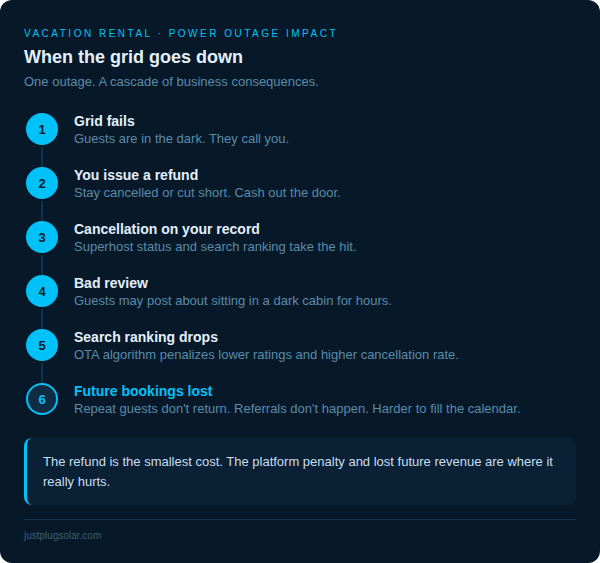
The grid going down at a vacation rental triggers a series of events.
Guests call, and you issue a refund. The stay gets cancelled or cut short, and that cancellation goes on your record with the platform. If the guest bothers to leave a review, it could be about them sitting in a dark cabin for hours. Your ratings and search result ranking drop, making it harder to attract bookings.
In a market where properties command premium nightly rates and guests have plenty of alternatives, one bad stay is expensive in ways that don't show up on a spreadsheet. The margin eaten by a refund is inconsequential compared with the potential long-term negative impact: repeat guests don't come back, and referrals don’t happen.
The Liberty crisis put this exposure under the spotlight. Rates have already roughly doubled in about four years. Wildfire-driven PSPS events have been adding outage risks for years. Now the underlying power supply itself becomes a question mark.
Even if Liberty secures replacement power, it will be competing against PG&E, Southern California Edison (SCE), and large industrial buyers with far more leverage. Rates will go up, but reliability won't improve. Moreover, there’s no guarantee that the same story won’t play out again in a few years.
Utility costs you can't control threaten predictable margins
Vacation rentals are investments, and the business case depends on margin predictability. You must know your operating costs to price, finance, and plan property.
However, utility bills don't cooperate with that. You have zero visibility into where rates are heading, zero ability to cap your exposure, and zero leverage over a procurement decision made by a small utility competing against tech giants in a wholesale electricity market. Guests crank the heat and run the hot tub, and you absorb the cost.
Grid-independent solar changes that equation. The energy cost gets front-loaded as a capital investment. Once the system is properly dimensioned and implemented, ongoing operating costs are minimal and predictable. If you finance the project, you can set your monthly payment, converting a variable operating expense into a known, fixed one.
The result: you have a cleaner margin and a more defensible financial model.
Winter solar in the Sierra: The honest answer
The obvious question for a property in the Sierra mountains: can solar produce enough during ski season?
Fair question. Shorter days and potential snow cover on panels are concerns. Here’s why they’re not a deal breaker:
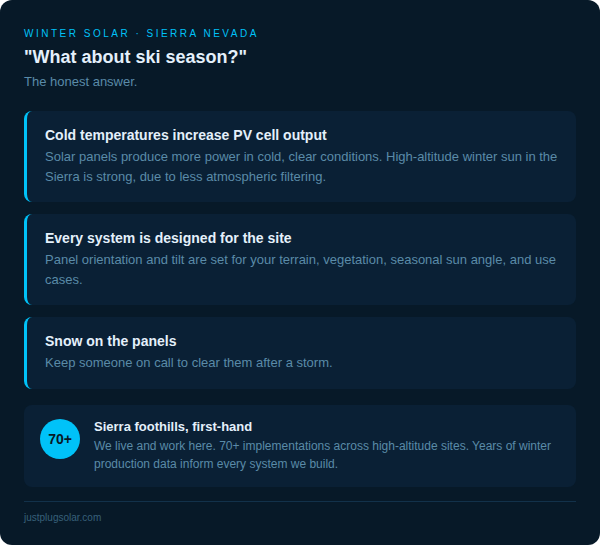
Cold temperatures actually increase PV cell output. Solar panels produce more power in cold, clear conditions than in summer heat. High-altitude winter sun in the Sierra is strong, with less atmospheric filtering than lower elevations. However, you do need to dimension sufficient battery storage capacity for the longer nighttime hours.
How do we know? We live in the Sierra foothills and have designed/implemented over 70 systems in high-altitude sites. We’ve collected data over several years to understand winter production and inform system dimensioning.
To ensure sufficient winter production, we customize panel orientation and tilt angle for each site based on terrain, vegetation, seasonal sun angle, and intended use cases. We also conduct detailed load analysis and planning to ensure the system meets requirements.
What about snow on the panels? System design can’t fix that, but someone with a broom and a squeegee can. It’s a maintenance task that can be addressed by keeping someone on call to clear the snow after a storm.
What about edge cases, such as extended storms with heavy cloud cover or when guests turn on the hot tub, oven, and many other appliances simultaneously? We address them with an automated switchover capability. If the grid is available, it will handle these high-draw events. If it’s unavailable, the system will draw power from an auto-start backup generator.
With this system architecture, you don’t have to pay for the solar capacity that only gets used once in a blue moon, but costs substantially more per unit of coverage. The automated fallback means that guests won’t notice any interruptions, while your solar investment works as hard as possible to maximize your ROI.
A differentiator in a crowded market
There are more than 3,400 vacation rentals in Placer County alone. Guests booking these properties at premium rates have options. Energy reliability is increasingly part of how they evaluate those options — not always explicitly, but through the reviews of guests who experienced an outage.
A rental that stays operational during a grid outage or a PSPS event (and eventually, whatever Liberty's procurement process produces) has a competitive advantage that shows up as an “absence” in five-star reviews: nothing went wrong, everything worked.
There's also the longer-term property value angle. Vacation rentals with a documented resilient energy infrastructure are easier to sell, easier to finance improvements on, and increasingly relevant in buyer due diligence in areas with known utility instability.
A timeline and outcome you can control
Liberty has until May 2027 to secure replacement power. The regulatory proceedings will run on their own timeline. Neither of those calendars is yours to control, and a lot of luck is needed for everything to work out in less than 12 months.
You can, however, control your property's energy infrastructure. A grid-independent solar system designed for your specific rental, including its size, load profile, site conditions, and guest usage patterns, removes your exposure to the uncertainties of Liberty's procurement process.
The platform algorithms, guest reviews, and nightly rate you can command don't wait on utility regulators. Your energy infrastructure shouldn't either. Learn more about our vacation rental solution and get in touch to discuss your requirements.