Off‑Grid Solar for Short‑Term Rentals and ADUs
Short-term rentals (e.g., Airbnb) and accessory dwelling units (ADUs) are excellent investments for enhancing property value, particularly for those who own land and ranches in rural areas, as more consumers seek unique, off-the-beaten-path travel experiences.
Today, guests are expecting more. They seek seclusion, views, and privacy — locating a unit close to the main house may make the listing less appealing to some renters.
However, placing a vacation rental unit or ADU at the opposite end of a 20- (or 40- or 60-) acre property is challenging because running new utility lines is expensive, time-consuming, or even impossible. Off-grid solar changes the equation.
Let’s see how an off-grid solar solution can help you unlock site selection opportunities, long‑term cost control, and a resilient guest experience.
Why off‑grid solar makes sense for vacation rentals and ADUs
Short-term rentals and ADUs are investments, and you must consider the total cost of ownership (TCO) and revenue opportunities. Here’s how off-grid solar benefits both sides of the equation:
Location freedom
You don’t need to place the ADU or rental unit close to the primary house for electrical access. Nor do you have to worry about trenching, electrical panel upgrade, and utility coordination, which add high cost and complexity to any project.
Off-grid solar gives you the freedom to site a unit farther from the main house for a truly secluded experience. It enables you to add units to remote parcels where utility service simply doesn’t exist, creating a truly off-the-beaten-path positioning — delivering an intentional experience that guests are willing to pay a premium for.
Predictable energy costs
Utility bills fluctuate, and you have no control over rate increases. You can’t tell guests not to use power-hungry appliances at peak hours. This variable operating cost can throw a monkey wrench into your financial plan.
With off‑grid solar, you front-load energy costs as capital investment. Once the system is properly designed and implemented (that’s key), ongoing operating costs are minimal and predictable. The result? Clean margins and fewer unpleasant surprises.
A built-in eco-narrative
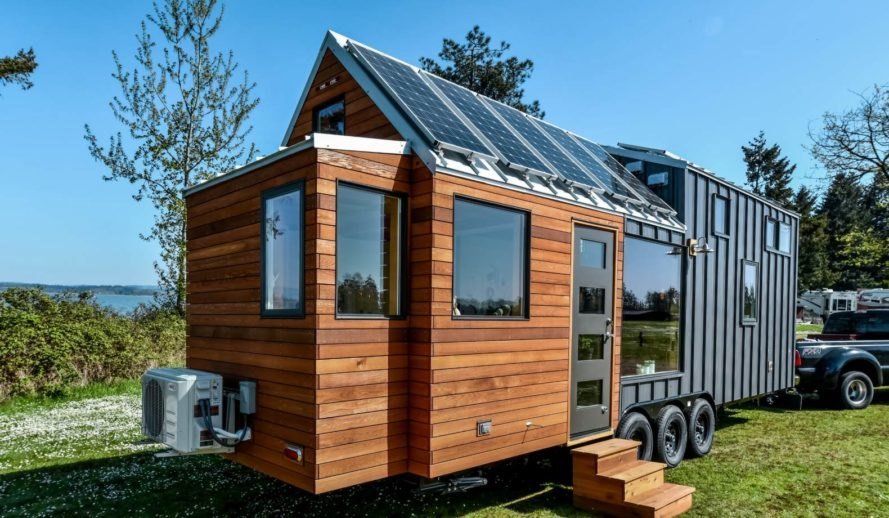
Once upon a time, we were curious about tiny homes. So, we rented one for a few days to see what that kind of space feels like. As more people become interested in sustainable living, they seek out off-grid rentals to “try it on for size.”
Off-grid solar is tangible and easy to grasp. It aligns with low-impact stays, nature-forward experiences, and remote/minimalist design concepts that are often synonymous with seclusion and tranquility. You gain a competitive edge by baking the sustainability narrative into the infrastructure.
Source: inhabitat.com
Resilience for a smooth guest experience
Grid outages not only disrupt guest stays; They also lead to refunds, bad reviews, and emergency calls. They can be particularly inconvenient in wildfire‑prone, rural, or weather‑sensitive areas, where prolonged outages are not uncommon.
An off-grid solar solution provides continuous power during outages and insulates you from unstable performance during peak demand periods. You have peace of mind that guests won’t be interrupted even when grid outages hit — protecting your bottom line and reputation.
Off-grid solar solution design considerations for short-term rentals and ADUs
First and foremost, you need reliability. Slapping together some equipment and hoping for the best isn’t a good strategy. Your off-grid solar solution must be properly dimensioned to support the property’s size, appliances, and expected number of guests.
Start with load planning
Evaluate the power consumption data of all appliances. Consider HVAC strategy, water heating, and pumping. Short-term rentals often experience bursty usage patterns. Guests may run multiple appliances simultaneously or crank the heat/AC without considering energy limits. Dimension your system for these realities, not best behavior.
However, a grossly over-dimensioned system isn’t the answer either. Too much excess capacity means you’re spending money on things that sit idle most of the time — impacting your return on investment (ROI) or payback time.
Our strategy is to dimension a system for ~95% of the maximum load to ensure the capacity you pay for is as fully utilized as possible. For the last ~5% (e.g., the once-in-a-blue-moon moment when a guest turns on every single appliance), we program an auto-start generator to take the punch (you should have one for backup anyway).
Make strategic appliance choices
Off-grid doesn’t mean sacrificing comfort, but it does reward smart choices. Select high-efficiency electrical appliances (e.g., a modern fridge and heat pump/mini-split air conditioner) and put those that draw a lot of power but are used infrequently (e.g., the stove, clothes dryer, or heating) on propane.
If you purchase a pre-fab unit, examine the appliance list to vet out (or at least question) appliances that draw excessive power. Also, inquire about substitution. For example, some manufacturers can switch out an electric clothes dryer or stove with a propane one.
What about an electric water heater? Electric instant water heaters are a big no-no. They will cost you dearly in inverter capacity (think $5,000+). However, we’ve built many systems to support regular electric water heaters without the high solar equipment costs.
The trick is to swap out a typical 4,500W heating element with an 800-1,000W one. It will take an hour or two, instead of five minutes, to reheat water after a shower. However, if you set the heater to turn on during the day (when the sun is out) to keep the water hot, there will be plenty to go around for the entire day. You can save on both inverter and storage capacities without impacting the guest experience.
Set up the conditions for success
Don’t provide appliances that draw high loads in the unit unless you accommodate them in the load planning calculation. Usual suspects include electric kettles and space heaters. Also, an ADU isn’t a nursing home for old appliances you don’t want in your house — they’re often inefficient and will cost you more in solar capacity than buying new ones.
Since these units are often smaller, you may not want to house the solar equipment inside. If you build a standalone shed or small attachment on the exterior wall, it should be well-insulated and well-ventilated to ensure the equipment’s performance and longevity.
Additionally, guest-proof your system. It should require minimal user interaction and include the necessary safety measures to protect against accidental overloads. For example, the inverter brand we use for whole-house solutions enables the owner to remotely monitor the system and adjust parameters without disrupting the guest experience.
Design an off-grid solar solution for short-term rentals or ADUs
Off-grid solar can help set your vacation rental apart; However, it isn’t a shortcut or a plug-and-play bolt-on. It works best when the unit is intentionally designed for efficient energy use and realistic loads. If you simply replicate a full-size, grid-connected home setup, costs rise quickly and reliability suffers.
Cost-effective off-grid projects start with setting clear expectations, making smart equipment choices, and a willingness to design for conscious energy consumption. Additionally, you can lower the initial costs and increase your ROI by having the right backup/resilience strategy.
And you bet we consider all these and more when designing a solution. Off-grid solar is most powerful when you start the energy consumption conversation early in the design process — get in touch to explore what’s possible.