Solar Panel Array Planning For Off-Grid Solar
While solar panels are the most visible part of a solar system (and many still erroneously assume that implementing solar means “installing panels”), most people don’t pay enough attention to the nuances of panel array planning to maximize yield.
Traditional grid-tied solar installers don’t tell you that, nor do they care. Their cookie-cutter processes aren’t set up to provide customized solutions.
In suburban installations, there’s virtually no choice but to put panels on the roof. The roof provides limited space and points whichever direction the house points, and you’re stuck with that production capacity. If you don’t produce enough? The utility companies will gladly sell you expensive electricity.
We’ve seen an installer slapping a ton of panels on a north-facing roof, adding $10k+ to the cost, just to make up for the fact that the panels are pointing in the completely wrong direction (the difference in production capacity of a north-facing vs. south-facing array is as much as 70%!)
Strategic solar panel array planning is often missing from traditional installation, yet it is fundamental for off-grid solar success. Working with the site, terrain, and vegetation should be a non-negotiable part of the process.
Besides determining where to put the panels, we consider how they’re wired to dial in every aspect. Let’s review the various factors we consider when performing solar array planning for our clients and how we address them.
Key considerations for off-grid solar array planning
Most people don’t realize that when part of a solar array is shaded, the performance of the entire string (or the entire field if the panels are all wired into one string) is affected. Even just a small shadow from a fence post can have a surprisingly outsized negative impact on solar production.
The impact of shadows is particularly critical in places where solar irradiation is high and abundant, such as Caliente. As such, we consider shading seriously.
We assess how the sun moves across a site throughout the year, including whether the surrounding terrain/mountains may cast shadows and when, as well as the effects of shading objects such as trees, buildings, and water tanks. Then, we select a location where solar strength is least affected by seasonal shifts.
Next, we consider the impact of insolation (also called irradiation or illumination) throughout the year by modeling the sun’s intensity and angle, along with the ambient temperature. Then, we apply the insights to optimize solar yield based on each client’s usage pattern.
A much less discussed but important factor is the SCC configuration. An SCC should be programmable to accommodate the reality of changing seasons and ambient temperature by balancing current vs. voltage.
For example, it’s more efficient to draw more current in the winter but have higher voltage during the summer due to thermally-induced resistance changes — the difference in ideal current fluctuates by 30% to 40% throughout the year. Modern, programmable SCCs automatically find the sweet spot to optimize efficiency.
Why does using an advanced SCC matter? The increase in efficiency through optimization and the ability to accommodate a broad range of operating conditions can reduce the number of solar panels by as much as 20% to 30% to achieve the same yield.
Then, there’s the question of how many SCCs to use. For moderately-sized solar fields (e.g., around 16 to 24 panels), we typically use two SCCs to divide the solar field into two sections (or strings). If one string experiences issues (e.g., one panel is shaded or damaged), the other will maintain its production capacity.
In a typical 2x8 panel arrangement for a 16-panel array, most installers would group the top panels into one string and the bottom panels into another. But that’s not always optimal.
For example, one client has a potential shading issue that could take out both strings if we wired them in a top-bottom arrangement. Instead, we divided up the panels vertically to increase the array’s resiliency.
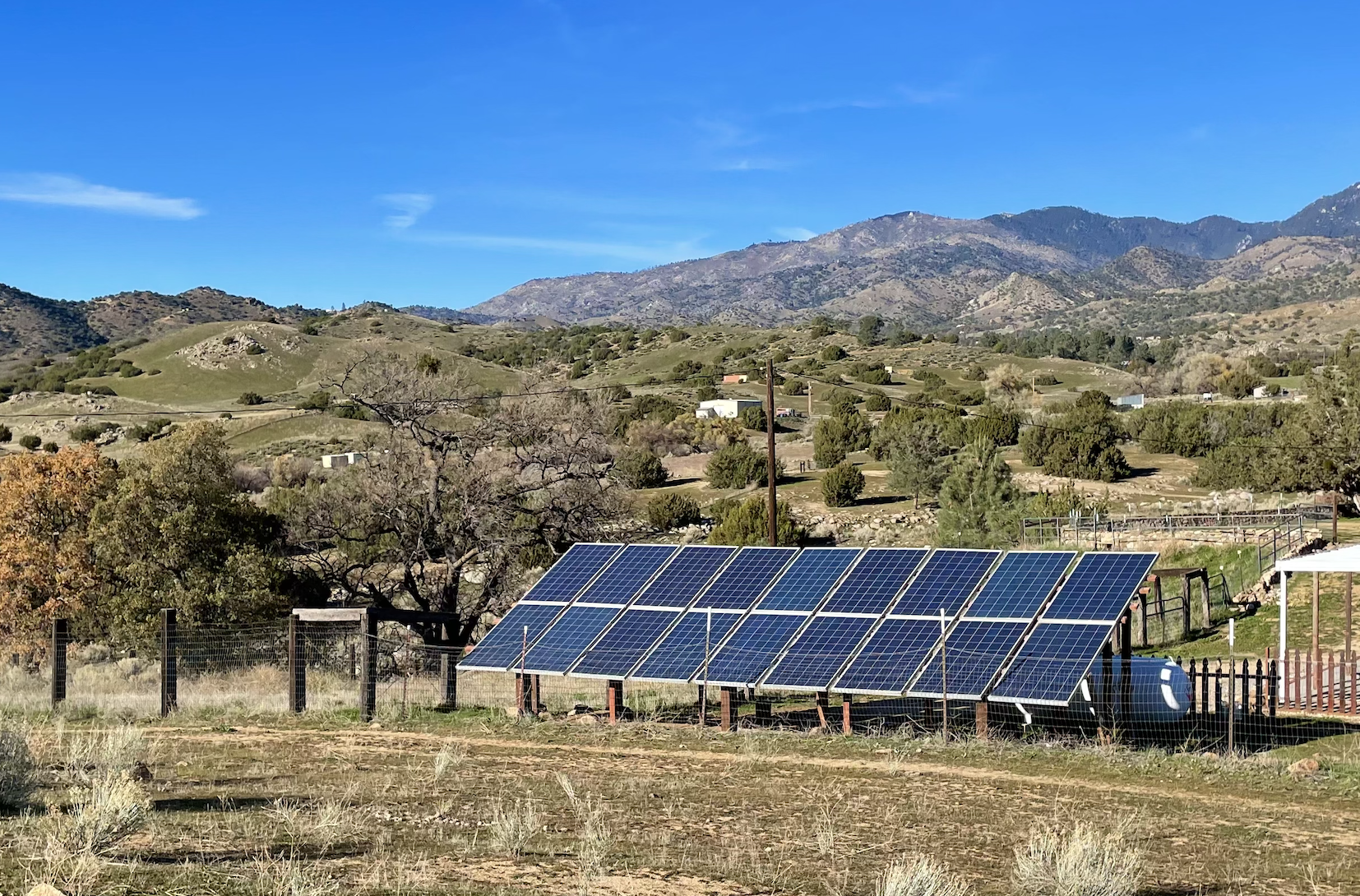
The art and science of solar array planning for off-grid solar
How do we pull all the factors together and connect the dots to position and structure a solar panel array?
We use several databases and tools to calculate and model the solar trajectory for each client site. For example, Google Earth Pro allows us to see how the terrain affects shading throughout the year. Meanwhile, NREL’s PVWatts Calculator shows each month’s solar yield for a specific location (but it doesn’t address terrain, which can skew results in mountainous areas). It also integrates with the NOAA database to account for local climates.
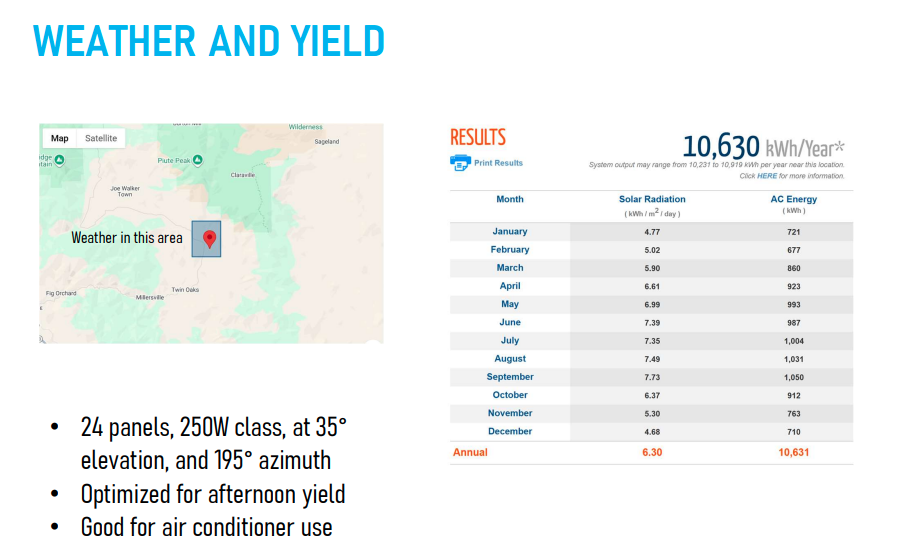
We use data from PVWatts Calculator to inform panel array design.
However, these tools don’t address shading from ground vegetation or built structures. To account for these factors, we combine observations from site visits with information from satellite pictures to ensure that our solutions work in real-world circumstances.
Then, we consider the proximity of the solar field to the equipment (which is typically close to the house and electrical panel). Long distances mean decreased efficiency and high cable costs. Adding a few panels to a spot closer to the equipment is often more cost-effective than trenching and pulling cables from an ideal location hundreds of feet away.
Of course, we also address client preferences. For example, if the “ideal spot” is shaded by a tree and the client would rather not cut it down, we may locate the solar field in an alternative spot and add a couple of panels to make up for the decreased production.
Off-grid solar planning is actually more nuanced
There’s slapping some stuff together and crossing your fingers. And there’s good planning to ensure your investment works the way it should. Many off-grid solar projects fall into the first camp, but things don’t have to go that way.
Good planning starts with understanding how off-grid solar differs from grid-tied systems — don’t accept the “conventional wisdom” about grid-tied solar at face value.
Planning for off-grid solar has more nuances and is often less forgiving. You (or the system designer) can’t fall back to the grid if the solution isn’t dimensioned properly. Nothing to hide behind! Therefore, addressing the various factors affecting everything from production to storage is essential for a cost-effective and successful implementation.
Ready to start your off-grid solar planning the right way? We can help.