What Rural California Property Owners Can Learn From the Lake Tahoe Energy Crisis (and what Liberty customers can do about it)
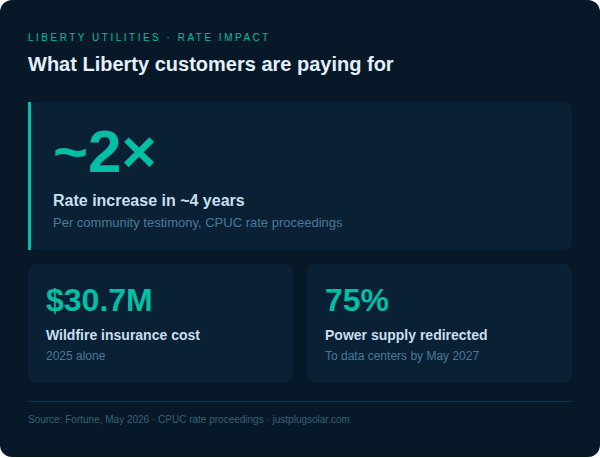
Liberty Utilities, which supplies electricity to roughly 49,000 residents across Placer, El Dorado, Nevada, Sierra, Plumas, Mono, and Alpine counties in California, will lose 75% of its power supply in May 2027. NV Energy, the Nevada utility that has provided the power for decades, is redirecting capacity to data centers in the Tahoe-Reno Industrial Center, where Google, Apple, and Microsoft are building or expanding facilities. Liberty's customers are left hanging.
Fortune reported on the crisis in May 2026, quoting a North Lake Tahoe resident and California Energy Commission official: "It's like we don't exist."
Liberty is now racing to issue an RFP for replacement power by summer 2026. But even if that procurement succeeds, these 49,000 customers will be competing in the Western electricity market against PG&E, Southern California Edison (SCE), data centers, and mining operations. As a small utility with no leverage, Liberty won’t win on price.
Property owners in those seven counties aren’t facing a temporary inconvenience with a clear path to resolution. It's a rude awakening on whom the grid is built to serve, and rural residential customers are not at the top of that list.
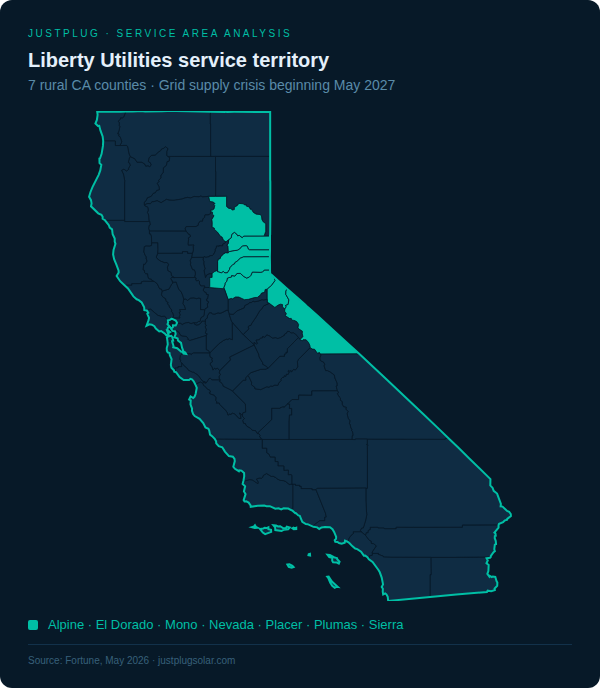
The Liberty situation isn't just a Lake Tahoe problem
The Liberty situation is the most visible current example, but the underlying dynamics exist across rural California.
Rural utilities typically serve low-density territory with aging infrastructure, high wildfire exposure, and limited regulatory clout. They depend on wholesale power markets that they don't control. When large industrial buyers (e.g., data centers, manufacturing facilities, and mining operations) show up with massive demand, small utilities and residential customers end up at the back of the line.
The bottom line: When 49,000 residents compete against load growth measured in gigawatts from data centers and tech giants, they lose.
In addition to availability, costs have become a growing issue.
Rates in Liberty's service territory have roughly doubled over the past four years. The high costs are driven by several factors, including skyrocketing wildfire insurance ($30+ million annually), infrastructure spending in high-risk terrain, and structural expenses to support seasonal spikes.
Then, PSPS events add another layer. Before the Liberty crisis became a national news story, rural Californians already knew that the grid would go dark for days when the weather is hot, dry, and windy. While reasons are different, the outcome is the same: you can’t count on the utility to keep the lights on and the property running.
The pressures are stacking, and regulatory hurdles worsen the situation.
A regulatory problem nobody owns
What makes the Liberty situation particularly instructive is the jurisdictional tangle behind it.
The CPUC approves Liberty's rates and procurement requests, but has no authority over NV Energy or Nevada's resource planning decisions. NV Energy controls the transmission lines and the upstream wholesale supply, answering to Nevada regulators and federal oversight.
Meanwhile, FERC governs interstate transmission and wholesale electricity sales, but doesn't set retail rates or dictate how individual states plan for industrial demand. Since Liberty sits within NV Energy's balancing zone, not California's grid operator (CAISO), California's usual planning tools don't fully apply.
No single regulator owns the whole problem. Liberty can ask the CPUC to authorize a new procurement. Advocates can push for a full formal proceeding. Both will take time, measured in regulatory calendar cycles, not months. Meanwhile, reality gives Liberty 12 months to figure everything out.
Even if a replacement power contract is signed before May 2027, the underlying exposure doesn't go away. The same market dynamics that let NV Energy walk away from Liberty's contract will shape what replacement power costs. Small utilities with isolated grids in high-wildfire-risk territory will pay more as the Western grid becomes more contested.
The writing is on the wall: property owners can’t wait for regulators to stabilize the situation. It’s time to take a proactive stance about your energy infrastructure.
What this means if you own property in the affected counties
If you have a home, ranch, vacation rental, or investment property in Placer, El Dorado, Nevada, Sierra, Plumas, Mono, or Alpine County, here's the straight talk:
Rates are going up regardless of how the procurement plays out. Replacement power from the open Western market (Liberty's most likely path) will be priced competitively against larger, better-capitalized buyers. Meanwhile, the CPUC's approved rate structure already includes ongoing wildfire insurance and infrastructure costs that aren't going away.
Reliability is uncertain through at least 2027, and potentially beyond. For part-time and seasonal property owners, the math is straightforward: you're paying escalating rates for reliability that's getting harder to count on, even in the best-case outcome.
Take control with a resilient energy infrastructure
Grid independence doesn't require waiting on Liberty, the CPUC, NV Energy, or FERC. Nor does it depend on an RFP process, a replacement contract, or a multi-year regulatory proceeding — factors that you can’t influence.
You can turn the tables by owning the energy infrastructure on your property, and grid-independent solar offers a path to taking control.
A grid-independent solar solution doesn't care about data center load growth in Northern Nevada or which wholesale supplier wins Liberty's contract. It generates power whether or not the grid is stable, and it's not subject to rate increases from a utility facing $30 million in annual wildfire insurance costs.
The practical setup doesn’t need to be radical or extreme. A grid-independent solar system uses off-grid solar to handle your primary load, substantially reducing your utility bill on normal days. The grid remains available as backup for high-draw applications or cloudy stretches. Rather than cutting the cord entirely, you reduce your dependence on the grid to the point where utility disruptions* won’t dictate your life, peace of mind, or income.
(* unlike grid-tied solar, which shuts off when the grid is down, our grid-independent solution continues to operate because it doesn’t feed into the grid.)
» Not sure where your property stands right now? Take the Justplug Energy Risk Score Quiz →
Energy infrastructure as an investment decision
There's an argument on longer-term property value that’s worth making as well, especially for second-home, vacation rental, and investment property owners.
Rural real estate that can't guarantee reliable power is harder to sell, operate, and finance improvements on. Energy infrastructure increasingly shows up in buyer due diligence, particularly in areas with known PSPS exposure or utility instability.
Grid independence is a hedge against whatever comes next: data center demand competing with residential load, rate increases, regulatory uncertainty, and wildfire-driven outages. Rather than betting on any particular outcome in the Liberty proceeding, smart property owners remove themselves from that bet entirely.
If you own rural property in the affected counties and want to understand what grid-independent solar looks like for your specific situation, start here →