Selling a Rural Property with a Solar System? Here’s How to Maximize Its Value
Listing and selling rural real estate is often a long game. A property can sit on the market for several years before the right buyer comes along. While you wait patiently, your solar equipment continues to age.
Here’s the straight talk moment: a buyer doesn’t care how much you paid for your solar equipment 20 years ago. They care if your system, in its current condition, can meet their needs. When a buyer evaluates the system’s performance months (or even years) from now, will it be up to snuff?
To preserve your solar system’s value, you must first understand how components degrade. Then, implement strategic upgrades to ensure it stands the test of time. Finally, have a plan to alleviate buyer doubts and eliminate uncertainties that kill deals. Here’s how.
What actually deteriorates in a solar system, and how
Different components age at different rates, and an effective pre-listing plan addresses these nuances.
Batteries are the most time-sensitive component. Heat, discharge cycles, and maintenance affect their degradation. They lose capacity, sometimes catastrophically, if left unattended for several years. More on this in the next section.
Inverters, charge controllers, and wiring degrade more linearly. The operating environment determines the degradation rate. For example, a hot, damp, dusty, and unventilated equipment shed accelerates deterioration.
Solar panels are static, and maintenance plays a minor role in their longevity. Choosing the right panels is your best shot at ensuring your system holds up, especially in harsh environments. More on this in the next section.
The overall picture: unlike a car, solar equipment doesn't lose most of its value the moment it leaves the lot. A well-maintained system from eight years ago can be a strong asset, while a neglected system from three years ago may be a liability. Let’s review how to ensure yours remains robust with time.
Set the stage for a potential multi-year listing
Here’s how to ensure that your system will perform in two or three years with minimal maintenance, eliminating unpleasant surprises that could derail a deal.
Protect your investment with a solid foundation
Solar equipment requires adequate ventilation to manage heat, moisture control to prevent corrosion, pest exclusion to protect wiring and connections, and organized cable management to ensure the system is inspectable and serviceable. If the operating conditions aren't right, subsequent upgrades are moot.
All equipment (except solar panels) should be housed indoors — but “indoors” can be quite interpretive in a rural property. If you put the equipment in a shed rather than the main house, follow this solar equipment shed checklist to ensure the operating environment is set up to preserve your system’s value and protect your investment.

A solar equipment shed with insulation.
Ensure your battery performs when it needs to
Lead-acid batteries have a relatively short service life. They last about five years if well-maintained. Without regular maintenance and an optimal operating environment, that window closes faster.
Here's a scenario that plays out more often than it should: a seller replaces their lead-acid battery bank shortly before listing, expecting it to strengthen the property value. When a buyer shows up two years later, those batteries have lost significant capacity, causing disappointment for both parties.
Upgrading to a lithium battery bank is a sound investment if done right. For example, with our proprietary software, we can configure our battery management system (BMS) to a minimal-wear holding mode, reducing the discharge cycling and thermal stress that drive degradation.
Moreover, our battery software allows us to mix battery modules of different ages and chemistries. This unique capability adds an option particularly well-suited to multi-year listings: sellers can implement minimum viable battery storage for showing purposes, then add capacity when the deal goes through to avoid over-investing upfront.
What if you recently bought a new lead-acid battery bank? All is not lost. You can orchestrate a gradual transition to lithium batteries with our battery software capabilities. When you add a lithium battery module to your lead-acid battery bank, you extend the lifespan of your lead-acid batteries and preserve value over a longer period.
Evaluate solar panel durability and performance
Solar panel performance follows a bathtub curve: the steepest degradation happens in the first few years, then levels off into a long, slow, predictable decline before accelerating again near the end of life. Heat, UV, temperature cycling, and humidity affect the rate of deterioration.
Not all solar panels degrade at the same rate. For example, we source utility-grade panels used in Arizona and New Mexico solar fields, where equipment must meet radiation tolerance standards. They hold up much better than consumer-grade panels that aren’t designed to withstand harsh environments, such as high UV, high altitude, and extreme temperatures.
Physical inspection of cracks, delamination, discoloration, oxidation, and soiling offers some insights into panel conditions, but not all visual imperfections affect performance. The best way to understand your production capacity is through a professional evaluation that measures output and identifies imbalances.
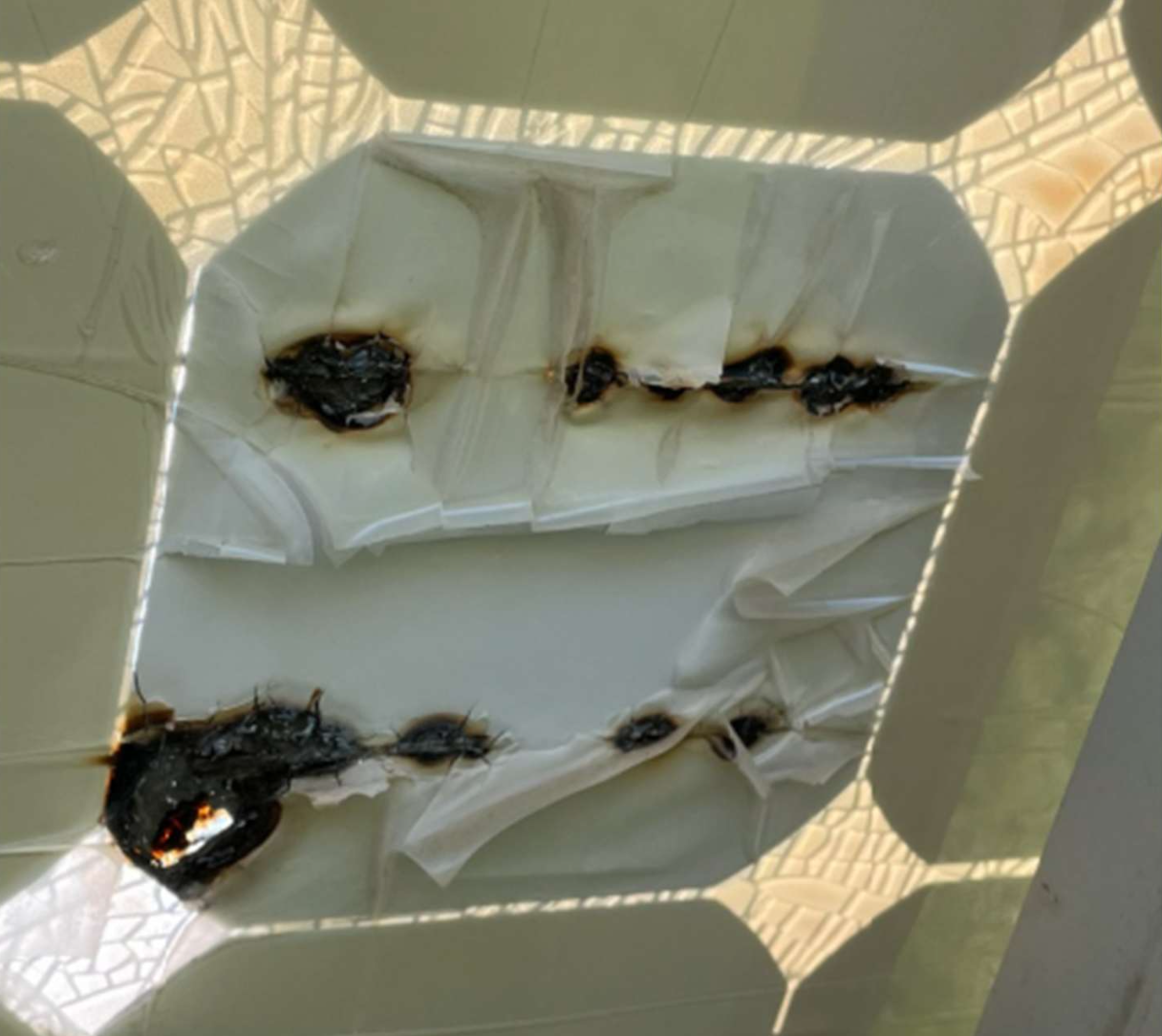
Cracks in solar panels impact performance.
The good news is that solar panels are relatively low-cost. If your panels have deteriorated, upgrading your solar field with utility-grade ones can help meaningfully increase your system’s performance and the property's perceived value.
Invest in fixes that will move the needle
Unfortunately, most pre-listing upgrade decisions are either too much, too little, or focus on the wrong thing. A seller who spent $10,000 on a new lead-acid battery bank six months before listing and one who did nothing for three years are both leaving value on the table — just in different ways. Here’s how to decide where to invest your money and effort:
What to fix before listing
Address safety issues such as loose connections, damaged wiring, corroded terminals, and equipment that doesn’t perform within spec. These disclosure issues could land you in hot water if handled improperly.
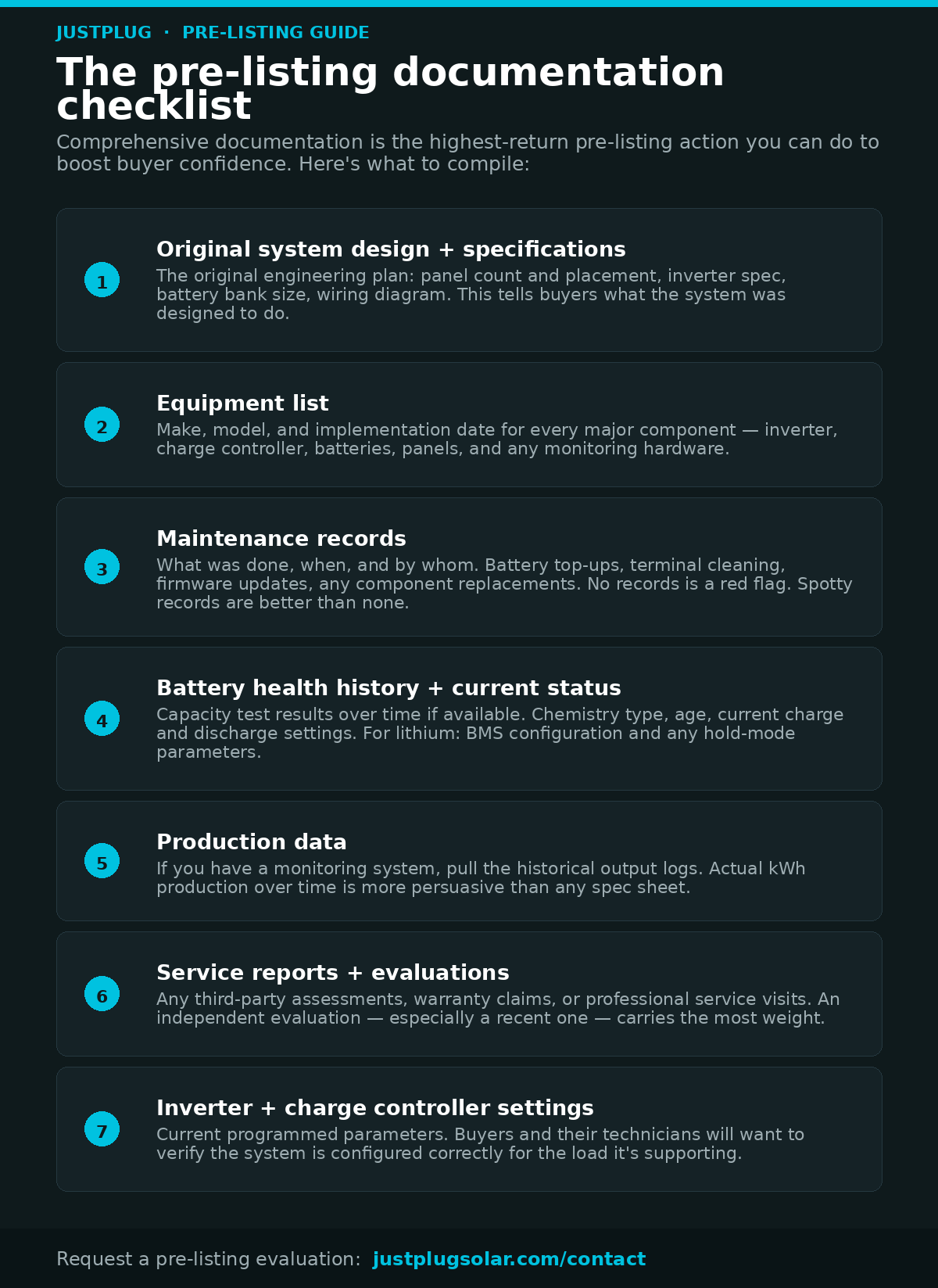
Compile original design specs, equipment records, maintenance logs, production data, and service reports. Thorough documentation inspires buyer confidence and increases your system’s perceived value.
Upgrade the operating environment with proper insulation, ventilation, pest exclusion, and moisture management. These changes will help you maintain equipment value even with minimal maintenance.
What to consider upgrading
The truth is that what was acceptable (or even premium) 20 years ago may no longer be sufficient by today’s standards. [ Cue the iPhone 17 side-eyeing a Blackberry circa 2006. ]
For example, a 4,000W or 6,000W inverter was considered a strong system twenty years ago. Today, we don’t spec anything under 6,000W — that’s the bare minimum for a two-person household running a frugal load. For most whole-house off-grid solutions, we start at 12,000W. If you want to present your property as capable of supporting full-time off-grid living, your inverter must provide sufficient capacity to meet modern demands.
Moreover, inverter capacity doesn’t exist in isolation. Solar production must be proportional to the inverter and storage capacity. A 12,000W inverter fed by six 200W panels doesn't function as a 12,000W system, and this is where many older systems hit their limitations.
Solar trackers with panels mounted on swivel sticks were popular twenty years ago and made sense when panel costs were high. However, the calculus has flipped, and ground-mounted panels now deliver much bigger bang for the buck.
But the ghosts of these trackers continue to haunt older installations because they limit power generation capacity to typically six to eight panels — the output isn’t nearly enough to feed a 6,000W inverter, let alone a 12,000W one.
If you have a tracker, your system likely doesn’t produce enough for modern requirements. Before upgrading your inverter or battery bank, understand if, and by how much, your solar generation falls short. Adding a ground-mount array to supplement your existing production will ensure you have a well-balanced system.
When to consider a grid-tied to grid-independent conversion
If you have a grid-tied solar system, the calculus is different from that of a maintained off-grid system. Grid-tied systems with aging net metering contracts, lease encumbrances, or PPA complications may not be worth preserving in their current form.
Depending on the system's contract situation, a pre-listing conversion to a grid-independent solar solution may present the property more cleanly and command a better price than trying to transfer a complicated arrangement.
Don’t go it alone: Remove question marks with professional support
Working with a professional energy partner isn’t just about a one-off evaluation or upgrade. It also provides continuity for the buyer, boosting confidence and perceived value.
When we work with a seller pre-listing, we examine the system and research the components. That knowledge doesn't disappear when the transaction is complete. We can help onboard a new owner, explain the system, assist with upgrades, and answer questions to ensure a smooth transition.
Such support removes a question mark that many rural property buyers have: not just "does this system work," but "what do I do when something happens and I don't know what I'm looking at?" Uncertainty kills deals: having a credible answer to that question is a selling point that’s sorely missing in most listings.
Set your rural real estate sales up for success with a pre-listing evaluation
A pre-listing solar system evaluation is a written, independent assessment of your system's current condition, documenting its components and capabilities, along with what’s required to meet specific standards.
It goes beyond checking individual components: a properly dimensioned battery bank connected to an undersized inverter and fed by six panels on a tracker does not make a functional whole-house system — even if every individual component technically works. An inverter upgrade without addressing panel capacity doesn't solve the problem. Neither does a new battery bank in an equipment shed with a temperature regulation problem.
A proper evaluation considers the system as a whole: whether solar production, inverter capacity, and storage are proportional to each other and to the actual loads the property needs to support; whether the operating environment protects the equipment; and the gaps between current capabilities and reasonable buyer expectations.
A written report also sets your listing apart by giving the buyer documentation they rarely get in a rural transaction: verified, third-party information about the energy infrastructure they're buying into — a clear picture of real-life system performance and an upgrade roadmap.
If you're preparing to list a rural property with an existing solar system, or if your listing has been on the market for a while, and you want to strengthen its positioning, get in touch to schedule an evaluation.