The Rural Property Buyers’ Guide to Solar & Energy Infrastructure
You found a rural property you like. It checks most of the boxes. But the listing mentions something about solar or being off-grid. Is that good or bad?
Energy infrastructure on a rural property isn’t a footnote. It affects your operating cost and the property’s livability. Depending on what's there, “solar” can be an asset or a liability. Knowing what you’re buying gives you an edge in the negotiation. Otherwise, you may find yourself staring at a money pit after closing.
This post walks through the four energy situations you'll encounter on rural properties, what to investigate in each, and how to use your findings to guide the next steps.
What’s the property’s energy situation?
Rural properties fall into four categories, and each requires a different due diligence path.
1. Grid-connected, no solar
The instinct is to treat this as a non-issue — there's utility power, move on. But it can lead to sticker shock and frustrations after moving in.
What’s the catch?
Rural utility customers pay more and experience longer outages than their urban counterparts. Before assuming the utility situation is fine, do a reality check: what are the current rates, what is the outage history in this service area, and what do outages typically mean for this property — will you be stranded without power for days?
Buying and installing a backup generator that can power the entire house can set you back $20k+, and the fuel costs of running one for a multi-day outage will make you cry.
Numbers to consider before making an offer
The high cost of electricity and frequent outages make rural grid-tied properties ideal candidates for a grid-independent solar implementation. Don’t label power as a “future expense” and sweep it under the rug when you’re in the perfect position to address it now.
Rural households carry a disproportionate energy burden, paying a higher share of income on electricity than urban households. In an area with high utility rates, the payback time for a well-designed grid-independent solar system can be surprisingly short (i.e., 3-5 years, not 20 years) — especially in rural sunbelt regions where solar yield is excellent.
Before making an offer, calculate the cost of a grid-independent solar solution for the property, and how the resulting reduction in utility bills affects the total cost of ownership over a 10-year horizon. That number is a concrete negotiating variable you can work with.
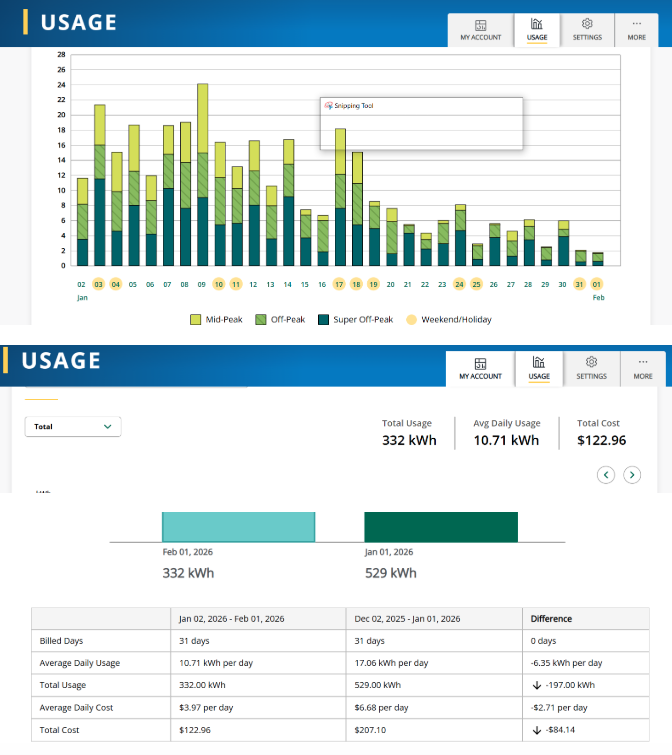
A $84 reduction in power bill in just 10 days with our grid-independent resilience solution.
2. Grid-tied solar
This situation has the most potential for closing-table surprises. The due diligence path takes longer, and you must know how to navigate the “gotchas.”
Owned vs. leased vs. PPA
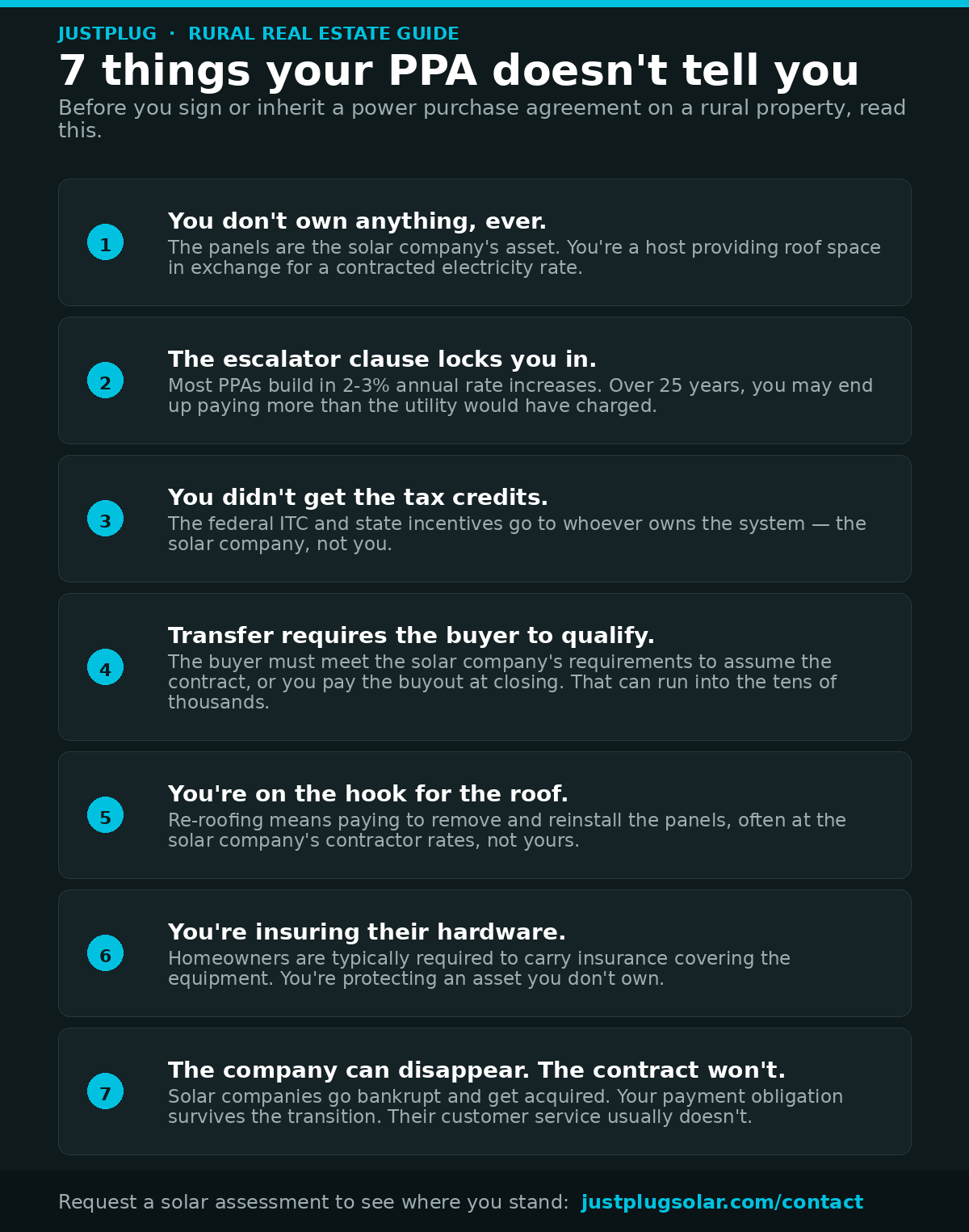
An owned system is a transferable asset. A leased system or a power purchase agreement (PPA) is a contract attached to the property, not the seller, and is a potential liability. If the system is leased or under a PPA, ask these questions:
What are the remaining terms and annual escalation rate?
What are the buyer qualification requirements to assume the contract?
What is the buyout cost to exit the contract before closing?
Buyouts on PPAs can run into the tens of thousands of dollars. These numbers need to be on the table before you commit.
Net metering contract status
Older grid-tied systems were implemented under net metering contracts that provided close to 1:1 credit for power fed into the grid. But those contracts have changed significantly thanks to NEM 3.0: new and renegotiated contracts in California now pay approximately 0.15 kWh of credit for every 1 kWh fed in.
A seller who has been benefiting from a grandfathered contract may be presenting economics that won't exist for you as the new owner. Read the fine print and see whether it transfers.
Outage behavior
Grid-tied systems shut off automatically when the grid goes down — a regulatory requirement. For a rural property where outages are longer and less predictable than in urban areas, a buyer who assumes "solar means power during an outage" will be unpleasantly surprised the first time it matters.
Some systems may have battery storage. However, these batteries most likely charge from the wall and only store enough energy for a suburb-grade outage lasting a few hours. Storing enough power to ride out a super-sized week-long outage is cost-prohibitive for us mere mortals.
Numbers to consider before making an offer
If an owned system is grid-tied and you want true energy independence, consider a conversion to grid-independent solar. The cost depends on the existing equipment and the property's load requirements. Understanding conversion feasibility before making an offer gives you a negotiating lever, either as a closing condition or a price adjustment.
3. Off-grid solar
Buyers make the most expensive mistakes when buying properties with off-grid solar. They either treat an aging system as a fully functional asset or walk away from a solid system because they didn't know how to evaluate it.
Assess a system as a whole, rather than a collection of individual components.
Solar production, inverter capacity, battery storage, and the supported loads function as an integrated unit. If any one of those is undersized or underperforming relative to the others, the whole system underperforms.
For instance, a new 10 kWh battery bank in a system with six panels and a 4,000W inverter is not a well-functioning off-grid solution, even if each component works as intended. The battery goes hungry all the time, impacting its lifespan, while the system struggles to boil water, keep the fridge running, and start an air conditioner simultaneously.
Before evaluating individual components, understand the system design intent: what was the system built to power, and does the current configuration, including panel count and orientation, inverter capacity, and battery bank performance, actually support that?
What to investigate
Solar panels. Consumer-grade panels tend to deteriorate in harsh environments. Watch for cracks, delamination, oxidation, and soiling that could decrease power generation.
Solar trackers. They’re old-school and mechanically limit the number of panels a system can carry, typically six to eight, which is insufficient to support a whole-house load.
Inverter. A system with an undersized inverter relative to the property's loads can't support modern off-grid living even if it’s in good shape.
Batteries. Lead-acid batteries have a service life of three to five years with consistent maintenance (a red flag if you’re looking at a vacant property). Lithium batteries last significantly longer. Ask about battery chemistry, age, maintenance history, and the most recent capacity test results.
Operating environment. Heat, moisture, dust, and pests accelerate component deterioration. The equipment shed's conditions reflect the equipment’s status.
Documentation. A system with comprehensive documentation is one that the seller has taken seriously. Ask for original design specs, equipment records, maintenance history, and service reports.
What to do before making an offer
Getting a pre-closing independent evaluation is the single most valuable thing a buyer can do. It tells you what the system delivers in its current condition, where the gaps are relative to your intended use, and what remediation would cost. You will know if the asking price reflects the system’s real value and be armed with the specifics to negotiate.
4. No grid connection, no solar
"No utility connection" seems like a liability, but it may actually be the cleanest starting point of all — if you understand what it costs to bring power to the property.
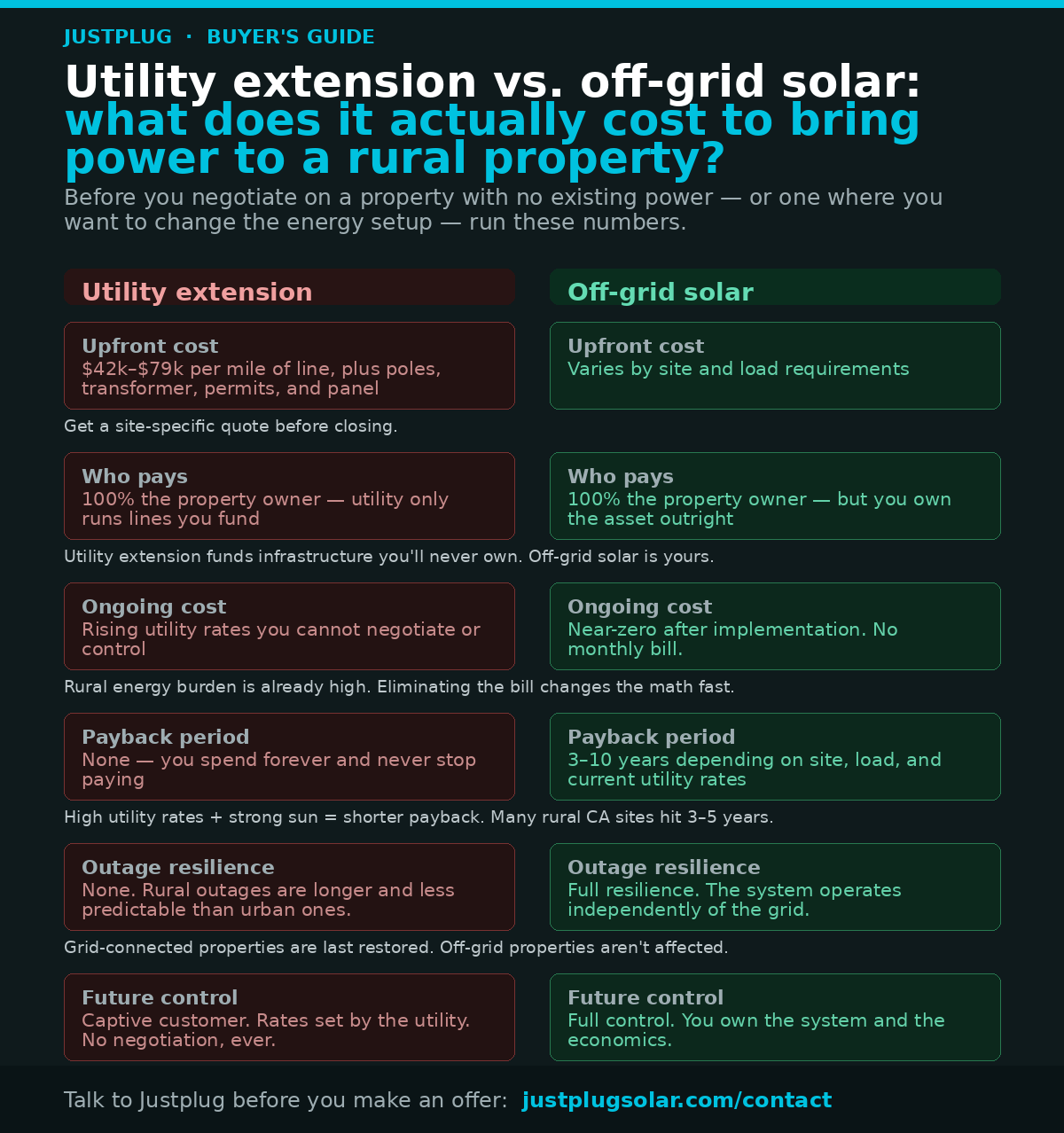
The cost of utility extension
Extending utility service to a rural property is expensive, time-consuming, and bureaucratically complicated:
One mile of overhead power line: $42,000 to $79,000
Utility pole installation: $1,200 to $5,600 per pole
Transformer: $20,000 to $30,000
Meter box, electrical panel, permits, and coordination: additional thousands
That’s just the beginning. Once connected, you become a captive customer of the utility company. You can’t negotiate rate hikes and must put up with increasingly prolonged and frequent outages.
The off-grid solar alternative
A properly designed off-grid solar solution on a property with no existing utility dependency is, in many ways, the ideal scenario. You don’t have to work around incumbent infrastructure, untangle grid contracts, or jump through hoops to get a utility company’s permission. You can design the system to meet your requirements and invest in the capacity that matters.
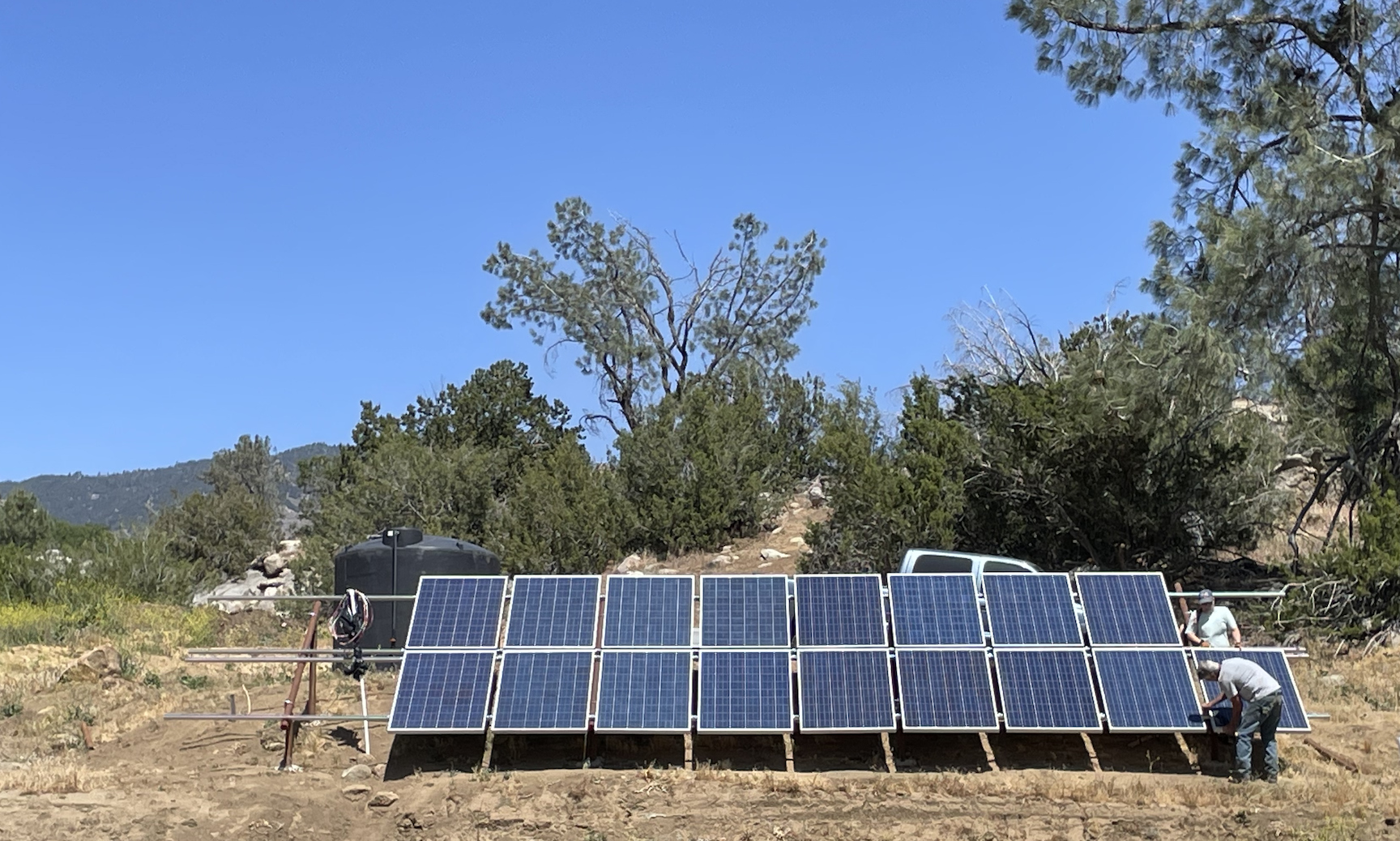
Here’s what to know before a negotiation: what would a well-engineered off-grid solar solution cost for this specific property, and how does that compare to the cost of a utility extension? In many rural situations, off-grid solar is cheaper upfront, significantly cheaper in the long run, and provides resilience that a grid connection cannot.
Run the numbers, and factor the cost into your offer to ensure that you have the budget to buy the land and build the infrastructure to support your intended use. (But don’t ask cousin Joey, who built an off-grid solar system for his 300 sq. ft. vacation cabin. A whole-property solution is a different beast.)
How to leverage your findings in a rural real estate negotiation
Information about a property's energy situation has a dollar value at the negotiating table. It helps you make an offer that reflects the reality of not only owning the land but also living and operating on it.
A documented, well-maintained off-grid system with a recent independent evaluation is a selling point you can likely accept at face value.
An undocumented system with aging lead-acid batteries and six panels on a squeaky tracker is a liability that you can put a price tag on.
A grid-tied system with a clean ownership structure is something you can work with. You may factor in the cost of converting it into a grid-independent system in your offer.
A PPA with an escalation clause, eight years remaining, and a $30,000 buyout is 30,000 reasons to restructure the offer.
A grid-tied property with no solar in a high-rate utility territory prone to outages is a candidate for a grid-independent solar solution. Consider the cost in your offer.
A property with no grid connection is not a dead end. Compare utility extension with off-grid solar implementation to understand what it takes to make it viable.
Become an informed buyer with an independent evaluation
For rural properties with an existing solar system, an independent pre-closing evaluation is one of the most valuable things you can do before committing. It gives you a verified baseline, a clear picture of what the system actually delivers, and documentation you can use in a negotiation or attach to the disclosure packet.
For properties without any solar, a conversation about the current situation and how you plan to use the land will give you a high-level understanding of what it takes to bring power to the property or introduce grid-independent solar to lower long-term costs and build resilience.
No matter the energy setup, entering a negotiation with your eyes wide open is the best way to avoid expensive surprises down the road. Get in touch and see how we can help.