The “Gotchas” of Grid-Tied Solar in Rural Real Estate Transactions
A property listed with solar seems like a win-win-win: higher property value for the seller, lower energy costs for the buyer, and shorter time-on-market for the agent.
However, it isn’t always smooth sailing. Consider this not uncommon situation: somewhere between the accepted offer and the closing table, someone discovers that the system is leased, the net metering contract won't transfer, or the system does diddly squat to protect the property from frequent and prolonged power outages in many rural regions.
What can buyers, sellers, and agents do to avoid these unpleasant surprises from derailing a deal? To address the root cause, we must first understand what grid-tied solar actually means and the different flavors your contract might come in.
What "grid-tied" actually means
Grid-tied solar systems are connected to the utility grid. Electricity generated by the panels first flows into your home, then the excess is fed into the grid. The grid fills in at night, on cloudy days, or when you need more power than the panels generate.
That sounds straightforward enough. But here's the first gotcha: a grid-tied system without battery storage provides zero power during an outage. When the grid goes down, the system shuts off automatically. It's a safety requirement because a grid-tied inverter that pushes power into dead utility lines would be a serious hazard to the line workers trying to restore service.
Rural properties in areas prone to wildfire-related shut-offs, high-wind events, or aging infrastructure experience longer, more frequent outages. A buyer who moves into a property with grid-tied solar, expecting power during outages, will be unpleasantly surprised.
What about those backup batteries, like the Tesla Powerwall? Most of these products are charged from the grid. You’re out of luck if you drain the stored energy and the grid is still down. These batteries can bridge you over suburb-grade outages that last half a day, but a battery bank that can store enough power for a multi-day outage is cost-prohibitive for us mere mortals.
Saying “grid-tied” implies that there are other flavors: the three main buckets are off-grid, grid-independent (i.e., operates separately from the grid but uses the grid as a backup), and grid-tied solar. Sellers should be upfront about what’s on the property, and buyers should seek clarification. Neither party should make assumptions.
With those basics clarified, let's review the common issues that can arise specifically in grid-tied solar arrangements, so buyers, sellers, and agents know exactly what to look out for.
Top three pitfalls of grid-tied solar
The truth is that grid-tied solar isn’t designed for energy resilience in rural living, nor for helping property owners optimize their energy independence by leveraging the environment. But the problem doesn’t lie in the technology or equipment’s capability — it’s how utility and solar companies structure grid-tied solar contracts.
Net metering: the train has left the station
For years, the economic case for grid-tied solar rested largely on net metering. The arrangement was straightforward: you fed excess power into the grid, and the utility credited you at close to the retail rate. You put one kilowatt-hour in and get roughly one kilowatt-hour of credit back to cover nighttime usage. The math worked.
That arrangement is largely gone in California thanks to NEM 3.0. For example, under current SCE contracts, customers receive approximately 0.15 kWh of credit for every 1 kWh they feed into the grid — a fraction of what earlier contracts provided.
Many customers now feed power into the grid and pay a sizable electricity bill for their nighttime consumption. Customers with grandfathered agreements may still be operating under better terms, but those contracts may not transfer to a new owner when a property changes hands.
The change in net metering arrangements has consequences for both parties in a transaction. A seller operating under a grandfathered net metering contract may tout meaningful bill offsets. A buyer who assumes those economics will continue is likely to be disappointed. If the contract doesn't transfer, the buyer pays for the hardware but not the financial structure that made it worthwhile.
PPAs: what they are, who they actually benefit, and their impacts on a transaction
A power purchase agreement (PPA) is one of the most misunderstood financial instruments in residential solar solutions. It's marketed as a way to get solar with no upfront cost, which is technically true. In reality, it’s a long-term electricity contract written on your property.
Here's how it works: a solar company owns the panels on your roof. You agree to purchase the power generated by those panels at a set rate for 20 to 25 years. In exchange, you pay nothing upfront and get a slightly lower electricity rate than the utility — at least when you sign the contract.
Sounds reasonable, but here's what the marketing materials don’t tell you:
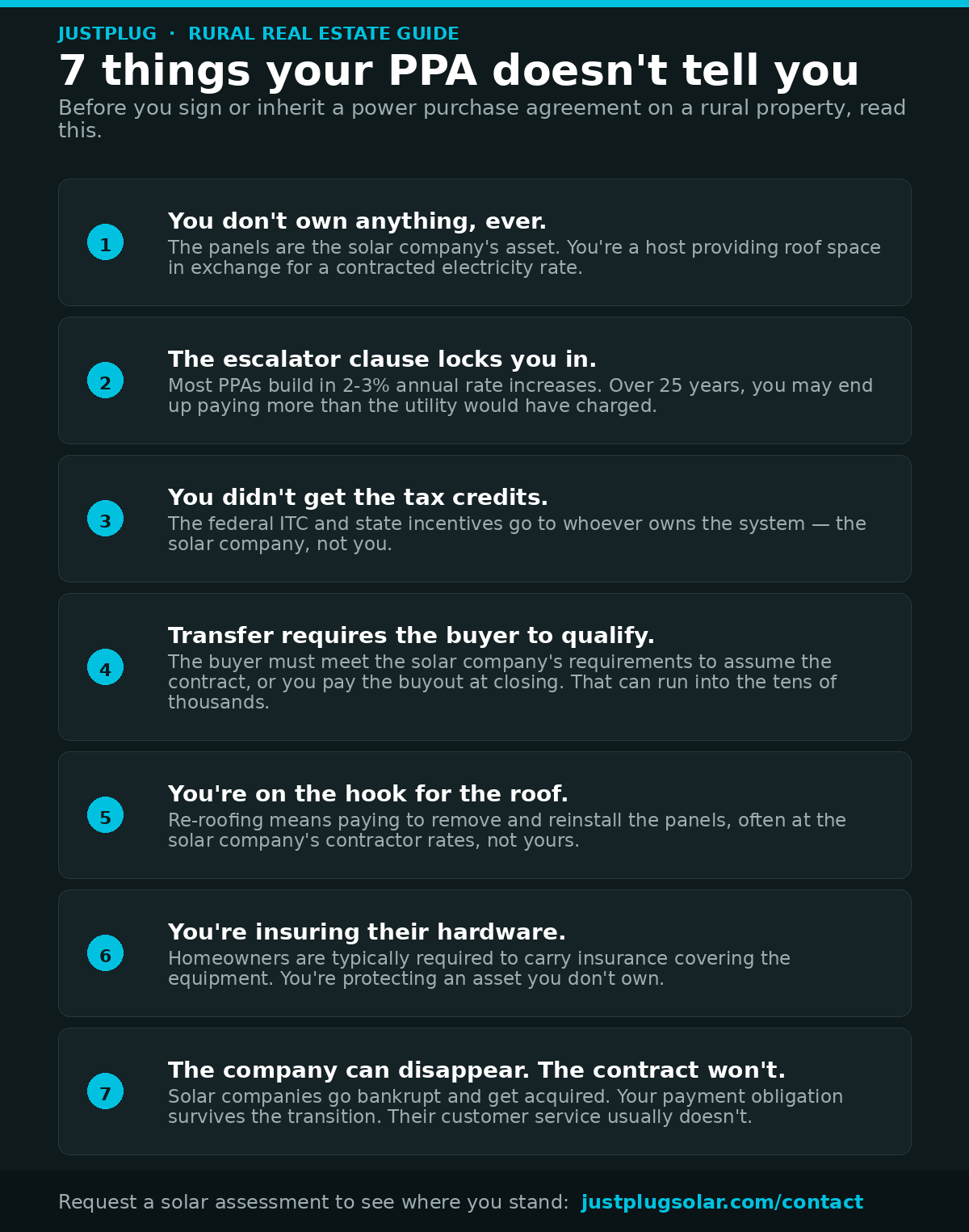
You don’t own anything, ever. The panels are the solar company's assets. You’re providing roof space in exchange for a contracted electricity rate.
The escalator clause. Most PPAs have built an annual rate escalation of 2 to 3 percent into the contract. Over a 25-year term, that compounds significantly. The electricity rate you're locked into in year 20 may be higher than what the utility would charge by then. You won't know until you get there, and either way, you can't renegotiate.
You don’t get the tax credits. Any federal or state incentives go to the system’s owner, i.e., the solar company. You get a slightly lower rate on electricity that was paid for, in part, with money you were entitled to if you purchased the equipment.
Transfer requires the buyer to qualify. The PPA doesn’t disappear when a property is sold. The buyer either assumes the contract, which requires them to qualify under the solar company's terms and agree to take on the remaining obligation, or the seller buys out the contract before closing, which can run into tens of thousands of dollars.
You’re responsible for the roof under their terms. Most PPAs require the homeowner to maintain the roof in good condition for the duration of the contract. If you need to re-roof, you're typically responsible for the cost of removing and reinstalling the panels — work that the solar company may insist only their contractors perform at their rates.
You carry the insurance burden. The panels are the company's asset, but homeowners are often required to maintain a minimum level of property insurance that covers the equipment. You're insuring someone else's hardware, on your dime, for 20-plus years.
If the company goes under, the panels are still their assets. Solar companies have gone bankrupt, been acquired, and had their contract portfolios transferred to other entities. The contract obligation typically survives, but the customer service usually doesn't.
The bottom line: PPAs are actually utility contracts with a 25-year lock-in. The buyer inheriting the arrangement has no say in the terms.
Leased systems: same core problem, different paperwork
A solar lease is structurally similar to a PPA with one distinction: instead of purchasing the power produced by the solar system, you rent the equipment at a fixed monthly cost. The panels still belong to the leasing company, and the contract still runs 20 to 25 years. The transfer process at closing remains the buyer's problem.
The practical difference is modest. With a lease, your monthly cost is fixed regardless of how much the system produces or how much electricity you use. With a PPA, you pay for what you use. In either case, the central issue is the same: you're in a long-term contract on equipment you don't own.
In a rural real estate transaction, leased and PPA solar systems should be treated identically from a disclosure and due diligence standpoint. Sellers should read the transfer terms and understand the buyout cost before listing the property. Meanwhile, buyers should request to see the contract before going down the negotiation path.
Now that you understand the “gotchas,” let’s review what you can do to prevent them from throwing a monkey wrench into your grand plan.
How should different parties in rural real estate transactions navigate the solar conversation?
Here’s how to protect your interests and avoid disappointments:
What sellers should do before listing
Read through your solar contract to clarify the following:
Is your system owned, leased, or under a PPA?
If your system is leased or under a PPA:
What are the remaining contract terms?
What’s the annual escalation rate for a PPA?
What are the transfer terms and buyer qualification requirements?
What’s the buyout cost if you want to exit the contract before closing?
If the system is owned outright, compile documentation of the original design specs, equipment records, production data, and maintenance history. The information will help prove that the system performs as claimed, strengthening your listing and boosting buyer confidence.
If the system is leased or under a PPA, decide before listing whether you’ll disclose and transfer or disclose and buy out. Don’t leave it until escrow to figure it out.
California disclosure requirements cover material facts that affect property value, including an encumbered solar contract. Disclose the information early in writing and include documentation to protect your interests.
What buyers should ask before making an offer
Don't let “the property has solar" be the end of the due diligence conversation. Ask these questions to understand the details:
Is the system owned outright, leased, or under a PPA? If it's leased or under a PPA, what are the remaining term, the escalation rate, and the transfer requirements? Do you qualify to assume the contract?
What is the system's actual production history, and how does it compare with the original design spec? Systems degrade over time and lose their value, especially if poorly maintained.
What happens during a power outage? Is there battery storage? The answers matter for rural properties where outages are common and can last days.
What is the current net metering contract, and do the terms transfer? If the seller has a favorable grandfathered contract, confirm whether the utility company will honor it under new ownership before pricing that benefit into your offer.
If you want to convert the system to an off-grid or grid-independent one, what would that involve? For buyers seeking genuine energy resilience, understanding the conversion path provides useful context.
How agents can set themselves apart by guiding the conversation
Buyers and sellers in a rural transaction involving grid-tied solar usually operate on incomplete information. The agent who understands this topic, asks the right questions early, and points clients toward the right resources can prevent late-stage surprises that kill deals.
Having a trusted expert in your corner is the best way to help your clients navigate tricky solar conversations. For example, we work with real estate agents and perform solar system evaluations before listing to align expectations.
Reframe the conversation with a grid-tied to grid-independent solar conversion
For sellers with owned grid-tied systems that are aging or operating under a near-expired net metering contract, a conversion to a grid-independent solar system before listing can reframe the entire conversation.
Instead of disclosing a potential liability, you're presenting a documented, owned, battery-backed system with no third-party encumbrance. Such a straightforward asset commands a higher price and moves faster.
For buyers inheriting a grid-tied system they're not excited about, the conversion cost is a negotiating variable. Understanding what a grid-independent solar solution looks like and what it would cost will give you concrete numbers to negotiate and make an offer.
Whether you’re buying, selling, or listing a rural property with a grid-tied solar system, the nuances can be intimidating. We get it. But you don’t have to navigate this on your own. Get in touch, and we can help you evaluate your system and options to optimize value.