Client Success Story: Boost Resilience and Cut Power Bills With Whole-Ranch Grid-Tied to Off-Grid Solar Conversion
When their grid-tied inverter failed, this client struggled to find service providers willing to travel to their ranch. The vendor who bothered to pay a visit told them to scrap the entire system and install a new one for $95k (including throwing out their perfectly functioning solar panels, which is wasteful and completely unnecessary).
Initially, the client asked us to fix the inverter, but the project evolved. Our solution now frees them from the constraints of grid-tied solar, lowers utility bills, and boosts resiliency against outages.
The sticker shock: Grid-tied solar frustrations
This client wasn’t just frustrated about the non-functioning equipment or the cost of replacement. A deeper conversation revealed that they were unhappy with the grid-tied solar arrangement.
When they signed the net-metering contract a decade ago, they essentially got a 1-to-1 deal (i.e., if they feed 10 kWh into the system during the day, they can “draw” 10 kWh out from the grid at night at no additional cost). They spent very little on electricity and even received credits for low-usage months.
Yet, one day, their power bill skyrocketed by hundreds of dollars. After jumping through hoops to talk to SoCal Edison (SCE), they discovered that when their net-metering contract expired (without any notifications!), SCE defaulted them to a different, less favorable arrangement (some might call it highway robbery).
Net-metering isn’t what it used to be. Edison takes $10 worth of power from people with grid-tied solar, sells it to their neighbors for $10, and gives them a $1.50 credit. It offered much better deals in the past, but if you forget to renew your contract, you get thrown into this crappy arrangement without the ability to get the old deal back.
Moreover, the client was increasingly frustrated by frequent and prolonged outages. Once, they came home to 900 pounds of rotten meat in the freezer when the power shut off while they were out of town. The other time, all the fish in the aquarium died. As the couple nears retirement age and plans to travel more, they prioritize peace of mind.
The decision: Maximizing long-term value
This client could spend a high four-figure sum to install the same grid-tied inverter, continue feeding power into the grid, draw power from Edison for nighttime usage, keep getting high power bills, and continue to worry about outages.
Alternatively, they may use the opportunity to convert their system to off-grid solar with Edison as backup. While initial investment is higher (but still less than a third of the $95k quote they received), the solution will greatly enhance their energy independence and significantly lower their power bills.
With our solution, they use off-grid solar as the primary power source. The system switches to grid power only when consumption exceeds solar production and storage. With proper dimensioning, the system only uses Edison very rarely — certainly not when the client isn’t home, and only essentials like fridges are running.
For this client, the cost-benefit equation is clear-cut. Besides saving on utility bills, switching to grid-independent solar gives them peace of mind — knowing that things won’t fall off the cliff when outages happen while they’re traveling. Moreover, they like the convenience of not having to start the generator when the power goes out!
The challenge: Sizable, unpredictable loads
The client has an extended family living on the property across multiple buildings. Many appliances, including power tools, may be turned on simultaneously, making it challenging to predict power requirements. They also have high water usage, and their powerful well pump, which has high surge power and substantial draw, kicks on frequently.
The bottom line: Such high and unpredictable usage will trip a run-of-the-mill off-grid system.
The typical 6,000W bi-phase inverter we use for smaller households in our Resilience solution won’t cut it. Even a 12,000W unit may come up short for the potential massive draw. Meanwhile, if we use two 12,000W inverters, the battery capacity must scale up proportionally to support the surge requirement.
Designing and dimensioning such a massive system requires substantial effort and coordination. For example, we must program the inverters to synchronize, but there is very little documentation for this use case (even the supplier was unable to provide the information).
We also needed to custom-build a 21 kWh lithium iron phosphate (LFP) battery bank with all the necessary measures to ensure safe and reliable performance.
The solution: A robust, resilient grid-independent system
Unlike typical solar companies that simply replace what’s broken and call it a day, we assessed the situation and proposed various options with a cost-benefit analysis to help this client maximize their long-term investment.
Based on the client’s priority and preferences, we decided to pull out all the stops.
We designed and built a rather massive system. It includes two 12,000W inverters with built-in charge controllers (providing 36,000W of surge power combined!) and a 21 kWh custom-built LFP battery bank with our proprietary software to balance performance, longevity, and safety. We also reused all the existing, perfectly functional solar panels to lower costs, reduce waste, and shorten the implementation timeline.
The benefit of such a massive system is that we have many opportunities to build in redundancy and resiliency.
The solution has two inverters and three individual battery packs, each with its own battery management system (BMS). We configured and wired the system such that if one inverter is faulty, the system will still work. If one or two battery packs have issues, the other one(s) will keep the system functioning. If one or two of the solar panel strings fail, the client probably won’t notice an immediate difference.
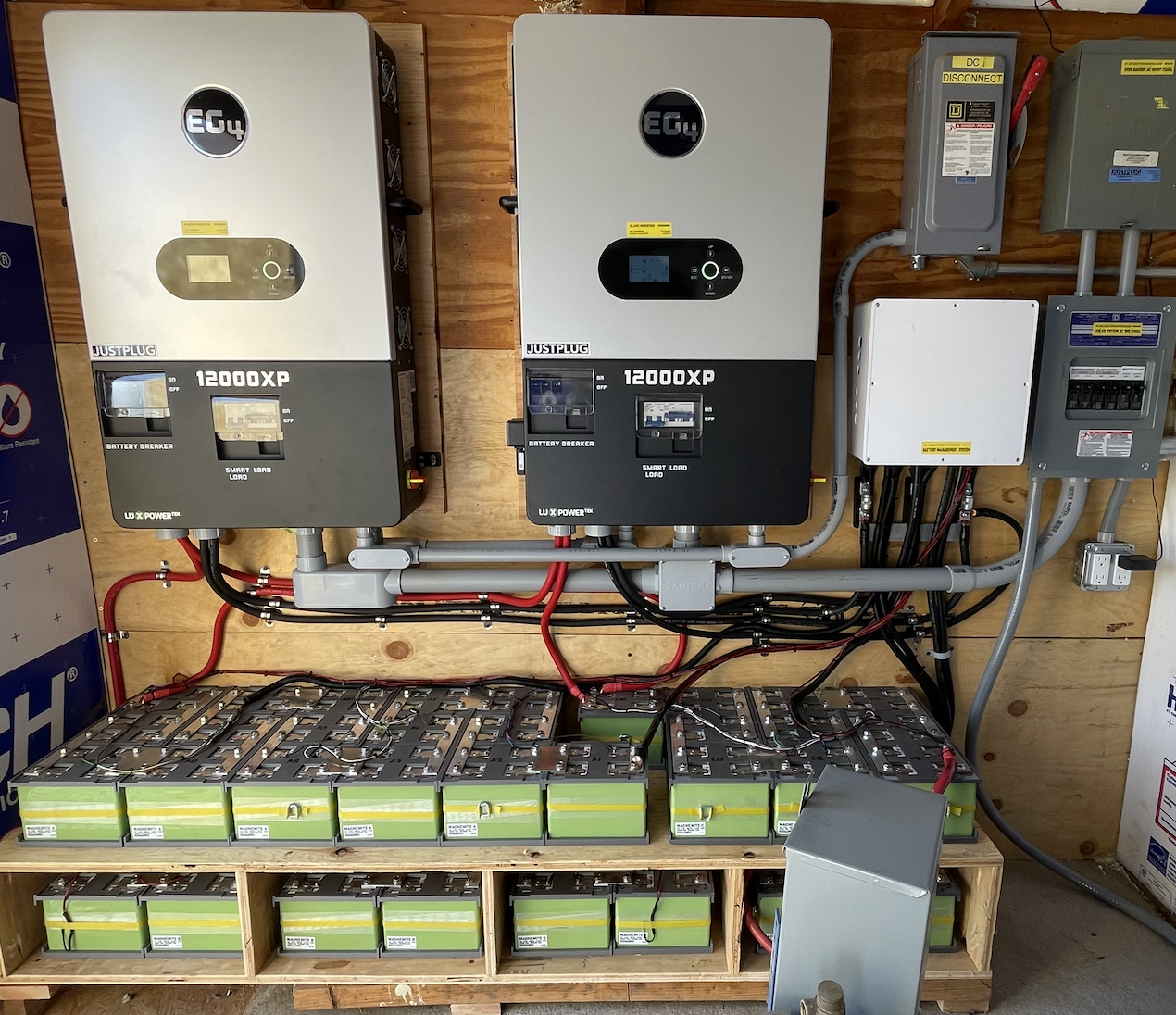
Inverter and batteries for this grid-tied to off-grid solar solution.
In addition to building and implementing the solar solution, we collaborated with the client’s electrician to safely connect the off-grid system to the house's electrical circuit.
Maximizing value with post-implementation monitoring
Getting the system working is, of course, critical. However, we’re not done yet. After the system went live, we monitored its performance remotely to ensure it worked as intended.
We reviewed various charts generated by the inverter app to track production, usage, and storage. When we saw that the panels performed exceptionally well, so much so that they generated a higher-than-expected voltage, we immediately went on-site to adjust the wiring, moderating the output voltage to ensure long-term safety.
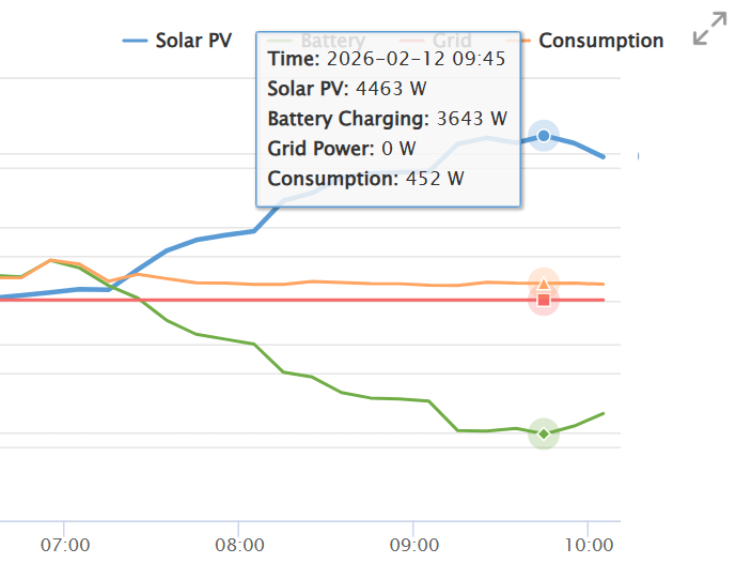
We also identified a wiring mistake made by the electrician by analyzing surge power data and helped the client address the issue promptly.
Make the switch from grid-tied to grid-independent solar
With net-metering becoming history, grid-tied solar customers must always pay for power usage after sundown. Honestly, it’s a crap deal when coupled with frequent outages and high utility rates.
For people who no longer get the 1-to-1 net-metering deal and see their electrical bills skyrocket, switching to off-grid solar offers long-term cost savings while building resiliency against prolonged outages.
Learn more and get in touch to explore what’s best for you.