Staring at Your Solar Panels When the Grid Goes Down? The Fine Prints of Grid-Tied Solar
Grid-tied solar made sense a decade ago: utility companies offered favorable net metering rates, the payback math looked reasonable, and putting panels on your property felt like getting ahead of the curve. For many rural property owners, it was a smart move.
The problem is that the arrangement has stopped working in the utility customers’ favor. If you’ve gotten a sticker shock from your power bill after your net-metering arrangement fell off the cliff or lived through an extended outage while staring at a roof full of solar panels — you know what we’re talking about.
Now, let's look at how you can turn the tables and regain control over your energy independence and resilience. In most cases, the best bet is to convert your grid-tied solar system into an off-grid solution. Here’s what you need to know.
Grid-tied solar’s fine prints
Grid-tied solar systems are designed to feed power into the utility grid and draw from it when your panels aren't producing enough (e.g., at night or on cloudy days). The model comes with two hard limits that rural property owners often learn the hard way.
You lose power during outages
Standard grid-tied systems are required by regulations to shut off when the grid goes down. This safety feature prevents your panels from back-feeding power to utility lines where workers might be doing repairs. However, it means that you’re not protected from outages.
Adding a battery product to a grid-tied system helps, but only partially. Those batteries charge from the wall, not directly from the panels. If an outage stretches long enough to drain your battery and the grid is still down — not uncommon in rural areas — you're out of luck.
It no longer pays you what it used to
Net metering credits used to be close to 1:1 — if you feed a kilowatt into the grid, you get roughly a kilowatt of credit (e.g., for purchasing power at night). That math has changed substantially across most states and utilities. For example, California's NEM 3.0, or Net Billing Tariff (NBT), reduced solar export credits by roughly 75% for new customers.
What you generate and what you get credited for have drifted so far apart that many customers on older contracts face sticker shock when the terms are renewed (often without notice!). For rural property owners who went solar partly to control their power costs, the business case went POOF overnight.
The upside? You can get back in charge with a grid-tied to off-grid solar conversion. But before diving in, let's clarify what that actually involves.
Grid-tied to grid-independent solar conversion in a nutshell
Converting a grid-tied system to off-grid doesn't mean scrapping everything and starting over. In most cases, your existing solar panel array can stay exactly where it is. What changes is how that power flows and where it gets stored.
In a grid-independent setup, the excess power that isn’t consumed immediately is used to charge a battery bank, rather than feeding the grid. When the panels don’t generate enough power to meet consumption needs (e.g., at night), you draw power from the batteries instead of the grid.
The panels and batteries create a self-contained system, and the grid (when available) is treated as a backup source rather than the primary one.
The core components of a conversion typically include:
A battery bank sized to your property's actual load requirements.
Inverter(s) that manage power flow between panels, batteries, and loads.
A charge controller that regulates how your panels charge the batteries.
An automatic transfer switch that handles the transition between your off-grid system and backup sources, avoiding the risk of accidentally back-feeding the grid.
But don’t yank the utility connection yet!
Many are pissed at utility companies and want to pull the plug altogether. Hold your horses: after all, you’ve paid for the connection, and it’s already there. For a small monthly fee, you can keep the meter box and use grid power as backup to achieve the practical sweet spot.
With the grid as backup, your off-grid system handles the load the vast majority of the time. During consecutive cloudy days or when you're running unusually high loads (e.g., power tools, large gatherings, heavy irrigation), the grid helps fill the gap. Your slash power bills significantly, and still have electricity when outages hit. But the grid is there when you need a boost.
So, what are the benefits? First, sh*t breaks, no matter how well-built. Having redundancies and plans B, C, and D is just good planning to ensure true energy resilience.
Moreover, this approach makes financial sense. You don't have to dimension a system for absolute worst-case scenarios if you have a backup. A system that meets 100% of the power requirement can be double the cost of one that meets 90 to 95%. Using the grid as a backup is a smarter use of your budget than paying for capacity you'll rarely touch.
The business case checks out if you have the right-sized solution tailored to your usage pattern. Let’s look at a real-world client story.
Grid-tied to grid-independent solar conversion in action
In this whole-ranch grid-tied to off-grid conversion project, we built a grid-independent solar system using an existing panel field, two high-capacity inverters with built-in solar charge controllers and auto-switchover, and a custom-built LFP battery bank. The client reused their solar panel array and now has a system that keeps the entire ranch running regardless of the grid’s status.
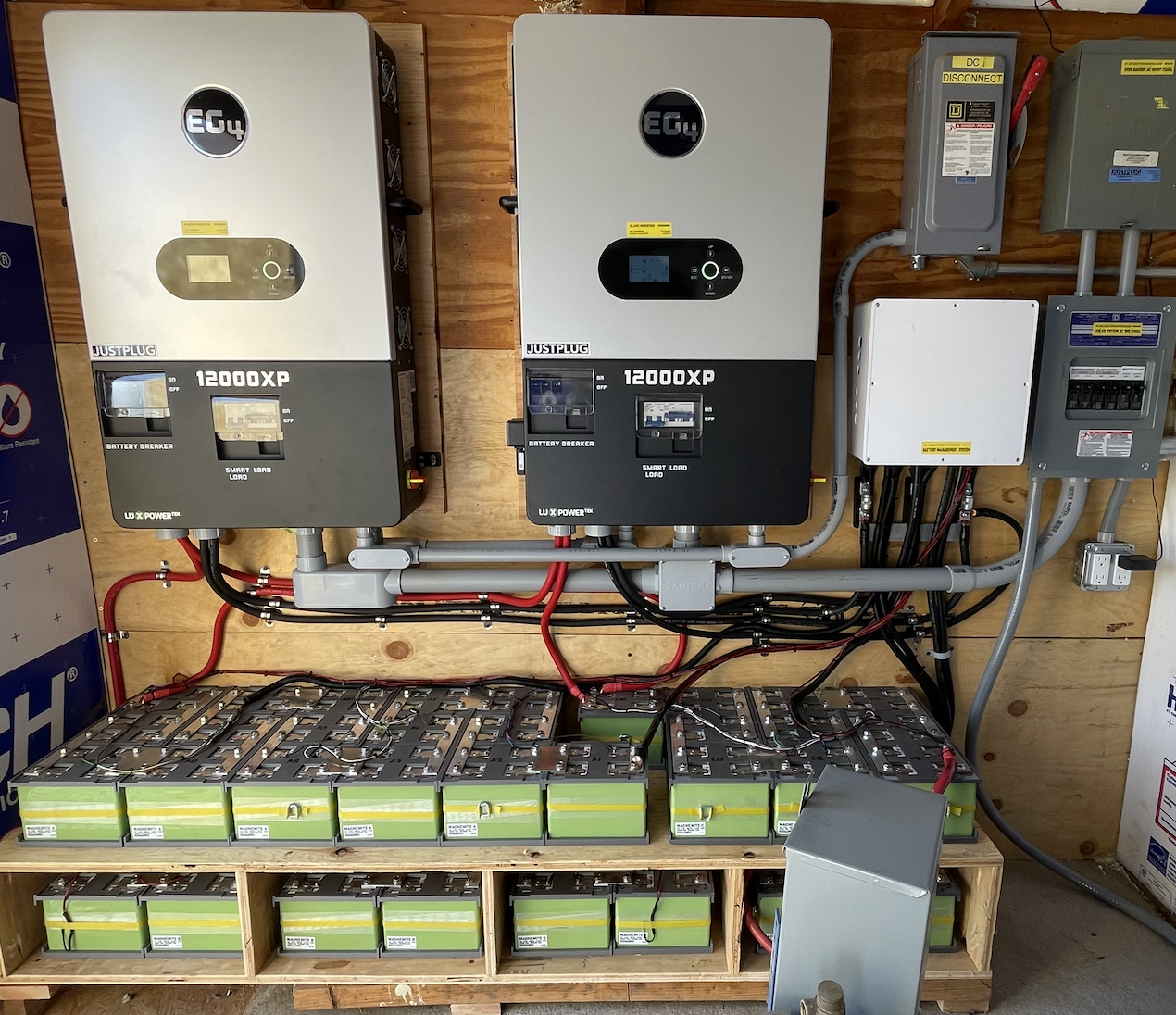
We implemented a new off-grid inverter and batteries for this grid-tied to off-grid solar solution.
Key considerations for a grid-tied to grid-independent solar conversion
The truth is that grid-tied solar gives installers a lot more leeway to be sloppy than an off-grid system. Why? If dimensioning is off, the grid steps in. Additionally, grid-tied solar is designed to maximize yields for utility companies, while an off-grid system prioritizes your requirements. They’re two different beasts. Here’s what to consider when performing a conversion.
Panel condition and orientation
We evaluate your existing panels’ condition to identify issues such as cracks, delamination, discoloration, oxidation, and soiling. We also measure their output to ensure they can support your load requirements.
Orientation and shading affect whether your existing layout will perform well in an off-grid configuration. We’ve seen many grid-tied systems with panels facing the wrong direction, sometimes producing just 30% of what they could if placed optimally. Moreover, the standard inclination maximizes year-round yield for utility companies, not your usage pattern.
Moving a panel array is a big job, and we don’t tell clients to do that lightly. We conduct a solar trajectory assessment and calculate yield vs. projected consumption. In many cases, keeping the panels as-is and adding a new array with the proper orientation and inclination is the most cost-effective way to boost production and meet requirements.
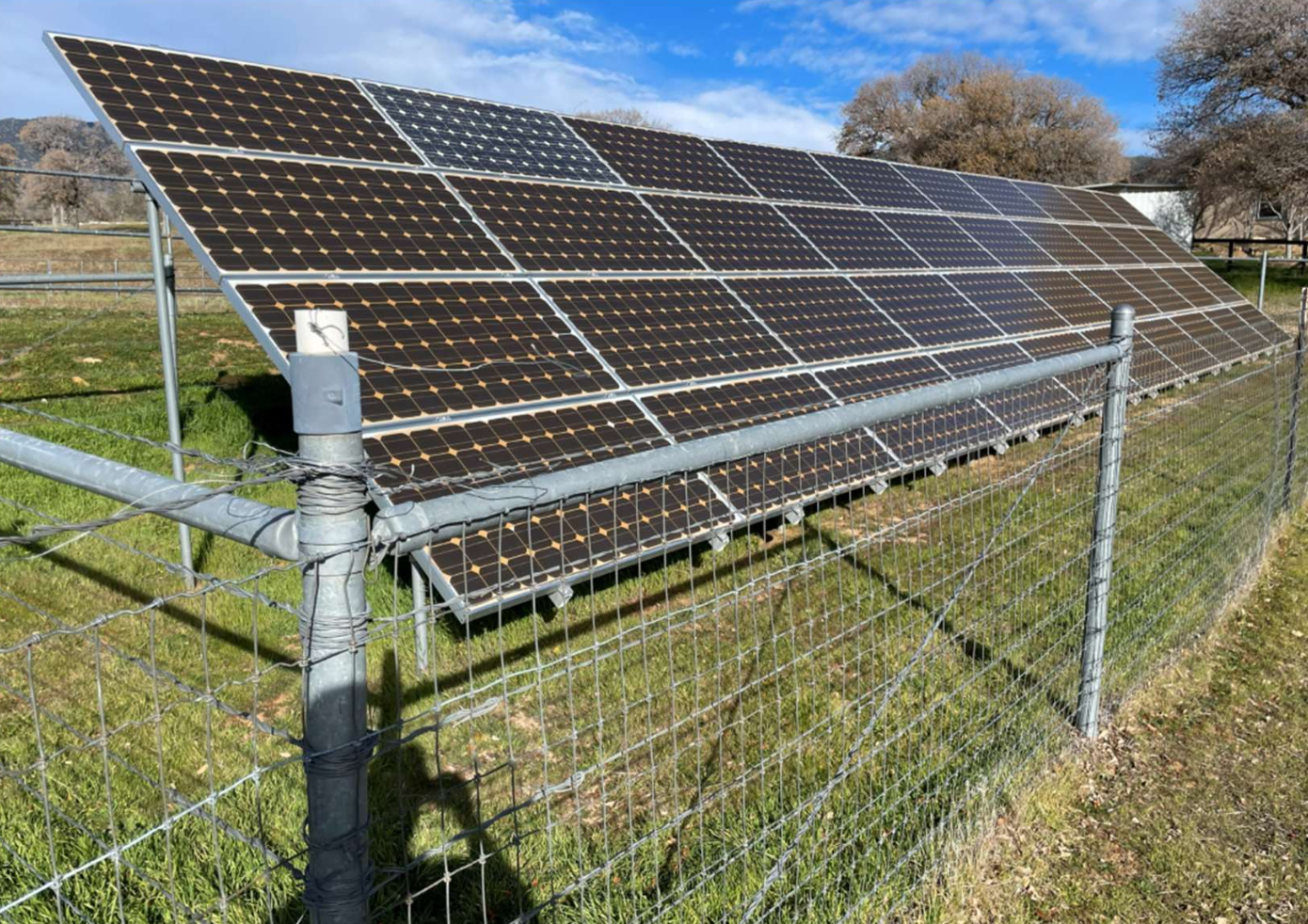
We evaluated a grid-tied solar field to assess the panels’ conditions.
Off-grid inverter upgrade
Grid-tied inverters are different from off-grid ones, so we typically need to replace them. We calculate your load profile and discuss your growth plans to determine the total capacity and configuration for your solution.
Additionally, we design redundancy and resiliency into the solution. For example, we often wire two or more inverters in parallel so that if one fails, the system will continue to operate at reduced capacity rather than go dark altogether.
Battery chemistry selection
Lithium iron phosphate (LFP) batteries are the workhorse for most off-grid residential and ranch applications. The chemistry is stable and long-lasting. Meanwhile, lithium cobalt chemistry offers higher energy density and can tolerate lower operating temperatures.
The right choice depends on your load, budget, and operating environment. This is not a decision to make based on a spec sheet alone. If you have an older lead-acid bank, that's a separate conversation — we often recommend a gradual transition to lithium batteries.
Load assessment and energy efficiency improvements
Off-grid systems are sized to loads, not to roof space. If your grid-tied system was dimensioned to maximize net metering credits rather than powering your property’s actual needs, the conversion is an opportunity to reset that math.
Large properties and ranches often have complex load profiles, and we perform load-based sizing before designing a solution. As part of the process, we evaluate existing appliances and equipment and may provide upgrade recommendations. For example, by replacing an old whole-house HVAC system with a couple of energy-efficient mini-split air conditioners, you may save thousands on production, inverter, and storage capacity.
True energy independence for rural properties
The truth is that grid-tied solar doesn't make you independent. On the other hand, a grid-tied to off-grid conversion, done properly, is a concrete way to close the gap and regain control.
If you have a rural property dealing with frequent outages, a net metering contract that's been renegotiated into the ground, and a grid-tied system that isn't giving you any real resilience, conversion is often the most cost-effective path forward to lower your bills and achieve true energy (and therefore, operational) resilience.
If you're curious what a conversion would look like for your specific property, let’s talk. We'll give you a straight answer on whether it makes sense for you.