When designing an off-grid solar solution, heating and cooling loads can significantly influence system size and overall cost. A poorly planned HVAC strategy can double or triple a solution’s capacity, requiring larger inverters, more panels, and more batteries.
Whenever possible, we help our clients select heating and cooling equipment before finalizing their solar solutions. We also discuss real-life operating behaviors and conditions, such as daytime vs. nighttime usage, seasonal variation, peak demand, and insulation.
The bottom line: choosing efficient climate control equipment can save thousands on solar infrastructure without compromising quality of life.
Mini-split air conditioners (or heat pumps) are one of the most solar-compatible HVAC technologies available. However, many people have poor experiences with installers who quote them $10k+ per unit with zero transparency.
This post explains why a mini-split is still likely your best bet despite the higher price tag, how to evaluate your options, our mini-split recommendations for 2026, and how to significantly lower your cost.
Why mini-splits, especially reversible models, make sense for solar
Mini-splits are the most energy-efficient air conditioners. Reversible units that are capable of both heating and cooling enable homeowners with off-grid solar to get more out of their investment. Here’s why:
Solar panels actually perform more efficiently in cooler temperatures, and clear winter skies can produce strong daytime output. Running a heat pump (which facilitates heat exchange rather than generates it) during those daylight hours converts that (free) solar energy directly into heat, reducing or eliminating fuel consumption from propane, diesel, or resistance heaters.
In other words, you’re turning sunlight into heat in real time instead of storing energy and losing efficiency through multiple conversions. Additionally, many mini-splits have soft-start operation. Unlike traditional compressors, they ramp up gradually, helping avoid large surge loads that strain inverters.
However, choosing mini-split units can be daunting…
The price seems right if you browse Amazon. However, you can’t tell which brand you can trust and which one may not even exist in a few months. Meanwhile, most “incumbent” brands, such as Samsung, LG, Mitsubishi, Panasonic, and Fujitsu, have pulled their products from the consumer market and only sell through installers, who charge two kidneys and a leg… just the hardware can cost $7k!
But there’s always a way…
So, we jumped into the rabbit hole and did the research to see what us mere mortals can buy and install at a reasonable cost.
Our evaluation criteria for mini-splits
We consider these top criteria when evaluating units based on practical performance, long-term serviceability, and compatibility with real-world solar solutions:
1. Cost vs. energy efficiency
A cheaper unit that consumes 30% more power will cost far more over its lifespan because you’ll need a larger solar array and battery bank. We evaluate the SEER score (which indicates energy efficiency) and operating wattage to achieve the lowest total cost of ownership (TCO).
2. Practical refrigerant type
We prioritize units using widely adopted refrigerants that technicians can easily source and handle for long-term serviceability. Exotic or phased-out refrigerants may save a few dollars initially, but can create expensive service problems later.
3. Extendable line sets
Real-world installations rarely match factory assumptions. Buildings differ, mounting locations vary, and outdoor units often require adaptation for shade, airflow, or structural reasons. Units that support extendable refrigerant lines provide installation flexibility.
4. Long-term serviceability
Even excellent equipment eventually needs maintenance. We favor manufacturers with established distribution networks and readily available replacement parts. Reliable access to replacement parts protects your investment and ensures your climate control system remains usable.
Additionally, specs should be clearly listed on the unit. If you need to extend or shorten lines, move the unit, repair a part, etc., you’ll need that information to do so correctly.
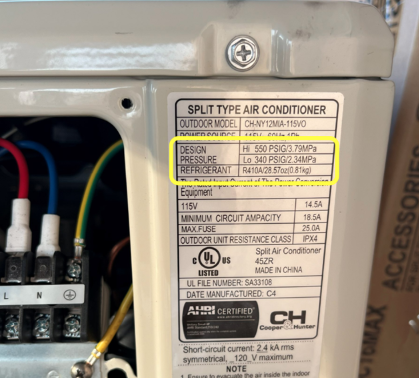
Example of specs listed on a unit.
“What about those pre-charged units?”
We don’t recommend “DIY” units with pre-charged lines because contamination is often unavoidable, and the chance of leakage is high. In a traditional installation, you can test if a system holds a vacuum before releasing the refrigerant. You can't check if a pre-charge unit holds a vacuum. Achieving a vacuum at higher altitudes is particularly challenging due to the lower air pressure. Moreover, it’s hard to troubleshoot properly because you can't perform a vacuum test.
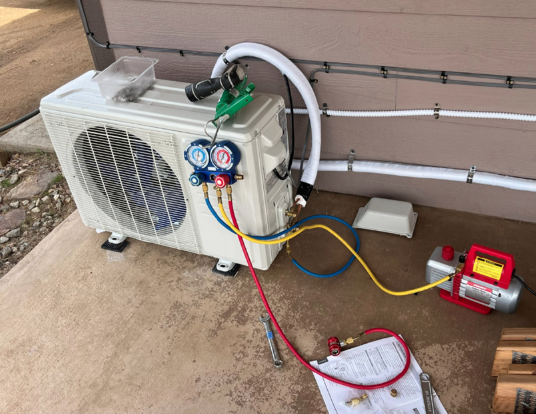
Line evacuation and refrigerant charging in progress.
Our mini-split recommendations for 2026
Mini-split technologies evolve quickly, which is great news because manufacturers are constantly improving the SEER score. Based on the criteria above, we’ve selected three readily available options from an upper-mid brand with a decent reputation:
For bedrooms: Cooper & Hunter 9,000 BTU; 115V, 23 SEER; ~$700.
For medium rooms: Cooper & Hunter 12,000 BTU; 230V, 23 SEER; ~$1,200.
For large rooms and/or tall ceilings: Cooper & Hunter 24,000 BTU; 230V, 21 SEER; ~$1,900.
We put in a C&H unit for a client last spring. They’re very happy with the performance and have not had any issues:
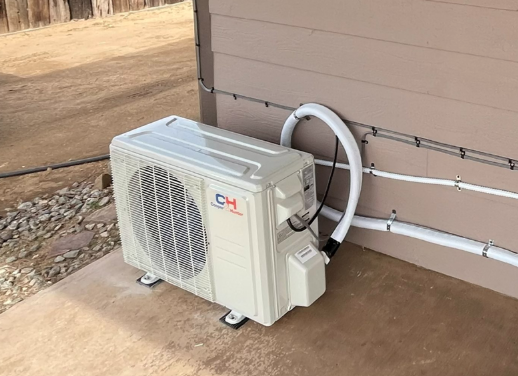
For a moderate, one- to two-person household, we typically recommend installing two units, one in the bedroom and the other in the living room. This configuration allows for zone control, only conditioning the spaces you’re using. Additionally, it provides redundancy.
Yes, we can put it in for you :)
Now, you know how to get a good-quality reversible mini-split without the astronomical price tag. However, putting it in isn’t exactly a stroll in the park.
We’ve helped some clients install mini-split air conditioners as part of the energy efficiency planning service when designing off-grid solar solutions. But even if you’re a utility customer, you should be able to access energy-efficient heating and cooling without paying an arm and a leg!
So, hit us up to discuss how we can help.
This article contains affiliate links. If you purchase through these links, we may earn a commission at no additional cost to you. We only recommend products we believe provide real value and performance.