Utility vs. Off-Grid Solar Power Quality (aka, If You Need an Obscure Reason to Switch to Off-Grid Solar)
Most people compare energy sources based on cost, availability, or environmental impact. Yet, few consider this hidden metric that directly affects equipment lifespan, performance, and efficiency: power quality.
Power quality describes how stable and well-regulated electricity is. The most practical metric for residential systems is voltage stability, i.e., how tightly voltage stays near its intended nominal value.
We recently converted a grid-tied solar system to an off-grid setup. While providing remote monitoring, we collected data to compare Edison’s power quality with that of the off-grid solar solution. The results challenge a common assumption about which source delivers higher-quality electricity.
What “power quality” actually means
Several measurable characteristics determine power quality:
Voltage stability — how tightly voltage stays near nominal.
Frequency stability — how precisely frequency stays at 60 Hz.
Waveform purity — how closely the waveform resembles a true sine wave.
Among these metrics, voltage stability is the parameter that most directly impacts residential appliances and equipment.
The importance of voltage stability in real-world applications
Consistently elevated voltage may cause these consequences:
Electronics experience increased internal stress.
Motors run hotter, accelerating wear and insulation breakdown.
Transformers can approach saturation.
LEDs and power supplies degrade faster.
Some devices become less efficient.
Voltage quality can affect appliance lifespan, pump durability, motor reliability, and electronic component longevity. Even small increases in operating voltage can accelerate thermal aging inside devices. Over time, that translates into earlier failures and higher replacement costs.
If your LED bulbs don’t last as long as “advertised,” there’s your culprit.
But how do we evaluate voltage quality objectively and ensure that utility companies don’t screw people over?
Understanding the ANSI voltage standards
ANSI C84.1-2020, officially titled American National Standard for Electric Power Systems and Equipment—Voltage Ratings (60 Hz), defines the nominal voltage ratings and permissible operating ranges for 60-hertz electric power systems used in the U.S. Here are the key limits for a 240-volt residential service:
Range A (Normal Operating Range) should be ±5% of nominal, i.e., 228V to 252V.
Range B (Extreme Allowable Range) should only be used under unavoidable conditions. The lower limit is 208V, while the upper limit is 253.9V.
Range B exists to acknowledge real-world system limitations and explicitly states that sustained operation in this range requires corrective action. Electrical equipment is engineered for nominal voltage (Range A), not long-term operation near allowable extremes.
Utility vs. Off-Grid Solar Power Quality
Now, the rubber meets the road.
This is the chart we see when monitoring a client’s off-grid solar system (with Edison as backup) over the duration of one week:
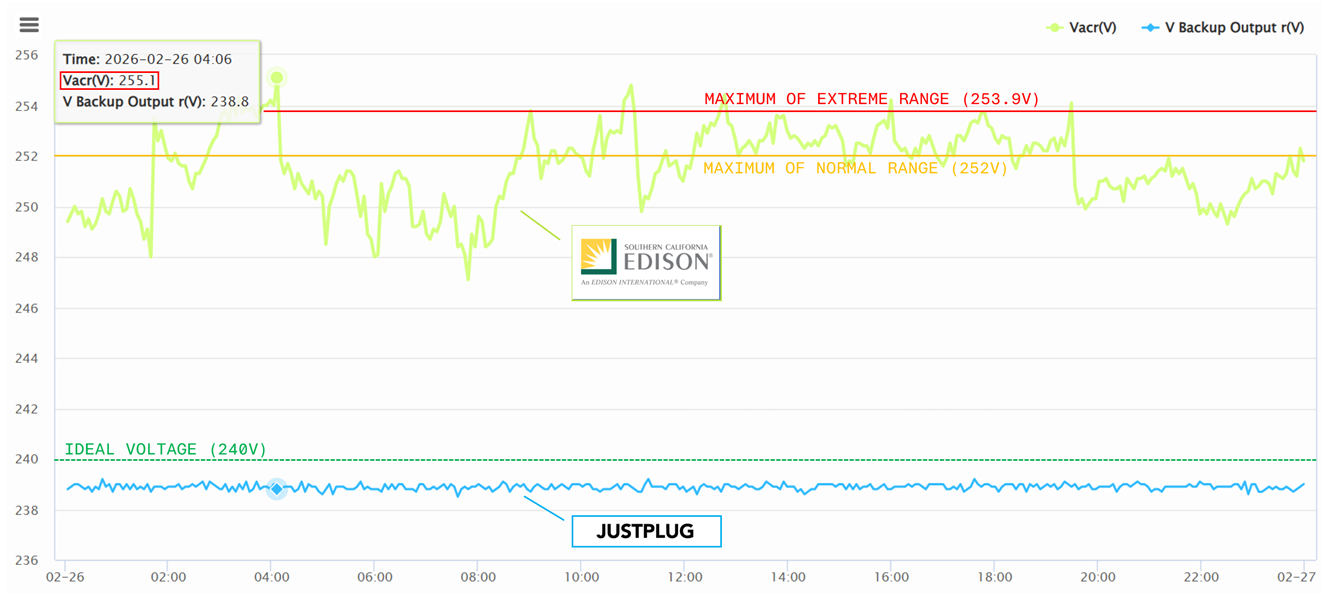
The solar inverter carries all loads, while the utility line was energized but carried no load (i.e., client utilization doesn’t affect the reading).
Current from the solar equipment maintained a steady voltage (~238-239V) well within Range A and stayed close to the ideal voltage of 240V. It demonstrates tight clustering with minimal variance even when supporting high surge loads (e.g., the well pump).
Meanwhile, utility voltage behaviors were a completely different story. We see:
Repeated excursions above 252V (outside Range A).
Peaks at 255.1V — exceeding 253.9V, the maximum for the extreme range.
Operation within Range B for extended periods.
Voltage hovering just below the maximum allowable sustained level.
This means utility customers in the area are constantly operating within the extreme band close to the ANSI limit.
Why do utility companies raise voltage?
Let’s start with this equation: Power = Voltage x Current
For a given power demand:
Higher voltage → lower current
Lower current → less heat loss in wires
Less heat → smaller or cheaper conductors can be used
Thicker cables mean better voltage regulation, but they’re expensive, especially over long runs in rural areas. Raising voltage is often a cheaper engineering solution than replacing miles of conductor.
So, instead of installing new cables to deliver the power customers need, utility companies increase the voltage (and lower the power quality) at the expense of customers’ interests.
High-quality solar inverters are precision voltage regulators
Modern, high-quality off-grid solar inverters are more than a simple power source. They’re actively regulated power synthesizers, using digital control loops, high-speed feedback, closed-loop voltage regulation, and real-time load comparison to deliver high-quality power.
The result? You get extremely tight voltage control, and your appliances live long and prosper 🖖🏼.
The proof is in the pudding, and the myth is busted
While many assume that utility power is more stable than solar, grid electricity actually can’t hold a candle to modern, high-quality off-grid solar equipment — especially in rural settings where utility companies don’t make much profit and cut corners on improvements and maintenance.
Power quality might not be the main reason to switch to off-grid solar, and that’s fair. It’s very much, eh, nerd stuff. However, it’s a useful piece of information if you ever wonder how power sources affect appliance longevity when you can’t sleep 😬. Or need to know that a motor part blowing up early isn’t your fault.