Why Energy Infrastructure Makes or Breaks Rural Real Estate Deals [Interactive Quiz]
Rural real estate transactions involve unique aspects, including water rights, road access, zoning, soil conditions, connectivity, and, increasingly, energy, which goes beyond whether a property has power. You must consider the source, reliability, operational and maintenance costs, and the path to enhancing your energy resilience.
Yet, energy infrastructure is often downplayed in rural property transactions. It’s disclosed, sometimes evaluated, and often glossed over. That gap creates consequences for every party involved: sellers may leave money on the table, buyers may inherit problems they didn't budget for, and agents may watch deals fall through due to uncertainties.
Whether you’re buying or selling, here’s how to set a transaction up for success and prevent unpleasant surprises.
Interactive quiz: Is your property energy resilient?
Rural properties consume more power than you think
You may wonder: why should the energy conversation be such a prominent topic in rural real estate transactions? Buying a property is just the first step — you have to live there and run it. Can the energy infrastructure support your expected lifestyle? Can you count on it for essentials like water, food preservation, and communication?
Additionally, what’s the total cost of running and maintaining it? This is not a trivial question. Rural households use roughly 50% more electricity than urban ones — 15,258 kWh per year compared to 10,290 — with essentially the same average household size.
The reality is that energy is a bigger line item for rural property owners than most buyers expect. You must account for it in your ongoing costs. To start the energy conversation, be prepared for scenarios you may encounter.
The four energy situations in rural properties
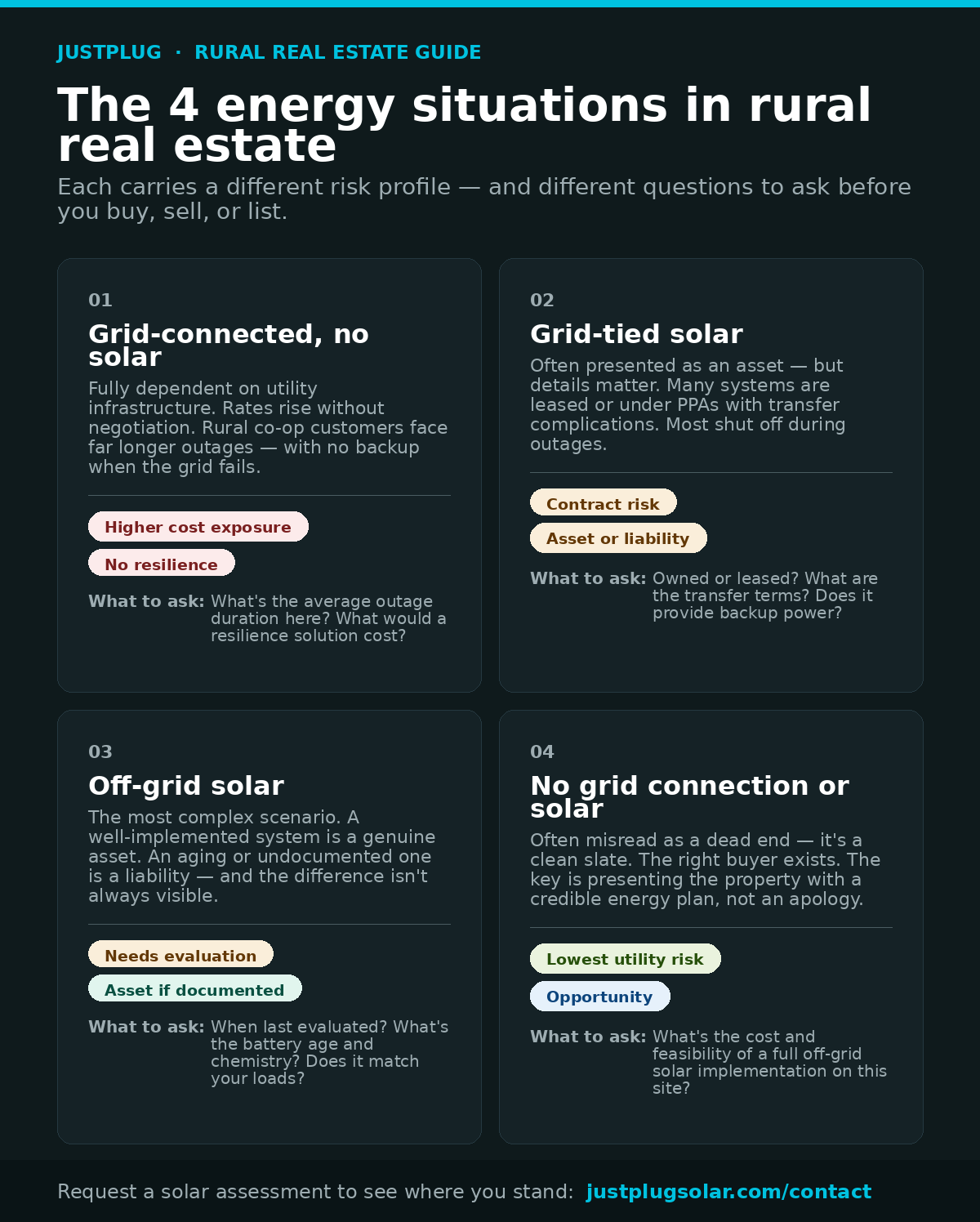
Here are the four energy setups that most properties fall under in a rural environment.
1. Grid-connected with no solar
This is the most common scenario and is easy for most first-time buyers to understand. Unfortunately, it gives people a false sense of security, leaving them exposed to risks.
These properties depend entirely on utility infrastructure that owners have no control over. Rates increase without negotiation, while outages last longer (e.g., during the Borel Fire, many residents in our area experienced a week-long power outage).
Most people have backup generators, but many don’t have an auto-start feature. Your food in the fridge may spoil if you aren’t home to yank the generator cord during an outage. The fuel cost of running a generator over a multi-day outage isn’t for the faint of heart, either.
2. Grid-tied solar
A grid-tied solar system is often presented as an asset, and it can be. However, beware of the fine print. Many grid-tied systems were implemented under net-metering contracts, but they no longer exist in their original form. Others are leased rather than owned, creating a transfer problem at closing. Additionally, grid-tied systems must shut off during an outage (as required by regulations), giving buyers who assume solar means independence an unpleasant surprise.
The system’s details, such as whether it’s owned or leased, current contract terms, and true production capacity relative to original spec, make a significant difference in its value to the buyer.
3. Off-grid solar
This is the most complex scenario for buyers and agents. A well-implemented, properly maintained off-grid system is a genuine asset. It reduces operating costs, provides resilience, and adds to property value. However, an aging, undersized, or poorly documented system is a liability. Yet, the difference isn’t always apparent.
A system may appear functional while running at a fraction of its original capacity. Buyers who don't evaluate an off-grid solar solution before closing often discover gaps afterward. We’ve seen people realizing that their system can only power a few lights after moving into their new home, and they showered at truck stops for months before the issue was resolved.
4. No grid connection or existing solar solution
Raw land without grid access is frequently misread as a problem when it’s really just a different kind of opportunity — a clean slate to do off-grid living right. The right buyer for an off-grid property exists: they're drawn to autonomy, lower long-term costs, and the freedom to build on their terms.
The key to attracting the right buyer is to present the property with a credible energy plan rather than an apology. The cost and feasibility of implementing an off-grid solar solution should be part of the listing conversation. With the right information, resources, and visibility, you don’t have to be hamstrung by the lack of utility connections.
Bonus tip: Sellers may build in a “starter energy infrastructure” to eliminate uncertainties with support from the right partner. You may then hand off the energy conversation to this partner, who will be available to help the buyer upgrade based on their needs.
How energy infrastructure affects rural real estate transactions
The energy conversation involves both utilitarian aspects and buyer perceptions. Here’s a breakdown of its roles in rural real estate deals:
List price and days on market
Buyers price uncertainty into their offers. Properties with documented, functional energy infrastructure command higher asking prices and sell faster. Conversely, those with unresolved energy questions tend to sit longer and attract lower offers.
Additionally, homes with grid-tied solar sell for an average of 6.9% more and 20% faster than comparable homes without. For off-grid systems that eliminate utility dependency and power bills, the value case is at least as strong, and in markets where grid service is expensive or unreliable, arguably stronger.
Buyer confidence and deal contingencies
Unknown energy situations generate contingencies and delays, which kill deals. Comprehensive documentation, a recent evaluation, and a clear remediation roadmap help sellers and agents remove friction in the negotiation process.
Bonus tip: Sellers may partner with a solar expert who’s available to support system hand-off and help buyers learn about their solution, boosting confidence.
Ongoing operating costs
Rural households already pay more for energy than their urban counterparts, while the quality of power and service is often lower. Moreover, buyers must consider the costs of outages, including food spoilage, the risk of being unable to run medical devices, and fuel expenses for backup generators.
Utility customers in rural areas often get sticker shock when fixing their breaker boxes, which often costs thousands of dollars. Meanwhile, jumping through hoops to beg utility companies to send someone out to open the box is yet another story…
Resilience, peace of mind, and livability
Rural outages are longer and less predictable. They're a material livability consideration for buyers who work remotely, manage livestock, operate powered equipment, require medical devices, or simply want reliable refrigeration.
Properties with genuine energy resilience address that concern directly and can be positioned more favorably in the market. For example, our Resilience Solution helps grid-tied homeowners lower power bills, ease the impact of rate increases, and protect their household against prolonged outages.
Agent liability
If a buyer discovers after closing that the solar system was misrepresented in the listing, e.g., an off-grid system can’t support basic household loads or a grid-tied system is leased with unfavorable transfer terms, they may hold the agent accountable. Brokerages and agents who get ahead of the energy question protect their clients and themselves.
Questions every rural buyer, seller, and agent should be asking
Here are the energy questions you should ask to protect your interests in a rural real estate transaction:
For sellers
Do you have comprehensive and accurate documentation of the energy system, including original design specs, maintenance records, and equipment manuals?
Do you know whether your grid-tied solar system is owned outright or under a lease or power purchase agreement (PPA)? If it’s a lease or PPA, what are the transfer terms and the buyer’s responsibilities?
Do you know what it would cost to bring an older off-grid system up to current standards, and what’s the impact of that investment on the asking price?
For buyers
If the property has a grid-tied solar system, is it owned or leased? If it’s a PPA, you may not be able to renegotiate terms or get out of the contract.
When was the system last independently evaluated? Can the owner produce documentation? Has anything changed since the inspection? (Note: lead-acid batteries typically last 3-5 years if maintained properly. An evaluation done 2 years ago doesn’t reflect current capacity.)
What loads does it actually support, and do those match how you plan to use the property? What would it cost to upgrade or replace if the evaluation shows issues?
For agents
Do you have a resource you can call when energy questions come up on a rural listing?
Can you present your seller's system as an asset, rather than a question mark or a liability?
If your buyer is evaluating an existing system, can you provide a written, unbiased assessment before close as part of the disclosure packet?
Energy clarity is a competitive advantage
The bottom line: rural properties that present cleanly close faster. Energy infrastructure is a clear opportunity to either strengthen a listing or create unnecessary friction.
Sellers who evaluate and address their energy situation before listing position their properties ahead of comparable ones that leave the question open. Buyers who commission an independent assessment before closing gain a negotiation tool and avoid inheriting someone else's problem. Agents who know how to handle the energy conversation win more rural business and close more deals.
The good news is that you don’t have to go it alone.
We work with rural property owners and their agents in Kern County and surrounding areas. If energy is a question mark on a property you're buying, selling, or listing, let's talk.