Energy Independence as an Asset: Increase Rural Property Value with Off-Grid Solar (Part 2 of 2)
Part 1 of this series discussed how solar increases property value. This installment reviews the top three use cases and shows how to design a system with resale in mind.
Top 3 use cases where off-grid solar helps increase property value
We typically encounter three starting points when rural homeowners consider adding off-grid solar to their properties:
1. Properties with an ailing grid-tied solar system
Many rural homeowners installed grid-tied solar years ago under favorable net-metering contracts. Today, that math no longer holds. Reduced export credits and rising fixed utility have eroded savings. Meanwhile, most grid-tied systems don’t work during outages (unless you spend over $100k on cold-start batteries), providing zero resilience when power goes out.
Many people have an over-dimensioned solar field. They can’t use up all the electricity during the day. Utility companies take most of the power generated, selling it to their neighbors at the full rate while paying them a fraction of that. However, without storage capacity, they draw electricity from the grid at night at the full (often peak) rate. They’re essentially generating power for utility companies for free and still having to buy power from them.
Transitioning toward a self-reliant, fully off-grid configuration reframes the system from “policy-dependent” to infrastructure-driven, restoring buyer confidence and value by repositioning solar as a strength instead of a liability.
In practice, the implementation is more streamlined than building a system from scratch. Most people can reuse their existing solar panels and mounting mechanisms. Trenching and cabling are mostly done, so additional construction work is often minimal. The project focuses on replacing the grid-tied inverter with an off-grid-capable one, ensuring performance meets modern expectations, and adding battery capacity for self-sufficiency.
2. Utility customers seeking to add solar
These grid-dependent homeowners have no solar on their properties. They’re paying full retail rates, absorbing regular increases, and experiencing outages with little recourse. For them, adding off-grid solar lowers operating costs while they still live on the property and improves resale appeal by reducing long-term energy risk for the next owner — a unique selling point that’s increasingly attractive to rural buyers.
In practice, the implementation typically involves adding an off-grid solar system to handle the day-to-day load. We advise most clients to retain their utility connections as a backup for infrequent large loads, so they don’t have to spend thousands on capacity that rarely gets used, thereby shortening payback time.
Our modular design enables homeowners to add production and storage capacity relatively easily without a system overhaul. For example, we collect and analyze data after implementation and review the insights with the owner. If we discover that the system flips to the grid more often than desired, the owner can add capacity incrementally instead of buying capacity they may or may not need upfront.
3. Existing off-grid owners seeking improvements
Some rural properties already have off-grid solar, but older systems are often undersized, lack data monitoring, or suffer from aging components. These setups can rarely meet modern household needs. As buyers become more discerning, outdated systems may become more like a money pit than a value-add.
To boost property value, owners can modernize these systems, improving capacity, reliability, redundancy, and transparency (e.g., system data, documented maintenance, clear upgrade paths) to increase buyer trust and perceived property value.
The good news is that more often than not, there is just one or two “weak links” in these systems. If you pinpoint the problem, you can address it surgically instead of tossing the baby out with the bathwater. The difference? Instead of a $50k+ bill to rip and replace, you may pay a fraction of that.
Besides performance enhancements, we advise owners to conduct a system health check to address issues before they develop into equipment damage, downtime, or fire hazards. A clean, safe setup positions the off-grid solar solution as an asset with long-term value, increasing buyer confidence because they don’t have to spend tens of thousands to fix it.
Designing off-grid solar solutions with resale in mind
A reliable off-grid solar system is dependable, allowing buyers to focus on the land, the home, and the possibilities — making everything else easier to value. Here’s what to consider when designing off-grid solar systems as an infrastructure to boost resale value:
Right-size for typical use cases, not extreme scenarios
An undersized system can create anxiety and limit usability. Yet, oversizing one to handle rare peak loads or worst-case scenarios may inflate costs without improving buyer appeal. From a resale perspective, the system should support everyday living comfortably and handle seasonal variation without constant management, so buyers don’t have to make lifestyle compromises.
Design for expandability and flexibility
A resale-friendly off-grid system should offer clear expansion pathways to reduce buyer hesitation. For example, a modular design allows owners to add solar panels, inverter capacity, and battery capacity without an expensive overhaul if usage changes, occupancy increases, or new structures (e.g., workshops, guest units) are added.
Make the system understandable
Buyers don’t want complex, “black box” systems. To make your off-grid solar solution resale-ready, prepare clear documentation of system components and capacity. Use equipment that offers user-friendly monitoring capabilities. Include a plain-language explanation of what buyers can expect.
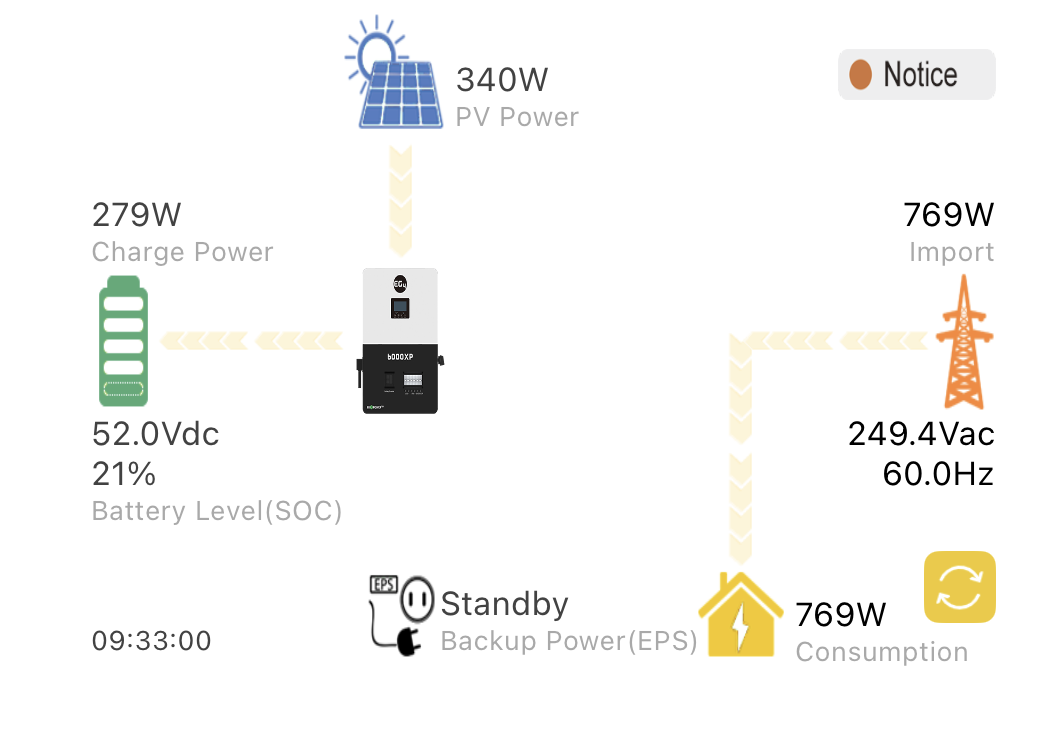
Our clients can monitor their systems’ performance via a smartphone app.
Prioritize reliability over complicated features
Unconventional configurations or highly customized solutions may work well for the original owner but may not serve buyers’ needs. Instead, use proven components and standard system architectures to enhance reliability and serviceability. Buyers want to know that parts and support are available and maintenance won’t become a headache.
Build in redundancy and automated backup
The system architecture should incorporate redundancy. For example, we configure panels into two or more independent strings and often use two smaller inverters instead of a big one with the same capacity. Additionally, we recommend that fully off-grid clients include an auto-start generator in their solutions for added resilience.
Set up the solution for long-term ownership
Battery lifespan, maintenance expectations, and service access all influence resale perception. Clearly defined maintenance schedules and realistic timelines enhance peace of mind. For instance, battery replacement is often required after seven to ten years, and including the process in your documentation reinforces trust and transparency.
Support adoption to increase confidence and value
To increase the perceived value, choose a dependable solution provider who can offer onboarding to the new owner and usage-based optimization over time to help them maximize their investment. This provider should also be available for maintenance tasks, positioning off-grid solar as managed infrastructure, not a DIY gamble.
Off-grid solar as a property strategy
Buyers of rural properties are increasingly pricing in resilience, autonomy, and cost predictability — not as abstract preferences, but as practical risk factors that affect livability and long-term ownership.
Sellers who proactively improve their energy systems position their properties to outperform comparable listings that leave energy as an unresolved variable. Off-grid solar reduces dependency, increases control, and converts energy from a volatile expense into owned infrastructure, helping rural owners protect value and meet evolving buyer expectations.
Ready to strategize setting up your off-grid solar solution for resale success? Get in touch to schedule a consultation session.