How Working + Guest Ranches Can Turn Remote Acreage into Revenue
Many multi-thousand-acre ranches face a dilemma: consumers would pay more to experience untouched land, but delivering power beyond current reach has been impractical, keeping the revenue potential of these areas untapped.
But for ranches that already house guests, there’s an even more immediate challenge. The existing infrastructure — the lodge, cabins, kitchen, and pumps — is only as reliable as the grid. In many rural regions, that reliability declines each year.
For working ranches with a hospitality operation, energy is the backbone of the guest experience. When it fails, everything falls apart. That’s why generators are standard equipment. However, they are a reactive fix, not a strategy. Moreover, they do nothing to help with the power bill when you’re drawing grid power.
Yet, having a hospitality component on your ranch is good business, and there’s no better time to grow it than now.
According to Expedia's Unpack '25 survey, 63% of consumers say they're likely to choose a lesser-known, less-crowded destination on their next trip, such as working ranches, mountain valleys, and remote meadows.
The demand is there. The land is there. The missing piece is an energy strategy that protects what you've already built and opens up what you haven’t been able to tap into. The good news is that it’s a solvable problem.
Protecting the guest experience with a resilient energy strategy
You may say, “We already have generator backup. We’re fine.” Well, not so fast.
We don’t have issues with generators. On the contrary, we often include auto-start generators in our energy resilient strategies to cover all the bases and then some. But we must understand what generators actually solve, and what they don't.
The core of the issue is that generators are a reactive solution.
You yank the pull cord when something has already gone wrong: disruptions to the guest experience have already happened.
Moreover, you have to worry about noise, fuel logistics, maintenance schedules, and cost per hour of runtime (ouch!). Generators somewhat save the moment like a band-aid, but sit idle the rest of the year when the grid is on, and the power bill is quietly doing its damage to your bottom line.
Here’s the dollars-and-cents straight talk: Electricity rates in rural regions have been climbing for years, and the trajectory is worsening. The power costs of supporting industrial refrigeration, commercial kitchen loads, guest cabin HVAC, and water pumps aren’t trivial. Consider the growing use of PSPS (Public Safety Power Shutoffs) by utilities during the fire season, and relying on the grid is no longer a sound assumption.
The verdict: high electricity rates + unreliable grid + an army of generators = poor ROI.
Generators solve the emergency. Yet, they’re costly and do diddly squat 99% of the time.
On the other hand, off-grid solar addresses the economics and offers reliability when deployed as part of a resilient energy strategy. It shields you from the increasingly uncertain future of utility pricing. It not only provides energy independence but also improves business continuity, which the grid can’t guarantee.
Let’s explore how to do it right.
The winning strategy: build resilience and boost your bottom line with off-grid solar
Here's where the conventional solar pitch has it backwards. Most people consider solar as the backup power source — something that kicks in when the grid fails, like a generator for tree-huggers. But if you think about it, that doesn’t make sense.
Once you pay the upfront cost for a solar solution, you get free power for the rest of its useful life. So, why pay a monthly power bill when you have free electricity?
The “solar as backup” framing leaves most of the value on the table. The smarter model flips the script: we use solar as the primary power source, running day-to-day operations. Meanwhile, the grid and generator act as a safety net, handling overflows, high-demand moments, or consecutive cloudy days.
For a guest ranch, the starting point is identifying the mission-critical circuits, i.e., the loads that define the guest experience. These may include kitchen refrigeration, water pumps, guest cabin essentials, and communications — things that may lead to refund requests or bad reviews if interrupted.
A right-sized system designed around those specific loads protects the core operation and generates bill savings from day one without unnecessary spending.
« Already have grid-tied solar? You probably have the experience of staring at your panels when the grid goes out, frustrated by how you still don’t have the resilience after all that investment. We’ve got your back. See how to leverage what you have to build true energy resilience. »
Unlock revenue opportunities in your back forty
With the core operation protected, let’s tackle the next question: what is all that land actually worth to your business?
The reality is that most dude ranches monetize a tiny fraction of their total acreage. The land’s revenue potential is artificially limited by where the power company is willing to serve and the costs of pulling a cable (= an arm, a leg, and a kidney).
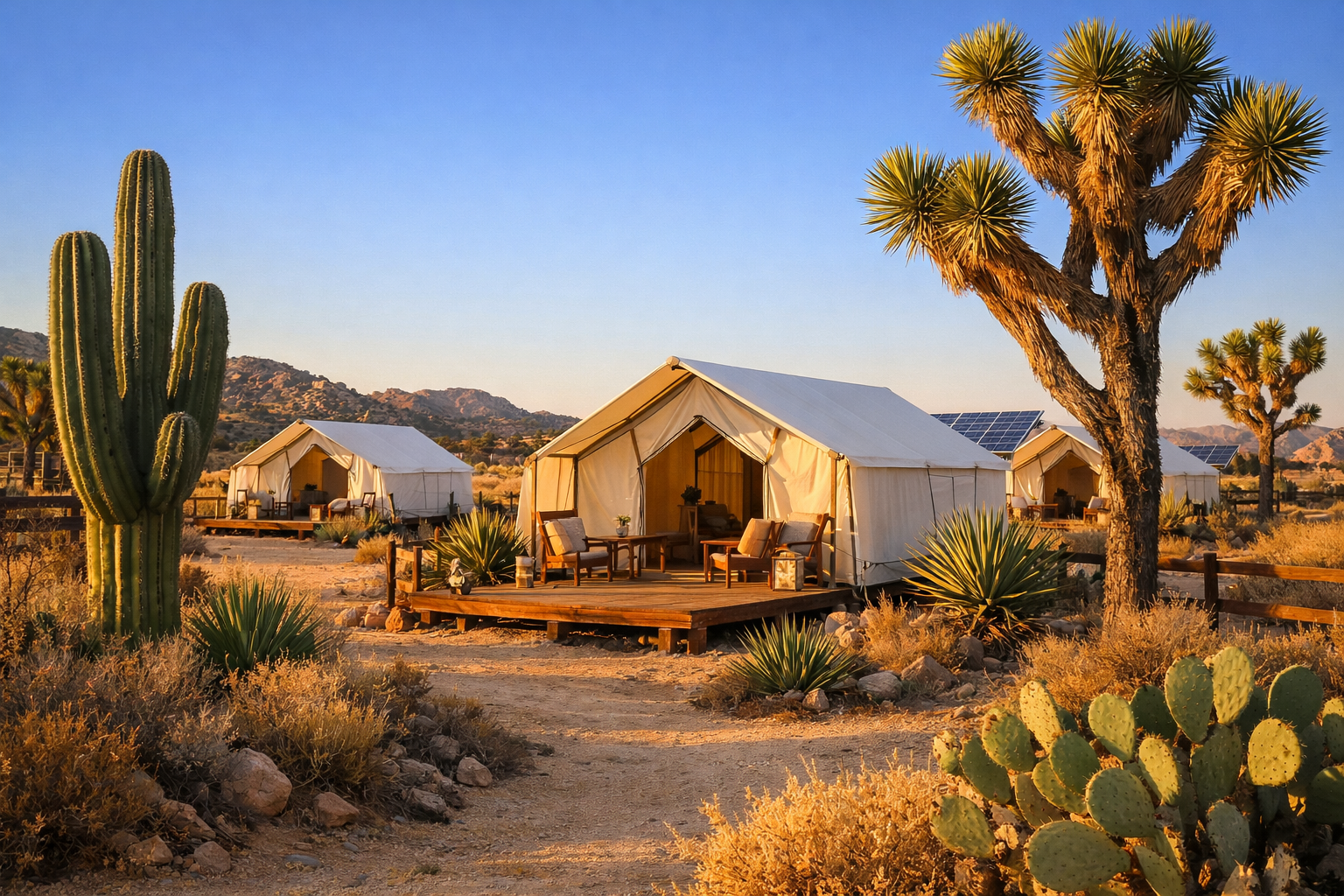
Meanwhile, the hospitality market has shifted. Consumers are seeking unique experiences. For example, the global glamping market was valued at $3.79 billion in 2025 and is projected to nearly double to $7.87 billion by 2033. People value locations that feel genuinely remote, authentic, and off the beaten path.
For most ranches, the bottleneck isn't the land. It's the energy infrastructure to bring that experience to the parts of the property where it would feel most authentic. Imagine a horseback ride to a secluded campsite outfitted with modern comforts where guests can stay for several days.
Yet, running grid power to a remote meadow or backcountry ridge is rarely practical. Trenching through rugged terrain, navigating utility easements, permits, and per-mile costs can make grid extension economically indefensible for a handful of glamping pods. Moreover, a utility buildout through the back forty would compromise the very atmosphere guests pay to access.
Off-grid solar solves the dilemma. You can right-size a self-contained system to support your long-term plan and accommodate your current budget. For example, you may start with two or three pods, not twenty. Then, you scale the investment based on your vision: validate the concept, build occupancy, then expand on your own timeline with the profits generated.
The practical side of things: do the math and plan the work
So, what’s the right amount to invest in an off-grid solar solution? Like any financial decision, the business case has two columns:
On the costs side, off-grid solar reduces monthly power bills, lowers generator runtime and fuel costs, and provides a hedge against future rate increases that show no sign of reversing.
On the revenue side, off-grid solar opens incremental income opportunities from remote sites that are currently idle. Plus, the revenue doesn't stop at renting out glamping pods. Guests who are already on the property are natural customers for your other offerings, such as meals, horseback riding, and guided activities.
Then, there's the column that doesn't have a line item but carries real weight. A power outage during peak guest season is a reputation event. In an era where one bad review can put your reputation in question, energy reliability is guest experience insurance.
Additionally, guests drawn to seclusion and a working land ethos increasingly expect that commitment to extend to how a ranch powers its operations. Incorporating solar goes beyond a marketing gimmick. It’s an operational reality that guests can see and respect. For ranches already invested in land stewardship, it's a natural boost to their brand.
Keeping your investment smart and manageable
A well-orchestrated execution is often a multi-phase strategy rather than a one-off, all-or-nothing monster project. A phased approach keeps the investment manageable. It’s designed with a holistic vision in mind while allowing learning opportunities to refine your approach and improve your return.
Here’s an example of how that may play out:
Phase one. Dimension a system for mission-critical lodge circuits, start generating bill savings, and lay the foundation for expansion.
Phase two. Build your first remote site, funded in part by the savings you’ve generated from phase 1. Start small and iterate.
Phase three. Expand to broader lodge coverage and/or remote site capacity, funded in part by the savings from phase 1 and revenue from phase 2.
Where to start
The right question isn't "how much does a solar system cost?" Investing in energy resilience is an ROI consideration. You must first identify where the operation is most exposed right now and the highest-value problem to solve.
For some ranches, it's the main lodge's vulnerability during PSPS seasons. For others, it's the power bill eroding margins. Or, it may be the back forty that's been sitting idle for decades while guest demand for exactly that experience keeps growing.
Justplug works with rural ranch and hospitality operations to design a robust, holistic energy strategy and an intentionally custom-engineered solution. Let's talk about your property →