Flying Blind During a Winery Harvest Outage is a Grid-Dependency Problem
Imagine a September day at your winery: Grapes are moving, tanks are active, and the tasting room is bustling. Then came a Public Safety Power Shutoff (PSPS) notice.
You have 48 hours or less to prepare. The first few hours aren’t a crisis, but the sequence of decisions you’ll have to make without knowing how long the outage lasts is guesswork.
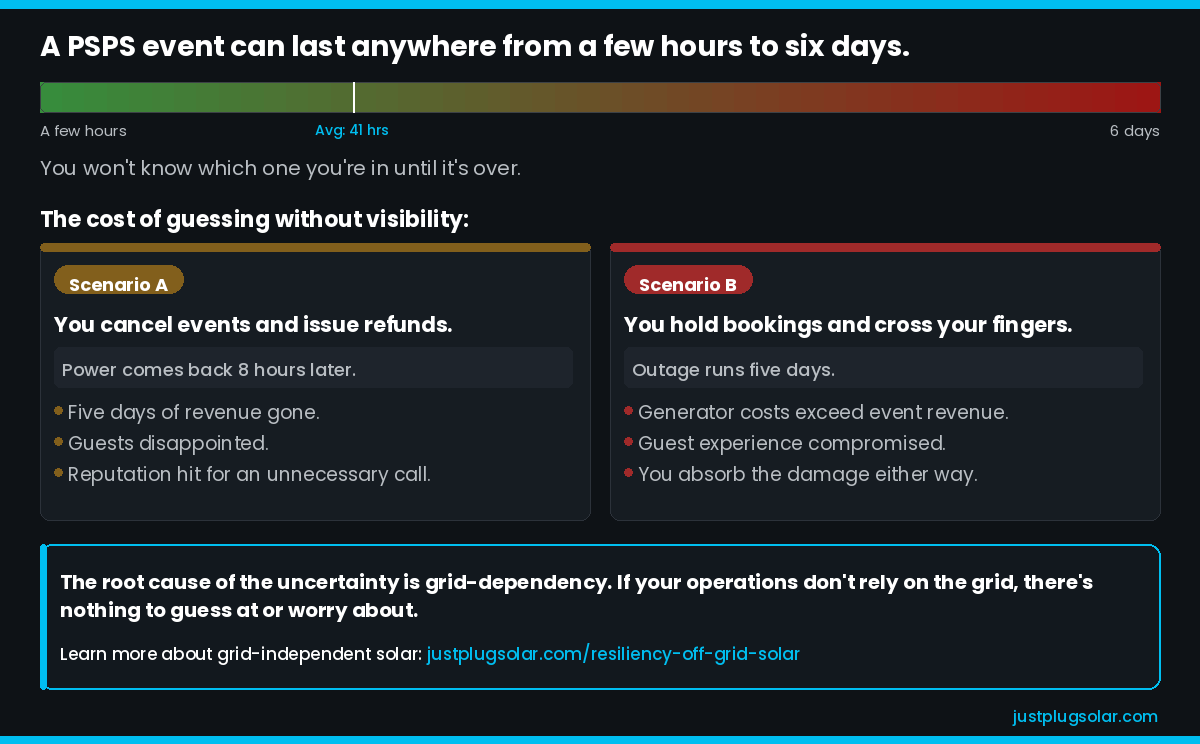
Cancel event bookings for the next five days and issue refunds, then the power comes back on in 8 hours. You lose five days’ revenue and risk your reputation.
Keep upcoming event bookings and cross your fingers. Not having power isn’t an option, so you spend more than you earn on generator rent and fuel, while worrying that the noise will impact the guest experience.
The uncertainty and lack of visibility hurt business more than the outage itself. The good news is that the root cause isn’t inherent in the winery business model — it’s grid-dependency. If your operations don’t rely on the grid, there’s nothing to guess at or worry about. Heck, there won’t even be any interruptions.
The problem is solvable, and we’re at the point where grid-independent solar technology is reliable and affordable enough to make the business case work.
Of course, don’t take our word for it. Making an infrastructural investment means, first and foremost, understanding the cost of the solution versus that of not taking action. So, let’s examine the impact of an outage and how the cost of guesswork compounds.
The cost of uncertainty as an outage progresses
If you know how long an outage lasts, you can plan for it. The challenge with a PSPS event is that it could go from a few hours to six days. The decisions you make from hour to hour can have irreversible consequences on your business.
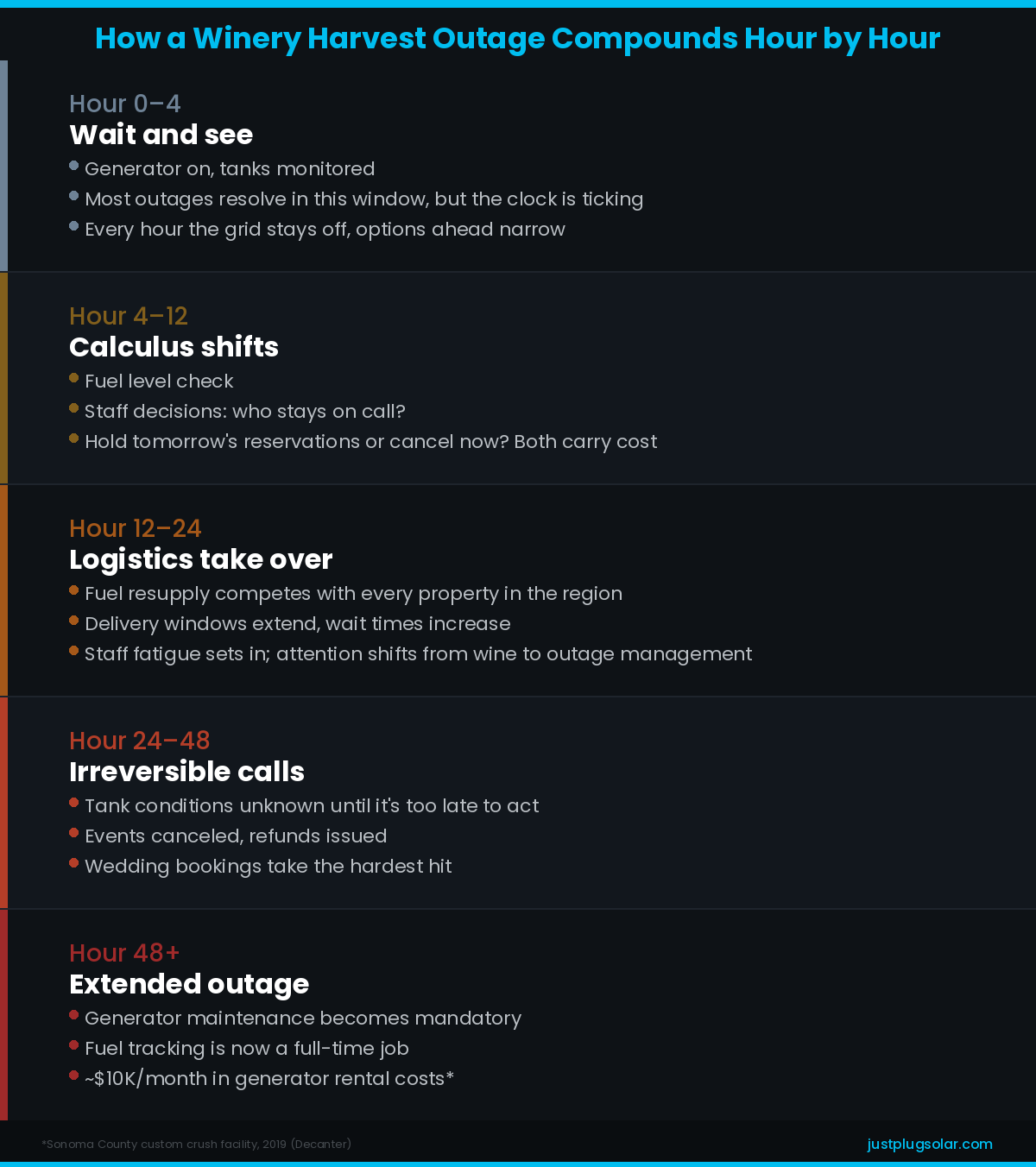
Hour 0–4: The wait-and-see window
The power goes out, but you’ve been here before. Most outages resolve in a few hours, so the measured response is to start the generator, monitor the tanks, and hold off on activities that can wait. No panic yet, but the clock starts ticking.
Active tanks are on generator power now. Fermentation generates its own heat. The logistics chain for the rest of the day becomes conditional. Every hour the grid stays off, the decisions ahead get narrower and more consequential.
Hour 4–12: The calculus starts to shift
The historical average for PSPS outages has been around 41 hours, but you don't know which kind you're in until it's over. By hour four, the questions that could be deferred at hour one start to demand answers.
How much fuel is in the generator tank? What's the resupply situation if the outage goes overnight? How do you handle staffing: who stays, who's on call, who goes home? How do you handle tasting room reservations: reach out to tomorrow's reservations now, or wait?
Every one of these calls is made without visibility into the key variable: outage duration. The cost of guessing wrong increases with each hour.
Hour 12–24: Logistics burden piles on
By this point, outage management has become the primary focus. The decisions consuming your attention aren't about wine or customers.
Generator fuel resupply in rural areas during an outage isn’t a simple transaction. PSPS events affect entire regions simultaneously. Every farm, ranch, property, and business with a generator competes for the same fuel from the same suppliers. Delivery windows become uncertain, wait times extend, and response times lengthen.
Meanwhile, the fermentation process doesn’t pause. Active tanks still need monitoring, and physical work continues while the logistics problem escalates. Staff exhaustion starts to set in. Harvest is already a round-the-clock operation, and generator uncertainty twists the knife.
Hour 24–48: The decisions impacting revenue and reputation
At this point, strains start to show. If generator reliability has been inconsistent due to a fueling gap, a mechanical issue, or a load spike, some tanks may have experienced conditions outside the target range. You can’t pinpoint the impact until after the fact, when there isn’t much you can do about the damage.
Event cancellations that were "possible" at hour four become “definite” by hour 36. You call every guest to reschedule or issue refunds. Customers are disappointed, and wedding bookings take the hardest hit. The revenue and reputational impacts don’t stop when the grid comes back.
Hour 48+: The cost of an extended outage
The October 2019 PG&E PSPS events in Northern California wine country ran from October 26 to November 1. During those six days, one Sonoma County custom crush facility spent roughly $10,000 per month on generator rental.
Sustained generator operation over a multi-day outage is a different beast from emergency backup. Maintenance checks become mandatory, and fuel tracking becomes a job in itself. Crew hours get consumed by generator management that wasn't in anyone's harvest schedule.
Running generators is manageable, yet expensive. The most costly part isn’t the outage, but a variable you can’t control: when the utility decides to restore power.
What if outage duration ceases to be a problem?
Every decision in this timeline, from when to resupply fuel and when to call off events to when to make a call on a batch, is made without knowing how long the outage will last. Reasonable decisions can still be wrong; right calls can still cost you.
A generator keeps the business on life support. But you must manage it closely while the clock ticks, and it doesn’t change the root cause: your operation depends on a grid you don't control.
Grid-independent solar removes that grid-dependency because it runs regardless of the grid’s status. The grid acts as a backup to solar and battery, not a make-or-break dependency on which your business activities hinge.
A PSPS notice becomes information. Our solutions are custom-dimensioned to cover all business-critical activities so you can ride out an outage, conducting business as usual, no matter how long it lasts.
Grid-independent solar for estate wineries
With grid-independent solar, the timeline we just described won’t happen because the dependency that causes the problem no longer exists.
➡️ Learn more about what grid-independent solar can do for a working winery: How California Estate Wineries Solve Outage Risks and Unlock Land Opportunities
➡️ If you already have grid-tied solar, a conversion to a grid-independent architecture protects you against outages. See what it entails.
➡️ Ready to think through what a grid-independent energy strategy looks like for your operation? Let’s talk.