Energy Resilience for Utility Customers: What Rural Property Owners Actually Need from Solar
You called the power company, listened to hold music for what seems like forever, and got a maddening non-answer about your latest bill, rate adjustment, or contract renewal. Meanwhile, the power went out again last week, and you’re dreading the next wave of PSPS events.
That story is getting old for rural property owners. Here’s the good news: utilities aren’t the only game in town, but you must play it right. Let’s explore how to turn the tables and take control, whether you have grid-tied solar now or no solar at all.
Why the old grid-tied solar math stopped working
For years, grid-tied solar made reasonable financial sense: you install panels, feed surplus power into the grid, collect net metering credits, and chip away at your bill. It was a smart move a decade ago, but two things have changed:
California's NEM 3.0 gutted export credits by roughly 75% for new customers or renewed contracts. Instead of close to a dollar-for-dollar credit on power you feed into the grid, you now get fractions in return. Your panels generate power, and the utility company sells it to your neighbors at the full rate. Meanwhile, you still have to pay for your nighttime usage. You’re stuck with a bill that doesn't reflect the power your system feeds into the grid.
On top of that, grid reliability in rural areas has worsened. Lower customer density means aging infrastructure and minimal incentive for utilities to invest in improvements. PSPS events — deliberate shutoffs to reduce wildfire risk — have become a fixture of rural California life, sometimes stretching beyond six days. Rural properties sit at the back of the restoration queue, because fewer customers per mile of line means lower priority.
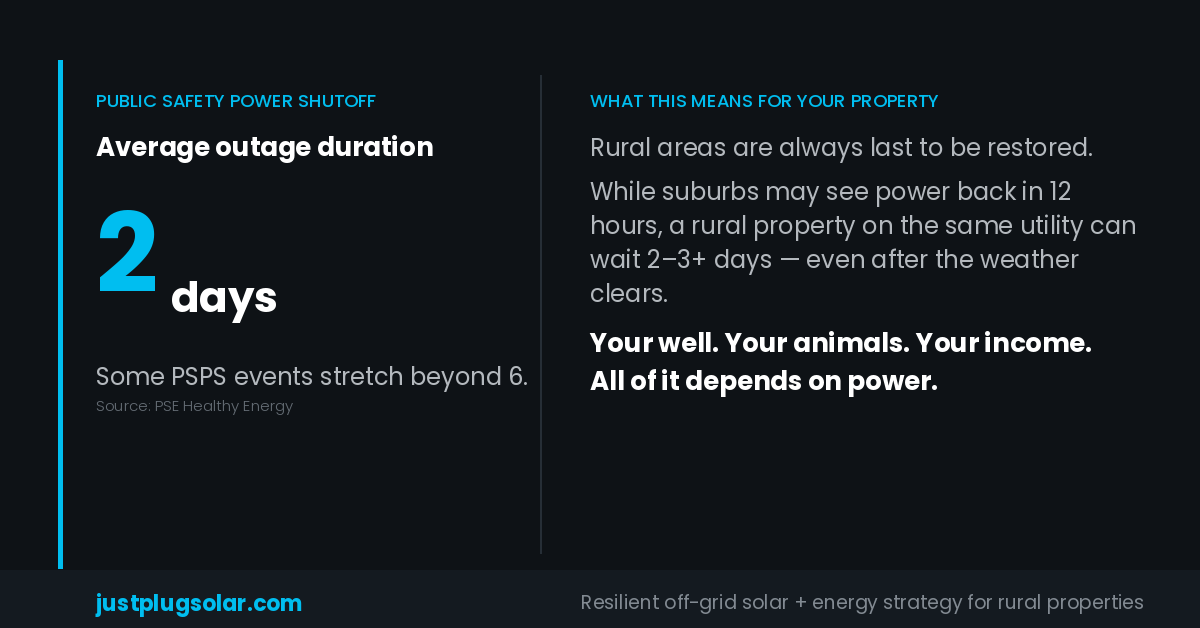
If you already have a grid-tied system, you've probably felt the gut punch: the moment the grid goes down, your property goes dark too because mandatory safety shutoff is baked into every grid-tied system. You sit in the dark with a solar array on your roof — that isn’t energy resilience. But you can do something about it.
What grid-independent solar actually is
Grid-independent solar is not grid-tied solar with a battery pack bolted on. The architecture, system logic, and design priorities are fundamentally different. The solution is built around your requirements, rather than the utility’s profits.
In a grid-independent setup, off-grid solar and battery storage are the primary power source. Your existing grid connection stays available as a low-cost backup. The critical distinction is that the system runs whether the grid is up or not. An outage notification is just information, and your property has power without any manual intervention or interruption.
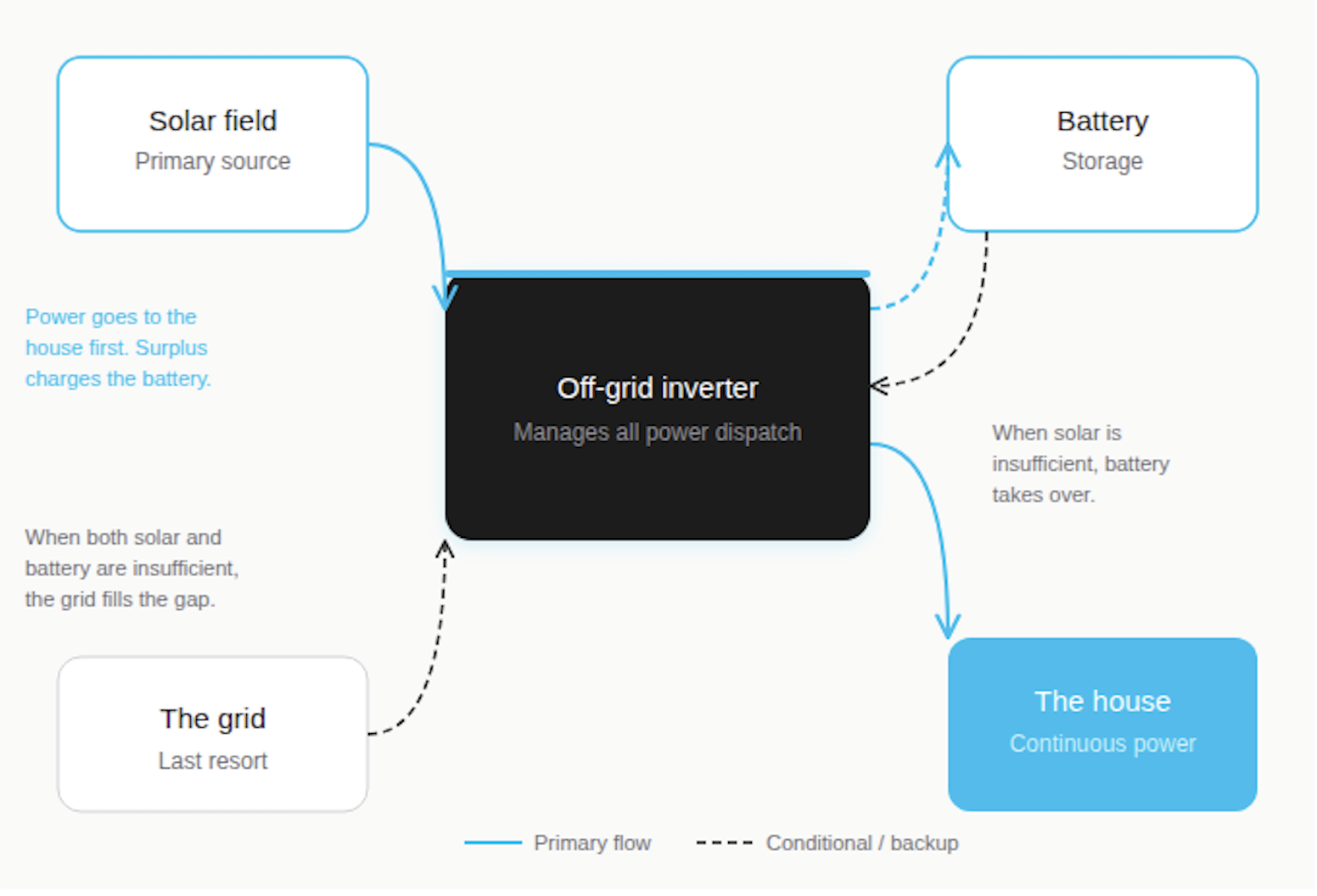
So, why not just pull the plug and disconnect from the grid? Using grid power as backup is actually the best way to reduce your costs and shorten payback time:
You've already paid for the connection. For a (relatively) low monthly fee, you can use grid power when you need it. For example, instead of dimensioning your system for occasional high-draw loads (e.g., that welder you use 2.35 times a year) or an extended stretch of cloudy winter weather, you let the grid take the hit.
Here’s the ROI calculus: a system designed to cover every conceivable peak load means paying for capacity you'll rarely use. Right-sizing the system to cover your day-to-day load and around 90–95% of all scenarios keeps the upfront cost and payback timeline in check.
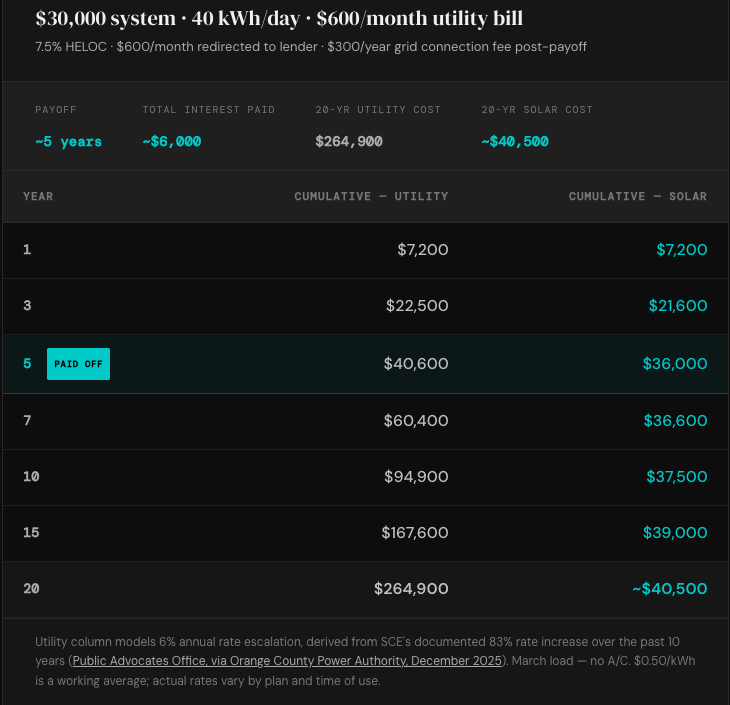
This payback time calculation example assumes a system cost of $30,000, financed with a 7.5% loan.
For utility customers who don’t have solar yet
For a utility customer starting from scratch, the model is simple: you buy a purpose-built grid-independent system designed for your property. However, it isn’t just about schlepping on a bunch of panels and calling it a day.
Even with the grid as backup, proper dimensioning is still essential for a successful implementation. For example, a system that isn’t sufficient for the day-to-day load will draw from the grid too often, and you can’t meaningfully reduce your power bills. Moreover, the frequent switching between the grid and solar will wear out the equipment prematurely, increasing your total cost of ownership (TCO).
That’s why we design each system from the ground up to address each property’s load profile and requirements. For instance, we measure and review actual consumption data and consider periodicity rather than "armchairing it” from spec sheets. This step alone regularly uncovers surprises that save clients thousands on solar capacity.
Grid-independent solar in action
One of our Caliente neighbors had been wanting to go solar for over thirty years, but hesitated because battery technology wasn't mature enough. However, worsening outages put their extensive irrigation operation at risk, and our solution allows them to get the best of both worlds. Their 12-panel setup handles a well pump, Starlink, refrigeration, and daily household load — keeping the essentials running through multi-day PSPS events.
For another two-person household, a load measurement exercise uncovered a booster pump that would have substantially increased the system cost. A practical test established that they could operate without it during an outage, and that tradeoff discussion saved them thousands in system costs. The solar solution covered a substantial portion of their energy needs without lifestyle compromises.
For owners of grid-tied solar systems
You have a system that was supposed to give you energy independence, but hasn’t. Meanwhile, paying for electricity when you’re feeding more than enough into the grid just doesn’t seem fair.
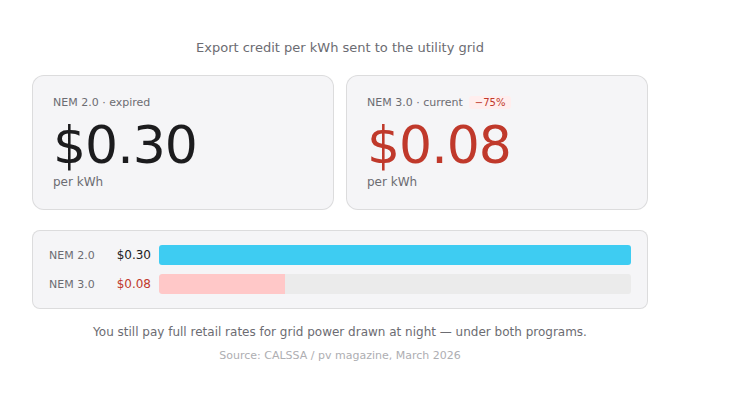
NEM 3.0: the math for export credit doesn’t work anymore.
In most cases, our clients keep their existing solar panels. The rest will be closer to an overhaul than adding a couple of things. Since grid-tied inverters require a live grid reference, most aren’t suitable for a grid-independent setup. You’ll most likely need to replace the inverter(s), rearchitect the system logic, and add battery storage.
Grid-independent solar in action
One of our clients hit the wall when their grid-tied inverter failed. The only service quote they received was $95,000, which included scrapping their perfectly functional solar panels. Their net-metering contract had expired without notification; SCE had defaulted them to a far less favorable arrangement, and their bill had jumped by hundreds of dollars overnight.
Then, there’s the cost of outages. They came home to 900 pounds of spoiled meat when the power cut out while they were away. Next, they lost an aquarium of fish to a separate outage.
Our solution, which reused the existing panel field and added two 12,000W inverters and a custom 21 kWh LFP battery bank, came in at under a third of that $95k quote and solved every problem of the grid-tied system: the outage vulnerability, night-rate exposure, and failed net-metering arrangement.
A mindset change that the utilities don’t want you to know about
Solar and utility companies have spent years selling panels as a bill-reduction mechanism. For example, PPA and lease agreements are structured as financial products that often put consumers in a bind.
For rural property owners, leveraging solar as a financial product misses the point. Your energy solution must keep your property running because much more is at stake when outages last for days. It should also help you build resilience and boost your property value as more real estate buyers factor the impact of outages into their decisions.
Here’s a better way to look at this: consider solar as an energy infrastructure — something you invest in, own, and control, with return on investment (ROI) and total cost of ownership (TCO) as part of the conversation.
Ready for your next step?
For utility customers without solar ➡️ Grid-Independent Resilience Solution for Utility Customers
For grid-tied solar system owners ➡️ Grid-Tied into Grid-Independent Solar Conversion
Either way, let’s talk. We’ll give you a straight answer on whether grid-independent solar makes sense for your property, and what you can do to enhance your energy resilience.