Reliable Energy with Predictable Cost for Land-Based Nonprofits
For organizations that own and operate on tens, hundreds, or thousands of acres of land, getting reliable power to where it needs to be isn’t as simple as walking into an office and flipping a switch.
Land-based organizations, such as land trusts, retreat centers, animal sanctuaries, scouting and outdoor education facilities, camps, historical sites, and research facilities, face mounting energy challenges. And the situation isn’t getting any better with skyrocketing rates, frequent outages, and the high cost of extending a utility line in low-density, rural areas.
The good news is that grid-independent and off-grid solar systems have become much more cost-effective and easier to manage. For example, our solutions are set-it-and-forget-it, and our remote monitoring program eliminates the need for a full-time onsite technician.
Moreover, the financial calculus makes sense. For example, most of our clients achieve payback in under 7 years through utility bill savings alone, not counting the labor and fuel costs of running a generator during frequent, prolonged outages or missed revenue.
We’ve worked with clients and organizations with different starting points:
Grid-powered with no solar. A sitting duck when utilities raise rates and scrambling to keep things running with a generator during outages.
Grid-tied solar. Unexpected electricity bills as net-metering arrangements end, and still having to deal with outages.
Existing off-grid solar. Low capacity and/or an ailing system with outdated equipment limits your operational capacity and growth potential.
Remote land with no power. Extending a utility line isn’t feasible, so you’re staring at a lot of land with potential but no way to tap into it.
No matter where you are, grid-independent and off-grid solar can help.
You’re a utility customer with no solar
We’re conditioned to depend on utility companies, but does the business case still pencil out?
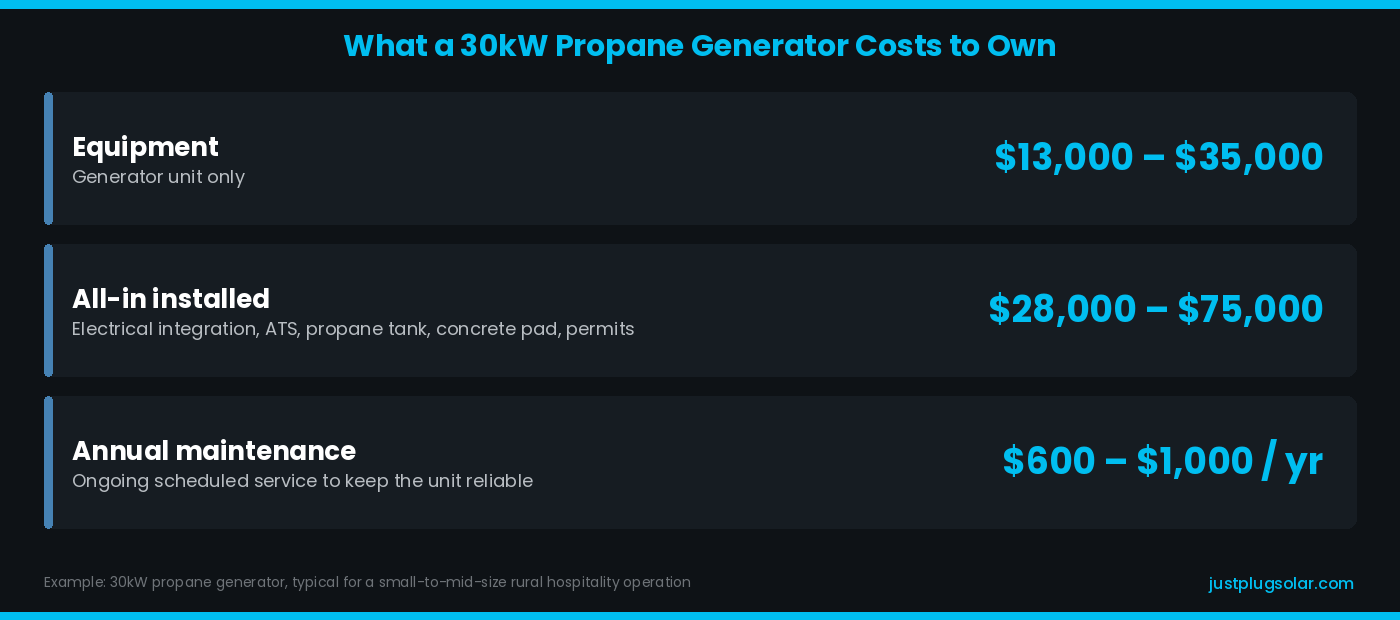
Outages stop well pumps, refrigeration, climate control, and more, throwing a monkey wrench into your operations and programs. Running generators with today’s eye-watering fuel costs isn’t fun either. You also need to divert staff to babysit the generator or even haul it around (e.g., to run the pumps at livestock watering stations).
Meanwhile, you face frequent, unpredictable utility rate hikes that make it challenging to control your budget and forecast your spending.
But here’s an alternative. Let’s say you take out a loan for a grid-independent solar system. Then divert a fixed amount from your utility bill (which you no longer have to pay) to repayment. Your outflow doesn’t change, but your energy expense becomes predictable, and your organization controls its own energy infrastructure.
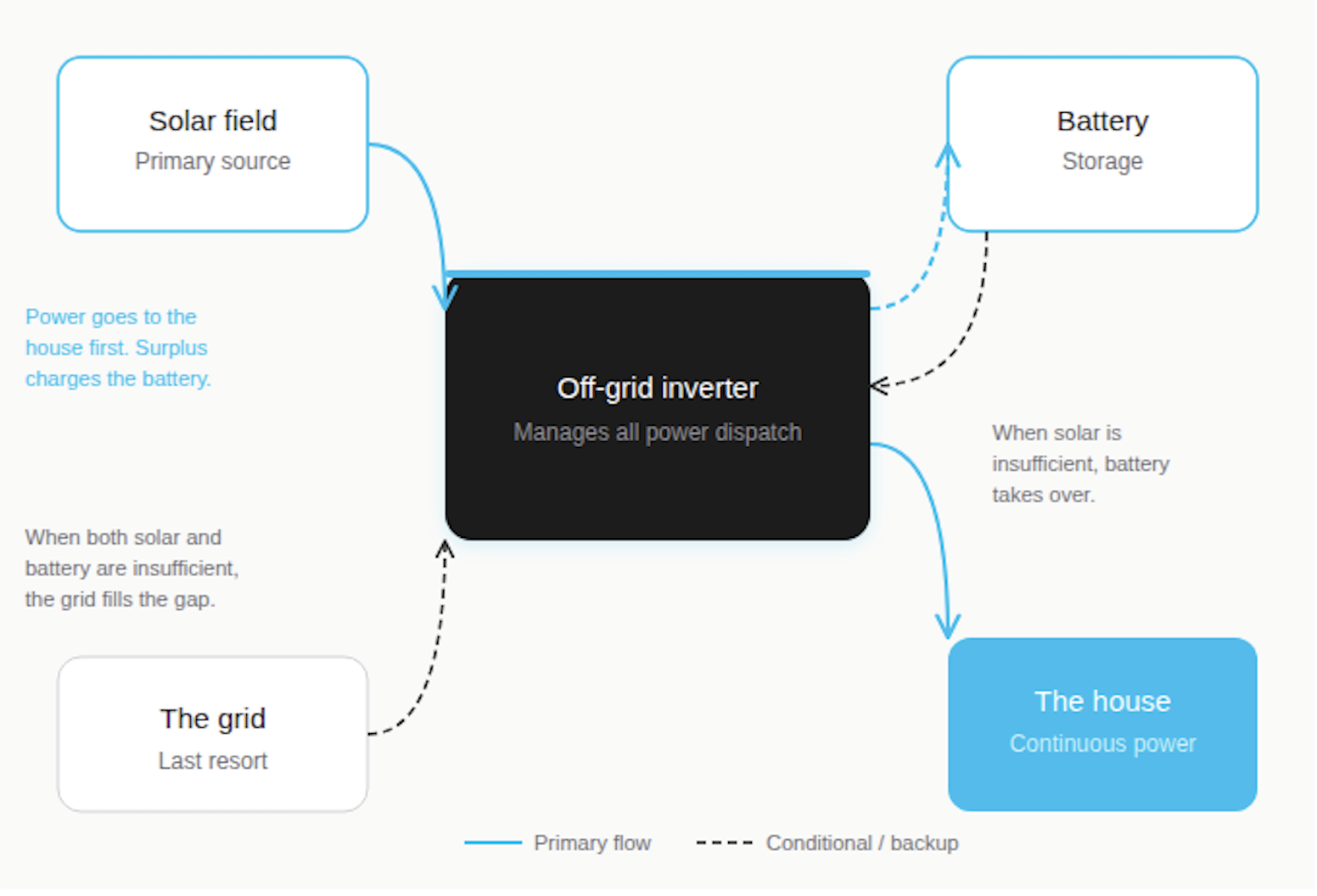
A properly engineered grid-independent solar solution eliminates a large portion of your power bills and keeps your operations running regardless of the grid’s status. We also help you make informed, intentional decisions, ensuring you have power for essential activities (and then some) during a prolonged outage without buying excess capacity.
You have grid-tied solar and still pay through the nose
Grid-tied solar has fine print, including the critical but mostly glossed-over fact that the system shuts off when the grid is down — leaving you with no power and scrambling for backup unless you’ve spent tens of thousands on batteries (and most still don’t charge from the panels, and they may run out during a multi-day outage).
For grid-tied systems without batteries, you still need to buy electricity from the utility company in the evening. When feed-in terms were favorable (e.g., close to 1:1), many can cover their nighttime draw with the power they feed into the grid during the day. But that’s no longer the case when most net-metering arrangements end.
When a contract renews, most people get around $0.15 credit for every dollar of power they feed in, often not enough to cover their nighttime usage. As a result, they get a big unexpected power bill.
Without the financial incentives offered by net metering contracts, the best way forward is to eliminate grid dependency by converting your grid-tied solar system into a grid-independent one. Since it works even when the grid is down, it also protects your operations against outages.
Your off-grid solar is PITA and limiting your growth
Off-grid solar technology has evolved. Equipment from a decade ago is less efficient and less reliable. Meanwhile, lead-acid batteries are inefficient, require constant maintenance, and often ooze toxic chemicals as they age.
Moreover, these decade(s)-old systems are often smaller because equipment was expensive. We’ve seen our fair share, and most top out at 6,000W capacity, limiting how much the system can support and what the facility can run.
If your lead-acid batteries struggle to keep up with demand, consider a gradual transition to lithium batteries. Our proprietary battery software lets us mix cells of different chemistries and ages to minimize waste and optimize the total cost of ownership (TCO).
However, if your equipment (e.g., inverter and charge controller) has become unreliable or failed, don’t default to repairing. Power electronic components (e.g., capacitors) have limited lifespans, and 15 -20 years is a good run, especially in harsh environments. Often, a theoretical repair would have cost multiples of a modern replacement.
For clients with an old or ailing off-grid system, a comprehensive evaluation and strategic upgrade can help boost capacity and reliability to meet modern requirements and the organization’s growth plan.
You have grand plans for that remote parcel… but “you want how much to pull a utility line??!”
Your land is probably one of your organization’s biggest assets, if not the biggest. But putting it to good use often means you need electricity on those remote parcels. Extending a utility line is extremely costly, and sometimes impractical. A DIY solar kit? Maybe good enough for a weekend cabin, but insufficient and unreliable for 24/7 operation.
Historically, off-grid solar was often seen as a compromise. But that’s no longer true. In many cases, the cost of setting up a robust whole-property solar solution is lower than extending a utility line (and you still have to pay a monthly power bill — forever!)
A properly engineered off-grid solar solution can support your growth plan and help you tap into your land’s potential by providing dependable power to well pumps, cabins, event spaces, research stations, and more.
However, don’t take shortcuts if you want a reliable system that actually serves your needs. Here’s the truth: Getting off-grid solar equipment to power a few light bulbs for a while isn’t hard. But meeting all your requirements without compromise and ensuring the system works as intended for the next two decades with minimal maintenance requires thoughtful design and professional implementation.
That means don’t pick a solar kit online and ask your facility manager to “figure it out.” Invest in a properly engineered solution that meets your needs and supports your long-term plan — do it once and do it right.
Key considerations when investing in a solar energy infrastructure
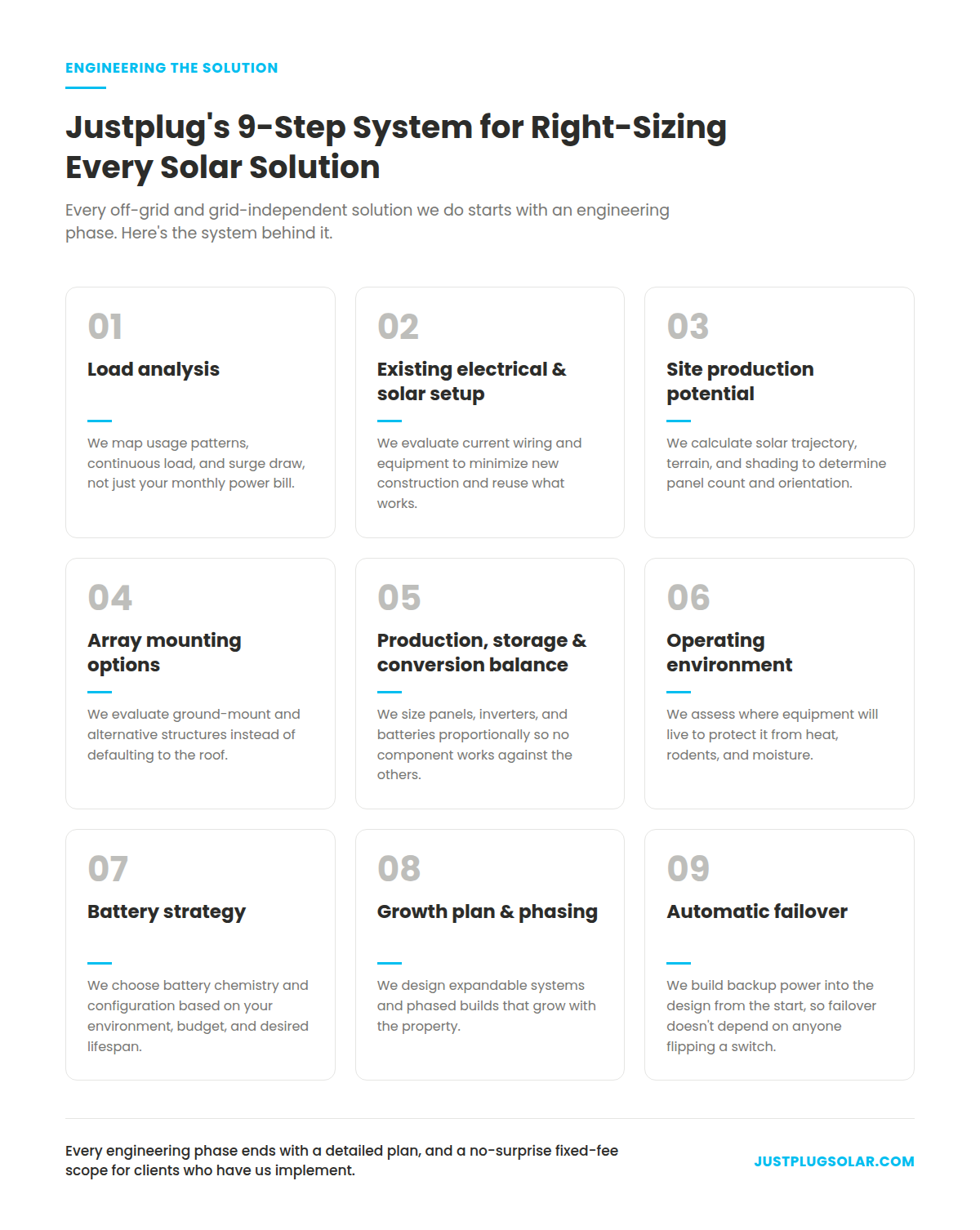
If someone tries to sell you a bag of parts without a comprehensive assessment of your load, requirements, growth plan, and existing setup — run the other way. An engineering phase that includes load analysis, terrain assessment, budget discussion, and growth plan/phasing consideration is non-negotiable for designing a dependable grid-independent or off-grid solar solution.
Then, consider your budget and funding process. What information do you need to raise the required funds? Can the vendor provide support and documentation to help you communicate to the board how you’ll use the money?
For example, we performed a comprehensive assessment for this nonprofit horse rescue, and the report formed the basis for an accurate estimate, helping the executive director raise sufficient funds without unnecessary delays.
The budget discussion may also lead to phasing considerations. For example, you can implement a full design in multiple phases based on your development roadmap and financing strategy. To do this cost-effectively, you need a long-term plan and a flexible, scalable modular system design so expansion doesn’t mean a rip-and-replace.
Also, clarify each party’s responsibility. Who will manage the project? Besides scoping and timeline, consider equipment delivery, coordination with your team and external parties, progress reporting, and post-implementation monitoring and support. If you already have a lot on your plate, a thoughtful partner can make a difference between sailing through the process and pulling your hair out.
Last but not least, not all vendors have the knowledge and experience to handle rural projects. Implementing solar in remote rural areas is a different beast, and workflows designed to slap as many solar panels onto suburban roofs aren’t suitable to handle these unique cases.
Lower long-term operating costs, protect your operations against outages, and tap into your land’s potential
Reliable owned energy infrastructure gives you energy independence unmatched by “renting” power from the utility company or jumping through the hoops to get a line extension. It puts your organization in control by boosting financial and operational predictability and resilience. Get in touch to see what’s possible.