Grid-Dependency is Costing Rural Hospitality Operators Their Peak Season
Building a business around factors you can’t control often leads to nerve-wracking moments. Relying on the grid during the fire/Public Safety Power Shutoff (PSPS) season, as your hospitality operation hits its busiest weeks, is one of those.
We get it — that’s just how things have been done. Most rural hospitality operators treat the grid as a fixed cost of doing business: pay for it, work around its schedule, and hope an outage doesn’t land when you have a big event booking.
But if you run a guest ranch, RV park, wedding barn, equestrian facility, or hunting or fishing lodge in rural California, you already know how frequent prolonged grid outages have become a growing stressor to your operations, profits, and sanity.
The root cause isn’t the grid connection, but rather a grid-dependent mindset. If you flip your thinking around so that the grid isn’t your first or only option for electricity, you can shrug at a PSPS notice.
Let’s start at the beginning and examine why grid dependency is such a big problem for rural hospitality operators in California.
The overlap: Your busiest months are also PSPS season
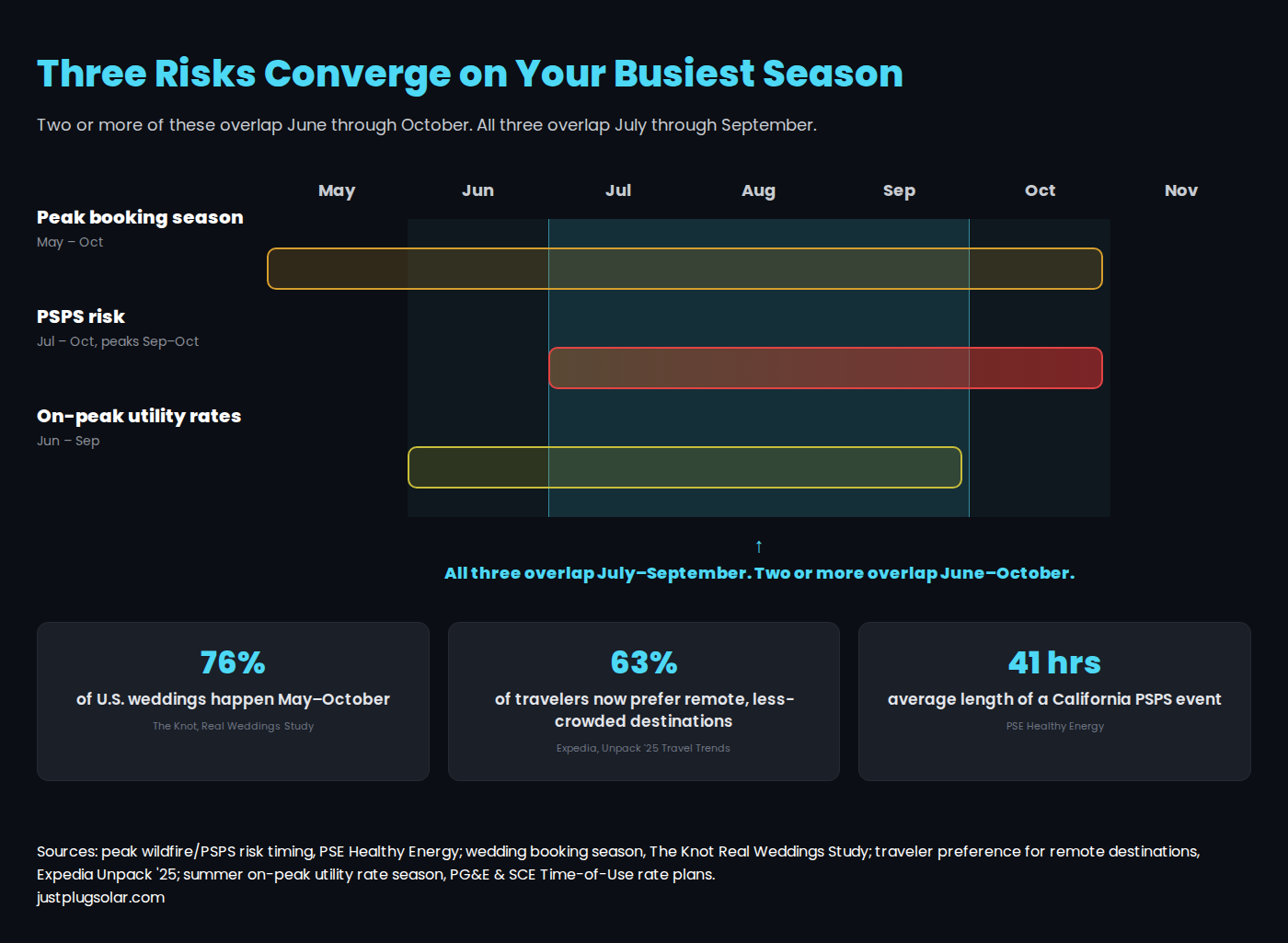
California's fire season, and the PSPS outages that come with it, have stretched from late spring through late fall. July and August carry the highest wildfire danger statewide, while September and October historically are the most dangerous months due to Santa Ana and Diablo wind events. You’re under elevated risk for half the year.
Now, map that to your booking calendar. Wedding season runs May through October, with 76% of U.S. weddings taking place in that six-month window. RV parks and campgrounds fill up over the same stretch, as do most guided hunting seasons that open in late summer and run into fall. Meanwhile, guest ranches and equestrian facilities build their calendar around months when people want to be outdoors — the same time when the grid is the least reliable.
The unpredictability of PSPS outages is costly. Without knowing how long an outage lasts, you often find yourself trapped between a rock and a hard place:
Cancel event bookings for the next five days and issue refunds, then the power comes back on in 8 hours. You lose five days’ revenue and risk your reputation.
Keep upcoming event bookings and cross your fingers. Not having power isn’t an option, so you spend more than you earn on generator rent and fuel, while worrying that the noise will impact the guest experience and the generator can’t handle the load.
This structural issue surfaces multiple times every year. You tense up with every Watch Duty notification… week after week.
Adding insult to injury
Your busiest season also overlaps with on-peak rates. That means you’re paying an arm and a leg to the utility, get no equity, and still have to worry about outages.
There’s another hidden layer: we’ve heard more than enough times that utilities don’t charge based on actual usage. Instead, they estimate from partial information. For example, a residential client received a $900 bill for a month when the grid was down for 24 days (!!), simply because the power company “projected” their usage based on the few days that the grid was up.
What do you do in that situation? Spend hours on the phone fighting with the utility? Grudgingly pay the bill so that you don’t get your power cut off? Any way you slice it, it’s an expensive PITA.
Modern guest expectations mean more is at stake when an outage hits
More consumers are seeking off-the-beaten-path experiences, with 63% of travelers preferring less crowded, more remote destinations. That demand fills your calendar every May through October, but it also makes an outage increasingly costly.
Reality check: most guests don’t plan on roughing it. Getting off the beaten path doesn't mean lowering their expectations. For example, WiFi is now the most important amenity for nearly half of North American campers. Guests measure your property against the standard of hotels or resorts they’re accustomed to. You shouldn’t expect a pass because you’re rural.
Moreover, an outage can have a cascading effect.
Picture a Friday in September: a wedding barn fully staffed for a Saturday ceremony, an RV park booked solid for a holiday weekend, or a hunting lodge filled for the opening week. Then, the PSPS notice comes. Now you have to choose between two equally not-ideal options: cancel and refund a booking you can't get back on short notice, or keep it and hope the outage doesn't last long enough to impact the guest experience.
The cost doesn't stop at the refund. A canceled event, an RV hookup without power, or a well pump that won't run means more than a lost weekend of revenue. It could mean a guest who won't rebook, a negative review that outlives the outage by years, and word that travels fast through a small, close-knit travel niche.
A generator is an expensive, reactive, stopgap measure
Most operators default to renting or buying a generator to mitigate the risks. However, this default reaction is expensive in many dimensions.
We took a closer look at the numbers: A 30 kW propane unit, a typical choice for a small- to mid-size hospitality operation, runs $28,000 to $75,000 installed, plus $600 to $1,000 a year in maintenance just to keep it from failing when you need it. PSPS events in California have averaged 41 hours, and fuel for a single event at that duration runs about $370 to $1,030.
Then there’s the operational burden: fuel monitoring, maintenance checks, and resupply logistics in a region where properties are competing for the same delivery truck the moment a PSPS notice hits. That's time and attention pulled off guests and revenue-generating work, at exactly the moment you can least afford it.
Many have been conditioned to accept these costs and stressors as a fact of life in rural hospitality operations. But that's a reactive response stemming from a grid-dependent mindset, and it's no longer the only option.
A generator may give you a false sense of security
Whether it’s the grid or a backup generator, the arrangement has a single point of failure. When one critical element goes down, everything shuts off with it. Moreover, a poorly maintained generator may even give you a false sense of security: you assume it’ll bail you out of an outage, but it won’t start the moment you need it.
The reframe: A grid-independent energy infrastructure that you own and control
If a generator doesn’t solve the root cause of the high cost of frequent outages, what does?
First, we must question the grid-dependent mindset. If grid outages don’t affect your power source, a PSPS notice is just information, rather than a scramble. With that in mind, the next logical step is implementing a grid-independent energy strategy.
Our grid-independent solar solutions flip the script, using grid-independent solar as the primary source and the grid as a backup. Unlike a generator, which sits idle when the grid is up (and you pay the utility), it works 24/7/365 and lowers your power bills. And unlike grid-tied solar, you have power regardless of the grid's status.
Additionally, we engineer our solutions for energy resilience by eliminating single points of failure. For example, we often include two or more independent battery banks in larger systems. If one of them experiences issues, it shuts off automatically to ensure safety while the system reroutes to use the other battery modules without interrupting operations.
Moreover, if a client already has an auto-start generator, we incorporate it into our solutions and wire it for automatic failover to ensure complete, uninterrupted coverage.
Hoping that the grid will stay on during a make-or-break weekend isn’t a strategy. With a grid-independent solar solution, you know you’ll have power to meet guest expectations and deliver an outstanding experience no matter what the utility does. Let’s talk.
Related reading:
How Generator Dependency Costs Rural Hospitality Operations
How Working + Guest Ranches Can Turn Remote Acreage into Revenue
Unlock New Hospitality Revenue from the Acreage in Your Estate Winery
Protect Your Winery's Hospitality Revenue with a Resilient Energy Strategy