How Generator Dependency Costs Rural Hospitality Operations
The grid goes down, you drag out the generator, and your business keeps running. All good, right?
Not so fast. While a generator keeps the lights on and your guests served, the cost can hurt your bottom line. This post examines the tangible and intangible costs of relying on a generator as your only backup option, and how to take a proactive stance to strengthen your energy resilience.
The cost of owning a generator
The cost of generators varies widely. Let’s look at a 30 kW propane unit as an example, which is a typical choice for a small- to mid-size hospitality operation.
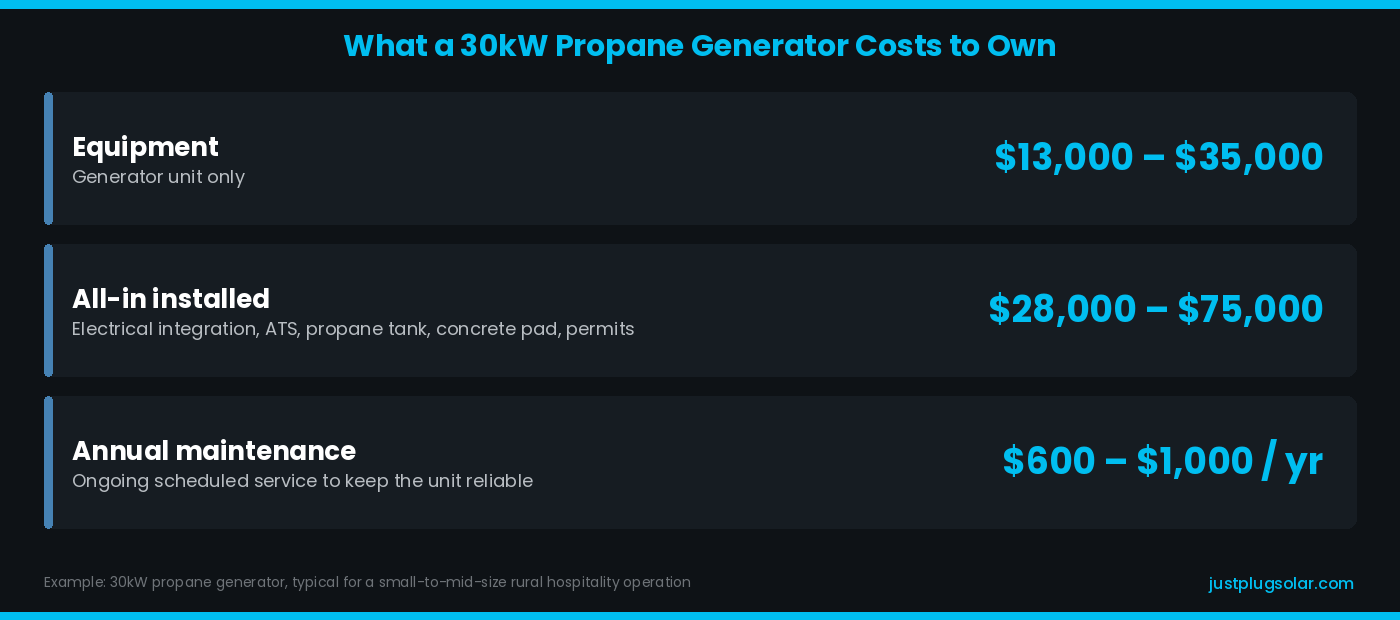
Equipment for this small commercial class runs $13,000–$35,000. All-in with installation, including electrical integration, the automatic transfer switch, propane tank, concrete pad, and permits, the final tab typically lands between $28,000 and $75,000.
Moreover, a generator isn’t reliable if it isn’t regularly maintained. A unit that sits unused for months is prone to battery discharge, starter issues, and fuel line problems. Annual maintenance is essential and runs $600–$1,000 per year.
The cost of running a generator during an outage
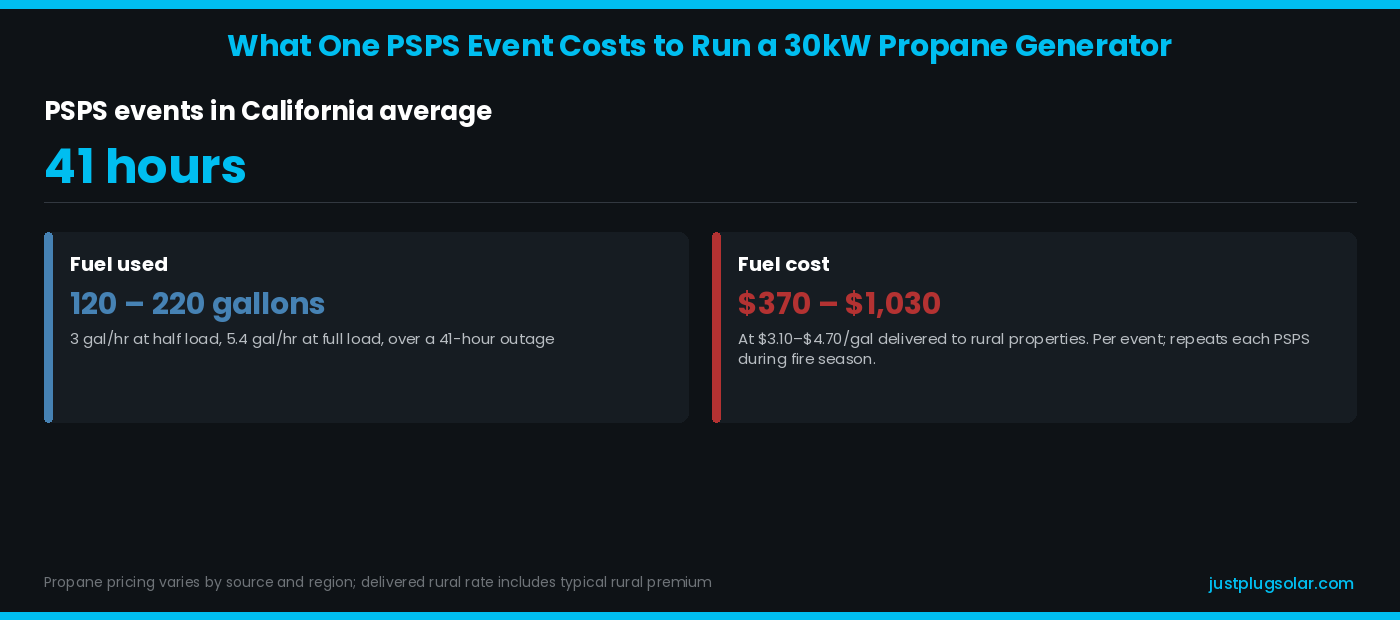
Public Safety Power Shutoff (PSPS) events in California have averaged 41 hours. A propane generator in the 30–38kW range burns roughly 3 gallons per hour at half load and 5.4 gallons per hour at full load. That’s roughly 120–220 gallons for a 41-hour outage at moderate load.
Propane price varies from $2.51–$3.42 per gallon, and rural delivery routes typically cost $0.60–$1.20 more per gallon. At a realistic delivered rate of $3.10–$4.70 per gallon for rural properties, fuel for a single 41-hour outage costs roughly $370–$1,030.
That’s for one outage. PSPS events often repeat throughout a fire season — and that cost repeats with them.
The operational load of relying on a generator as backup
For rural hospitality operators at peak season, such as a winery during harvest, a ranch during summer guest programming, or a vacation rental property over a holiday weekend, managing a generator adds to the already-demanding workload.
For example, you must perform fuel monitoring and maintenance checks while handling resupply logistics in a region where every other property is competing for the same supply during an outage. Valuable time and attention are pulled away from guests, operations, and revenue-generating activities.
Generators aren’t the only option, like they once were
We’ve been conditioned to accept these costs as a fact of life in rural hospitality operations, where grid power isn’t reliable and outages can last days. But that’s a reactive response stemming from a grid-dependent mindset, and it’s no longer the only option.
Solar equipment and battery technology have advanced by leaps and bounds. Today’s grid-independent solar solutions can support a full-property operation, providing an affordable and reliable way to boost your energy resilience.
Grid-independent solar isn’t simply a generator substitute. Unlike generators, which sit idle when the grid is up (as you pay an arm and a leg to the utility company), it works 24/7/365, lowers your power bills, doesn’t require costly maintenance, and keeps your business running without any disruptions regardless of the grid’s status.
What if you already have a generator or grid-tied solar?
Generators have their place in a resilient energy strategy. We incorporate your existing generator into your solution to maximize your investment while adding resilience.
A grid-tied to grid-independent solar conversion gives you a system that works regardless of the grid’s status, reducing or eliminating reliance on utilities.
A grid-independent solar solution is an energy infrastructure you own and control. It builds equity and helps you increase your property’s value while lowering your power bills.
Ready to explore what a grid-independent energy strategy looks like for your operation? Let’s talk.