How a Comprehensive Solar Assessment Supports a Nonprofit’s Fundraising
If you can lower power bills and protect your operations against outages with one solution, would you rinse and repeat the strategy at another facility?
It’s a no-brainer for the executive director at Lifesavers Wild Horse Rescue.
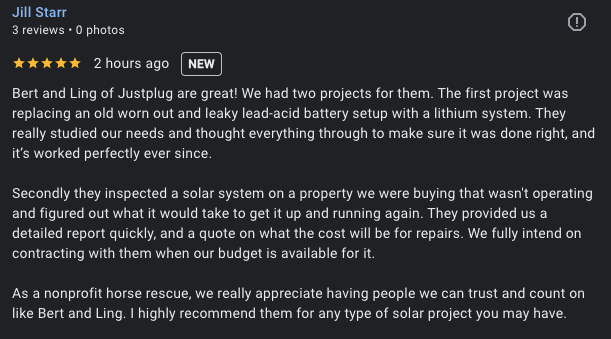
We performed a battery upgrade and system tune-up for the nonprofit’s Caliente location a couple of years ago. When they acquired a new ranch with a defunct but sizable grid-tied solar system, they contacted us to evaluate and convert it to a grid-independent system.
The system has to support a sizable residence while running equipment and well pumps for the animals. Although the conversion is well worth the money — the estimated payback time is around 4 years — it’s an investment that requires substantial funding.
The executive director had to find donors, but this could have been a chicken-and-egg problem. Without the funding, they can’t start engineering the solution. But without the details, how much do you ask for, and how do you communicate the project scope?
To bridge the gap and make informed decisions, the executive director involved us early to conduct a thorough assessment of the existing system.
A comprehensive solar assessment sets the foundation
A comprehensive solar assessment of the existing equipment and electrical setup helped us determine how best to meet the organization’s goals, such as lowering power bills and adding resilience, cost-effectively.
After an on-site inspection, we determined that the ground-mounted solar panels had over a decade of usable life left. The subsequent conversion project can reuse them to lower costs.
However, the two existing grid-tied inverters have failed, and they’re not suitable for a grid-independent setup. The existing system did not have batteries. A grid-independent solution will need sufficient storage capacity to maximize the system’s value. Additionally, the client should address several cabling issues and safety concerns immediately.
We also assessed the residence and evaluated the appliances’ power draw and surge ratings. The whole-house AC, clothes dryer, fridges, and electric stove and oven all pull significant loads. This information informed a comprehensive load analysis when we engineered a solution to meet the ranch’s needs.
Documentation and estimates support fundraising
As a deliverable for this phase, the client received a comprehensive report that would support fundraising and decision-making. They also asked us to provide a ballpark estimate to guide their efforts.
Normally, we don’t provide a quote until after the engineering phase. However, the detailed insights we gained from the assessment made this possible. In addition to a ballpark number, we provided an estimate document outlining the scope and project activities for presenting to potential donors.
Our documentation goes beyond qualitative insights — it also includes an ROI calculation based on the existing solar field’s annual yield and the estimated cost of a grid-independent conversion. A properly designed system can bring the electricity bill to virtually zero (except for the grid connection fee), and the client could expect a ~4-year payback time just from bill savings alone.
Additionally, they gain protection against prolonged outages, which are becoming more frequent in the area. They can also save on labor, fuel, and administrative costs of running generators during power shutoffs.
Getting a large donation in one go may be challenging, so we provided two options and an upgrade path. The client could start with a smaller system and upgrade later. In most cases, our modular designs make this kind of multi-year, multi-stage planning possible.
Successful funding starts with a robust assessment
Raising the right amount of funding gets the project off the ground without unnecessary delays. Our engineering-first approach, thorough assessment, and accurate estimation allow this client to do just that — they secure the amount the project needs to move forward in a few months.
In fact, when we drilled down to the details and crunched the numbers, the initial estimate was right on the dot! The project is now in progress, and we’re excited to share more as we complete the implementation.
Working with land-based non-profits means we don’t just execute. We listen and think along with you at every step of the planning and fundraising process to ensure you have the right information to move the project forward. Get in touch to see how we can help.