Client Success Story: A Hassle-Free Solar Implementation for a Part-Time Rancher
For rural property owners who live on their ranches part-time, managing an infrastructural project can be quite challenging.
Take off-grid solar as an example. Understanding the technology and equipment to make informed decisions is just the beginning. Making a two- or three-hour drive up the mountain every week, whether you want to or not, turns a weekend getaway into a chore to check off the list. Then, while you’re on the property, a work-in-progress solar system could mean you have no power at all! (And DoorDash isn’t exactly an option when you need food…)
That’s a lot of logistics to consider, and they have nothing to do with the technical aspect of implementing a system.
While we work with clients who like to roll up their sleeves, we also support those who don’t live here full-time and prefer a hands-off approach to implementing a grid-independent or off-grid solar solution. That’s how we helped this LA-based ranch owner modernize his off-grid solar system without him driving up even once during the project.
A legacy off-grid solar system
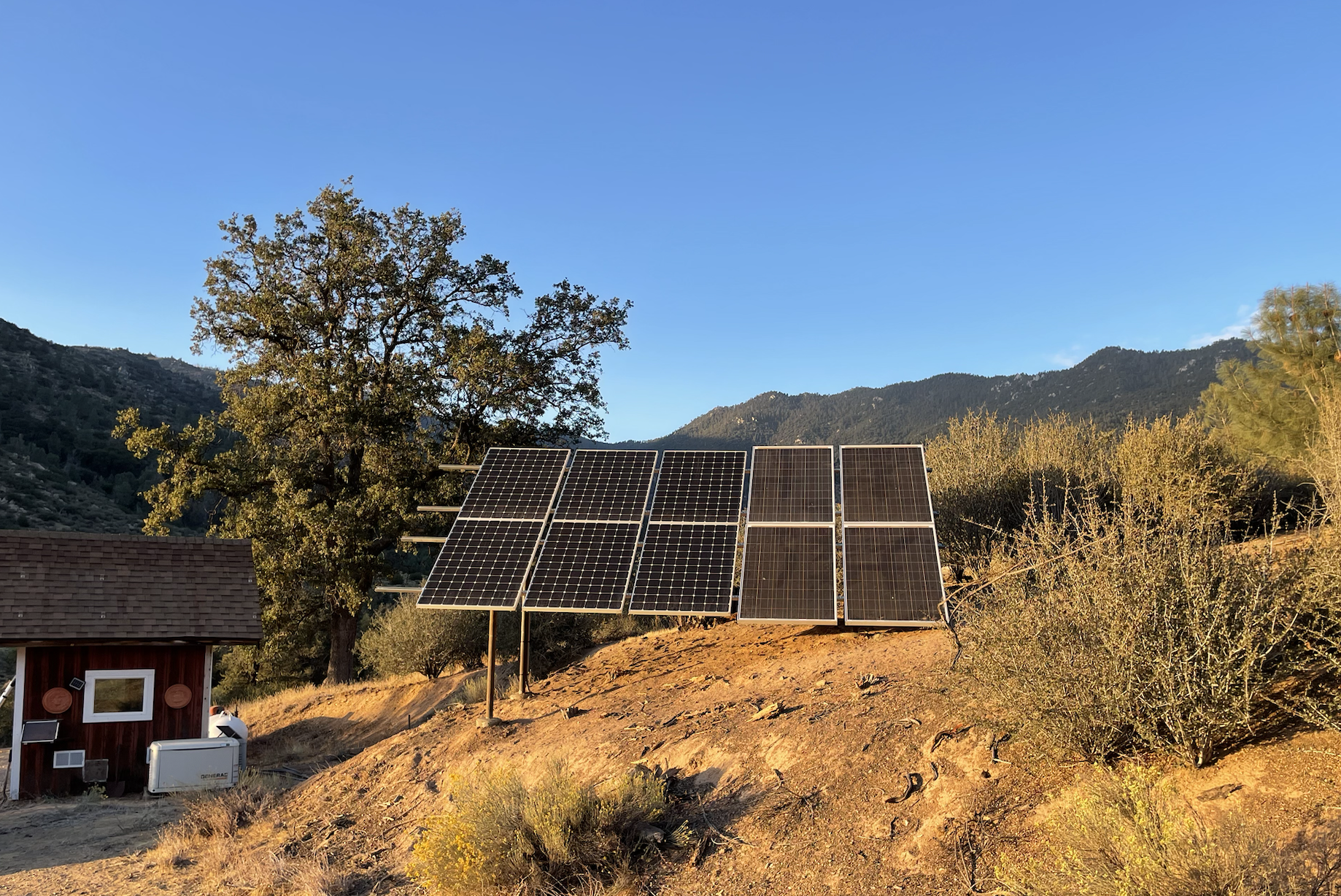
This client has a family-owned ranch in the mountains. The property had a 4,500W off-grid solar system with four panels and a lead-acid battery bank. When the owner contacted us, the solar equipment was unresponsive, and he lost power.
The system was never hassle-free, but it was enough to get by because the owner didn’t use much power and knew how to navigate the equipment. However, a weekend of outages and inconvenience during his daughter's visit prompted him to rethink the property’s energy infrastructure.
A solar assessment enables targeted improvements
When the client first contacted us, we planned for a service call to reconfigure the inverter and get the system functioning again. However, after a preliminary evaluation, we uncovered more serious issues that required a comprehensive assessment.
The inverter was at its end-of-life after about 20 years of service in a harsh environment. The equipment also showed rodent damage (a mouse literally set up shop inside the inverter!), while the previous technician failed to configure the settings to optimize battery life. As a result, even though the batteries were installed just a couple of years ago, they showed significant wear and were no longer operating at the stated capacity.
The solar panels appeared to be in good shape. However, the wiring was substandard. Additionally, with only four panels, the system is production-constrained. Although the batteries did reach full charge because the owner only visited a couple of days at a time, the setup put unnecessary strain on the batteries, especially in winter because of the panel orientation.
Moreover, our general visual inspection revealed multiple safety issues, including unsafe wiring, fire risks, vermin access, and shock hazards. These should be addressed as soon as possible and definitely before adding capacity to the system.
Understanding the client’s needs and plans
Before proposing a solution, we discussed with the owner how he plans to use the property, now and in the future. For now, he doesn’t plan to stay on the ranch for long periods or operate high-draw appliances or tools. The 4,500W system meets his current requirements — while we don’t need to add much capacity, the system should be maintenance- and hassle-free.
However, he may eventually turn the property into a nonprofit land conservation, pass it down, or put it on the market. In these cases, he may consider upgrading the system with higher inverter and storage capacities. As such, the system should be modular and expandable so adding equipment will not require a rip-and-replace.
A fit-for-purpose, custom-engineered solution
Can we repair the inverter? Most likely. But a theoretical repair would have cost multiples of a modern replacement. The equipment was near end-of-life, and a repair may extend its lifespan by just a couple of years. On the other hand, replacing it with a modern inverter + charge controller means at least a decade, if not more, of worry-free operation.
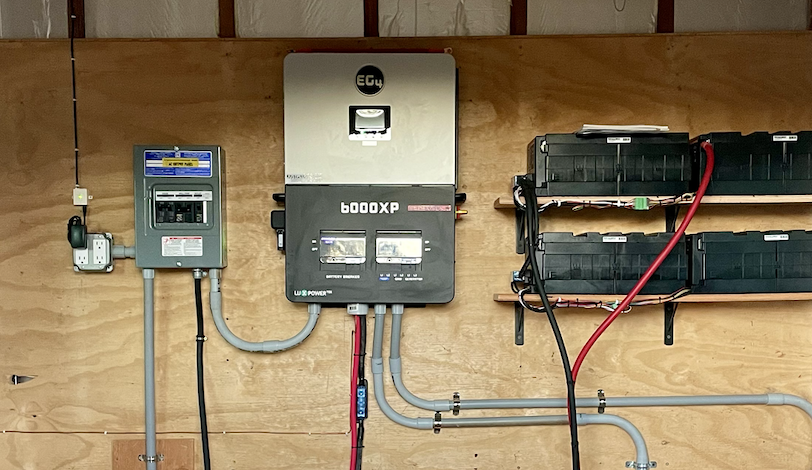
We proposed a 6,000W solution with 7.5kWh net storage capacity. We spec’d our custom cold-temperature-tolerant batteries because winter temperatures at that altitude can drop below freezing, and it would not be cost-efficient to insulate the shed enough or move the entire setup to the house to keep the operating environment above 35 degrees.
With our proprietary battery software, we don’t have to toss out the lead-acid batteries, which still have some capacity left. Rather, we add the cold-temperature-tolerant batteries to the mix for a gradual transition to an all-lithium setup while minimizing waste.
The client also decided to add six heat-resistant solar panels to the system, boosting production capacity and easing strain on the batteries to prolong their lifespan.
The system is modular and expandable for subsequent upgrades:
We can add another 6,000W inverter to double the system’s capacity and boost resilience.
We configured the equipment to accommodate a plug-and-play solar field expansion.
Our proprietary battery software lets us mix batteries of different chemistries and ages, so we can add new modules without tossing out the old ones.
Additionally, our scope includes provisions for plan B and monitoring. For example, it includes connecting the existing generator to the system and replacing the auto-start box to enhance resilience. We also included implementing an internet access extender for ongoing system monitoring.
A hands-off, worry-free implementation
The site was not immediately ready for implementation. The equipment shed needed an upgrade, and the additional solar panels required a frame. While we’re not a contractor or construction company, we work closely with local builders through our project management services.
We provided guidance for the equipment shed upgrade to ensure a satisfactory operating environment. We included a customized solar frame blueprint for the site and provided custom-fabricated mounting hardware to maximize production. We also coordinated with the builder to discuss the implementation details and help him source building materials.
We got to work after the shed was upgraded and the panels were in place. A hands-off implementation doesn’t mean the client was left out of the loop. We notified him when we went on-site and provided daily reports during implementation week, including photos, work accomplished, and remaining tasks.
Post-implementation monitoring, handoff, and ongoing maintenance
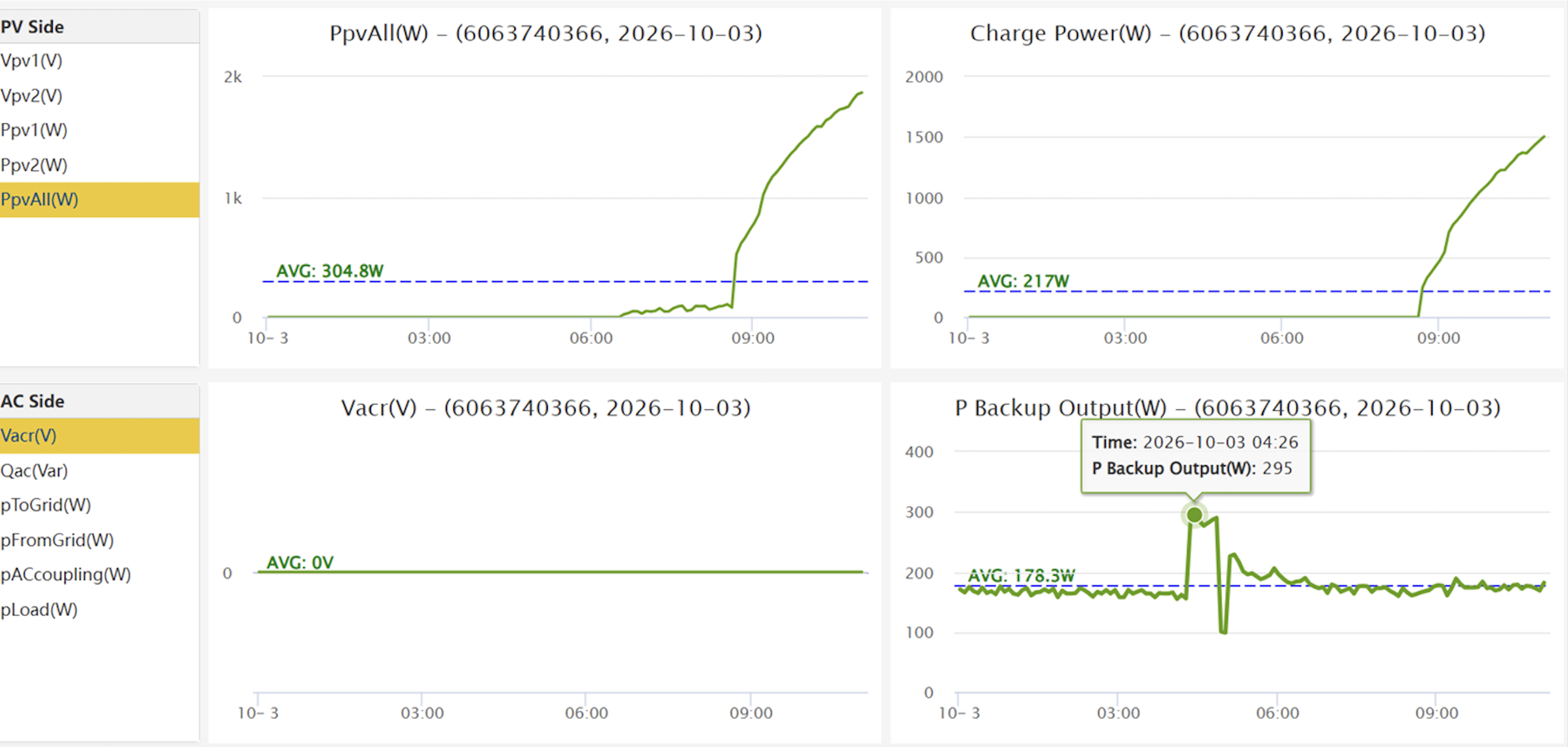
We’re not done after everything is working. Our scope included 30-day post-implementation remote monitoring — we observed the system’s behavior, fine-tuned parameters, and ensured the solution worked as intended.
Since the client doesn’t live on the property full-time, we coordinated a handoff when he was in town to walk him through the system and answer questions.
The data we’ve collected gave us unique insights to share. For example, his four old panels were not rated for high heat, and their production peaked at ~400 W (design capacity = 940 W). Meanwhile, the new ones that we provided are rated for high heat, and their production peaked at ~1,850 W (designed for 1,900 W peak under ideal conditions).
During the handoff, we also discussed ongoing monitoring and maintenance. These services are especially useful for large systems with multiple redundancies or property owners who are only onsite part-time because we check the data weekly and can spot potential issues before they impact system performance.
An end-to-end implementation that just works
A solar system implementation is an infrastructural project, and it deserves a professional, end-to-end process so that you can do it once and do it right.
We consider more than equipment and technical implementation. We discuss your schedule, your long-term plan for the property, and what you want your solar solution to do for you.
We also coordinate with builders and electricians to ensure everything from the operating environment to the connection between the solar appliances and the existing electrical circuits is done properly. Get in touch to see what “covering all the bases” looks like in a grid-independent or off-grid solar implementation.