Solar equipment was still a black box as recently as a decade ago. You installed a system and hoped for the best. You had no idea how much it produced, how much the batteries actually stored, or if the lights might go out on a cloudy winter day.
The good news is that technology has moved on. If you can check your living room’s temperature and turn on the A/C while driving home, shouldn’t you be able to see your solar system’s daily performance?
You can, with modern solar technology. Our whole-house solutions include equipment with remote access capabilities, so we can monitor system behavior, catch issues early, and adjust parameters remotely.
Clients in our proactive monitoring program also receive quarterly reports and recommendations to help them get the most out of their investment. Let’s explore the benefits of remote monitoring and reporting, and how we use data insights to help you maximize your solar investment.
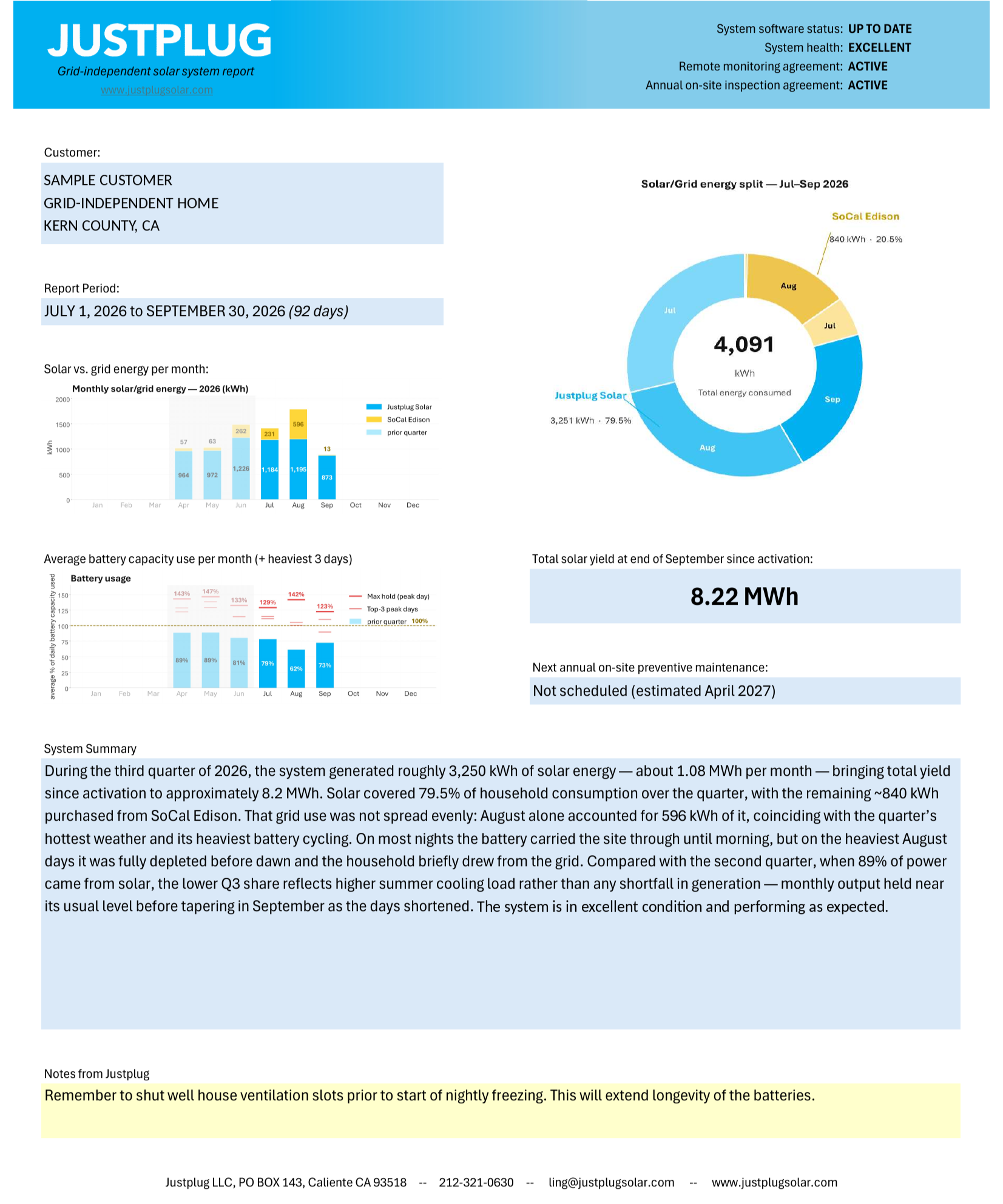
An example report for a grid-independent solar system.
The benefits of remote monitoring and reporting
We collect data and analyze telemetry on behalf of our clients to generate actionable insights. Here’s what you can gain from actively monitoring your solar system’s performance.
Catch system faults early before they impact your property
A small dip in production (e.g., a tree partially shading the PV array) may not cause issues in summer but could mean insufficient power in the winter months. When we see changes in solar production, we help you identify the problem. We also monitor battery behaviors and isolate potential issues with the energy storage component.
Using performance data to identify issues early is particularly critical for larger systems with built-in redundancies. These systems can function even when one or more components fail, and users may not notice the effects immediately. However, these issues show up in the data, and we address them before they impact the client’s daily life or business operations.
Identify non-solar issues and recommend solar-friendly habits
A jump in overnight use may point to a well pump short-cycling from a leak, a stuck heater, or a failing freezer. While these aren’t solar system issues, they affect your total power consumption. Based on usage data, we’ve helped one client catch an incorrectly wired well pump circuit and suggested solar-friendly habits to help another client maximize their investment.
Increase cost-efficiency of on-site appointments
While we can address many issues remotely, sometimes we still need to make service calls. The data insights help us make these trips more efficient. For example, we can infer what may be causing the issue and have the right parts and tools to address it in one trip, instead of two or three.
This efficiency makes a substantial difference in repair cost, since travel time, travel fees, and on-site minimum charges can add up quickly in remote locations. Meanwhile, being prepared means we’re more likely to fix the problem the first time, reducing downtime and minimizing inconvenience.
Optimize performance with curated software upgrades
Connected equipment needs software updates to optimize performance and ensure network security. However, you’ve probably experienced the “install one thing, break three things” scenario when updating software. Moreover, not every setup or use case requires every patch. We track manufacturer releases, compare them against each client’s configuration, and remotely apply releases relevant to each setup.
Adapt to seasonal or usage changes
Besides analyzing usage retrospectively, our reporting helps clients prepare for seasonal shifts. For example, we remind them to close the vents in their equipment sheds in the fall and reopen them in the spring to control operating temperature and reduce environmental stress on the batteries.
Our data analytics also help identify when a system may benefit from an adjustment. Let’s say a new family member moved in. They’re a night owl, increasing the household’s nighttime power consumption. If our reports show the client has purchased electricity from the grid at night for several months, we may suggest adding battery storage to lower power bills.
Increase property value with performance records
Our quarterly reports build a documented history of production, battery health, and maintenance. These records support real estate valuation, sales, refinancing, or wealth transfer by showing the solar system is an asset, rather than an unknown or a liability.
Offer peace of mind when you’re away
For clients who live on their ranches part-time or travel frequently, we’re their eyes and ears on the ground. Besides giving you peace of mind that everything works as intended, we address issues early to avoid unpleasant surprises when you return. After all, who would want to spend the few days they have on their property cleaning out a fridge full of rotten food, having involuntary candlelight dinners, or yelling at an inverter?
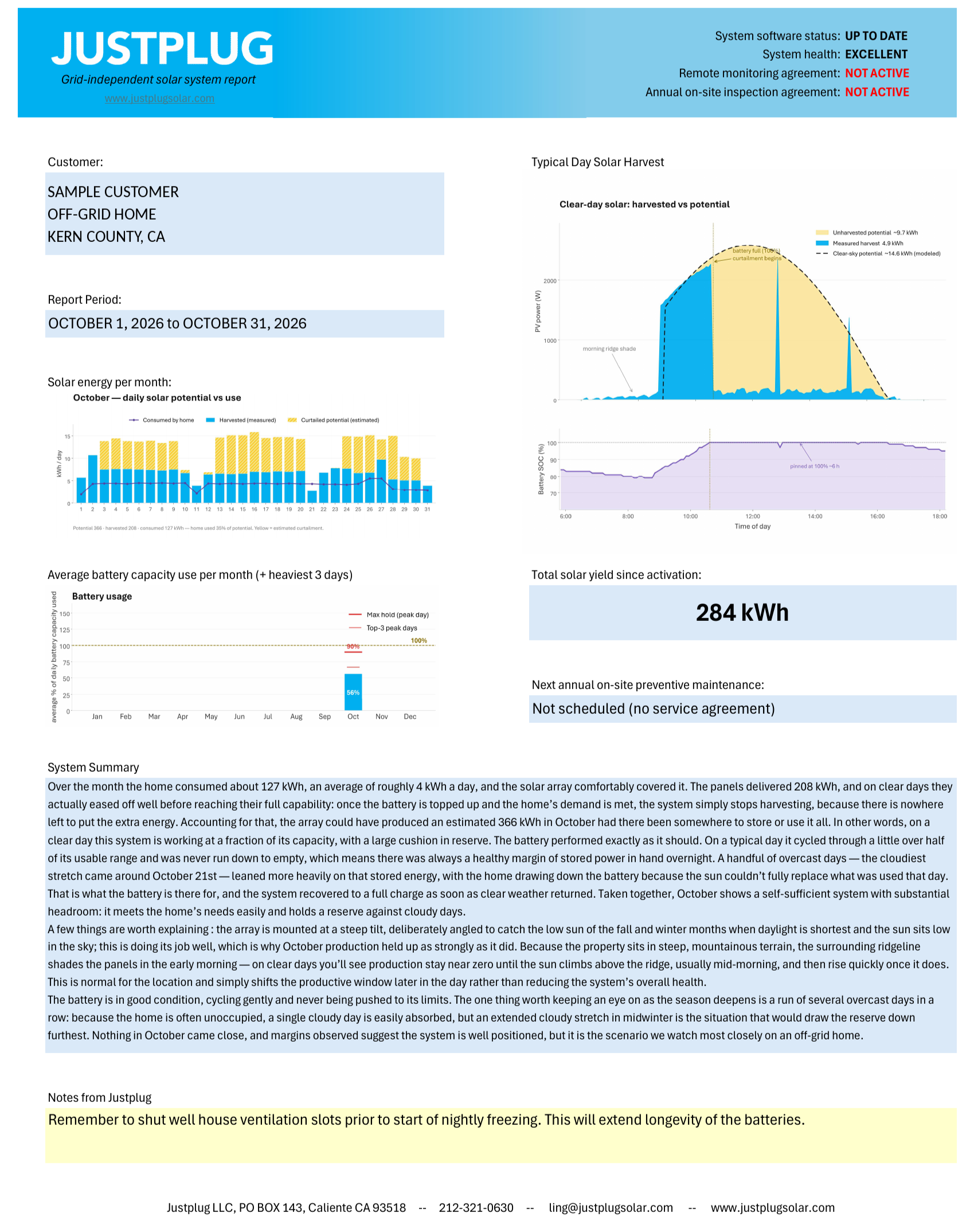
An example report for an off-grid solar system.
Justplug remote monitoring programs
Our optional remote monitoring programs focus on long-term system health and optimizing our clients’ total cost of ownership (TCO).
Tier 1: Reactive support
We keep remote access to your equipment but don’t check your dashboard on a schedule or provide a quarterly report. If you notice something is off or have a question, let us know, and we review the data to see if we can address the issue remotely at no additional cost. We also push curated software updates remotely to ensure optimal performance and security.
Tier 2: Proactive support
We check your system’s dashboard weekly (remotely) to ensure everything works properly. You can also contact us whenever you notice anything unusual or have questions. We track all software patches and updates and push a curated set to your equipment remotely to optimize performance and ensure security.
Additionally, we provide a quarterly report on system performance, relevant stats (e.g., total production, solar vs. grid power used), and recommendations. The plan includes one annual on-site system health check, during which we verify critical connections, check safety measures, inspect wiring, and measure battery health.
We recommend this program for large systems with multiple built-in redundancies, part-time residents, or frequent travelers.
What if I don’t want remote monitoring?
That’s fine, too. However, without the software upgrade service, we don’t recommend keeping your equipment connected to the internet. In this case, we air-gap your equipment, which also means that we can’t remotely access your system’s performance data. If you encounter any issues, we’ll need to come on-site for diagnostics, troubleshooting, and repair.
We’re invested in your system’s long-term health
Our monitoring programs help our systems maintain optimal performance long after we hand them off to clients. By understanding each system’s trends and patterns, we minimize catastrophic failures, which are expensive to fix, and provide personalized recommendations to help clients adapt their energy infrastructure as their lifestyle shifts or property grows.
Grid-independent and off-grid solar gives you control over your energy infrastructure. Take the first step to energy resilience: Let’s talk.