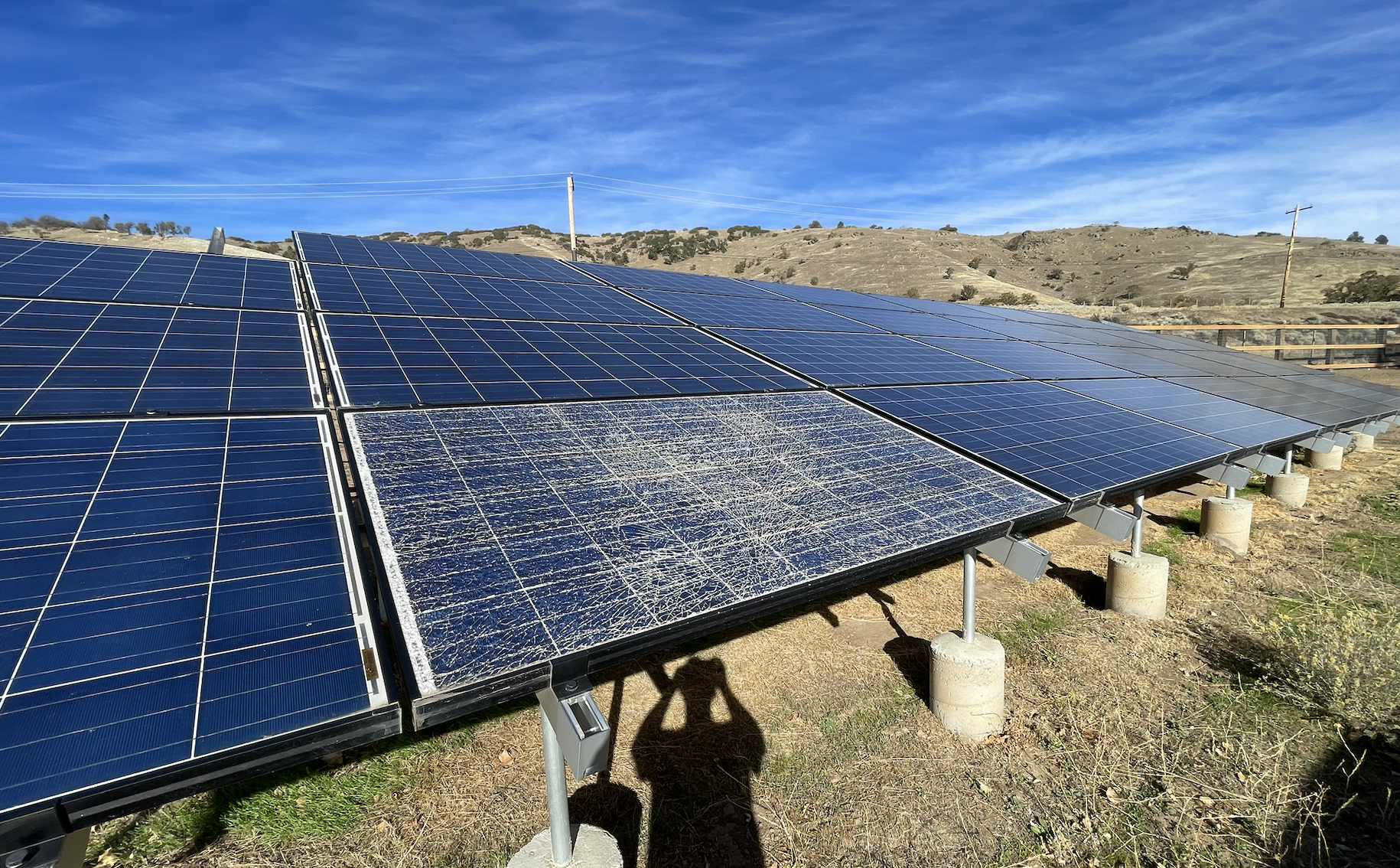
While implementing a grid-tied-to-grid-independent solar conversion project that reused the client’s existing solar panel array, we discovered one panel was shattered. The damage occurred after we assessed the system and provided the client with a fixed-fee scope.
The client asked a fair question: Can we swap the broken panel for a new one?
The reality is more nuanced. In most cases, swapping out a panel in an older array isn’t technically feasible. Let’s explore why we didn’t recommend a replacement and what we did instead.
Why you can’t “just swap in a new panel”
Without going too deep into nerd-ville, here’s a quick technical overview of PV panel performance.
Panels in a PV array should behave similarly because the lowest-performing module limits each string’s output. New panels of the same make and model have a similar performance profile, but things get complicated over time.
PV panels lose output as they age, and not evenly. NREL estimates the typical deterioration rate at a median value of 0.5% per year. Based on our experience, panels in the same field can be anywhere from 0% to 25% below their original output after a decade. Moreover, this spread doesn’t follow a predictable bell curve. Most panels age a little and a few age a lot, scattered unpredictably across the field.
A new panel won’t match the client’s decade-old panels, even if we could find the same type. Most likely, the original model is discontinued, and newer panels typically differ in voltage, size, and connectors, which must match for a swap to be possible.
How we handle an existing PV array in a conversion project
When we reuse an existing PV array, we assume the panels have aged unevenly and unpredictably. The only way to get accurate performance data is to measure each panel’s output. Then, we arrange panels with similar characteristics into the same string to maximize system performance.
Back to that broken panel. What are the options?
Just “swapping it out” isn’t practical. So, what can we do?
First, we consider the client’s setup and situation. This property has 90 panels, aka a boatload. Losing a few won’t meaningfully impact the system’s production capacity. Meanwhile, as a nonprofit organization, the client has set the budget and raised funds before the project started. A substantial cost increase at this stage would throw a monkey wrench in the works.
Two options are out the window:
Replacing all the panels would add capacity the client doesn’t need, increase the project cost substantially, and delay the timeline. With a field this large, the system already produces more than enough to meet the project’s objectives.
Adding an optimizer to each panel so it can produce independently of its neighbors. This outdated practice worked when panels were expensive. However, as panel costs have dropped significantly, adding per-panel electronics to a large field doesn’t make financial sense. Moreover, each optimizer adds a potential point of failure.
So, what did we do?
In this case, the best solution is to subtract rather than add anything.
Thinking on our feet for a contextually appropriate solution
Devising the most cost-effective solution requires understanding the engineering principles behind solar system design, along with a common-sense approach and a commitment to each project’s objectives. Our technical director is involved in every project — boots on the ground — adapting our solutions to real-world circumstances.
After measuring each panel's output and assessing the situation, we redesigned the array’s wiring on the spot based on the panels' performance data.
The field has 90 panels, wired in groups of three strings, and every string in a group must have the same number of panels. Removing the broken panel left its string one panel short. To rebalance, we removed one panel from each of the other two strings, leaving 87 panels and math that works.
Since we’ve measured and characterized all the panels, we removed the two most deteriorated ones to minimize the impact of this adjustment.
Broken panels happen, but we make repair easier. When implementing a new system, we anticipate possible repairs and maintenance. For example, instead of pulling two thick wires from the array, we pull four thinner ones (that means more work for us) — splitting the circuits at the array and combining them at the equipment. This setup gives us more options if we need to reconfigure the system in the future.
By giving up ~3% of production potential from a field that will likely generate excess power, we avoided delaying the project timeline or substantially increasing the budget. We rebuilt the field based on how the panels have aged and kept the other 87 existing panels in service. We made these decisions in the field, considering the circumstances and the project’s objectives rather than following some “lowest common denominator” procedures in a handbook.