How We Engineer Fit-for-Purpose Solar Solutions [Part 1]
Every rural property has different energy requirements. A working ranch that runs a deep well pump round the clock, a glamping site that fills up on summer weekends, and a home with three electric ovens and a workshop have varying usage patterns and seasonal demands. Moreover, each has its unique terrain, surrounding vegetation, and existing electrical setup.
A system right for one may not be right for another — even if their power bills show a similar amount.
However, the variables aren’t talked about in a typical solar conversation. Why? They matter much less in a grid-tied solar solution. When a system comes up short, the grid fills the gap. A setup that's roughly right works well enough, so a one-size-fits-most approach gets a grid-tied installer through most jobs.
On the other hand, off-grid and grid-independent systems don't have that cushion. Your system carries the load, and there's nowhere to hide when it can't. Even when a grid-independent system is designed to use the grid to run the occasional large load, an undersized design shows up clearly on the power bill: you pull far more from the utility than the solution promises, and you’re paying for it.
When a system has to stand on its own, it must be engineered for the specific use case rather than rubber stamping a stock design.
That's why we start every project by getting to know the property and its owner. Before implementing any equipment, we assess environmental factors and the owner’s requirements. Engineering is the groundwork for building a fit-for-purpose system, so you don’t end up with a collection of parts that may or may not deliver.
The engineering phase sets the foundation
The engineering phase starts with a requirement-gathering exercise. We look beyond your monthly power bills and consider surge power ratings, usage patterns, periodicity, and seasonality to properly size production (i.e., solar panels), inverter capacity, and storage (i.e., batteries).
For example, if you buy too many panels but don’t have the right inverter, you’ve paid too much for production capacity and still fail to get the power you need.
Make no bones about it — this process can be annoying for people expecting that we’d just swoop in, put some panels on the roof, and leave them alone. But if the goal is a system that works independent of the grid, we need to know how you expect it to perform.
Properly dimensioning the solution is the most cost-effective way to get the most out of your investment without sacrificing your priorities and lifestyle.
Additionally, a well-engineered solution ensures that the implementation process goes as smoothly as possible. The insights into not only the client’s requirements but also the site conditions allow us to create a detailed implementation plan.
For example, we create a detailed bill of materials, identify when a client will need to hire a contractor or electrician, and sequence the involvement of each party. That plan, in turn, enables us to provide a no-surprise fixed-fee scope in most cases.
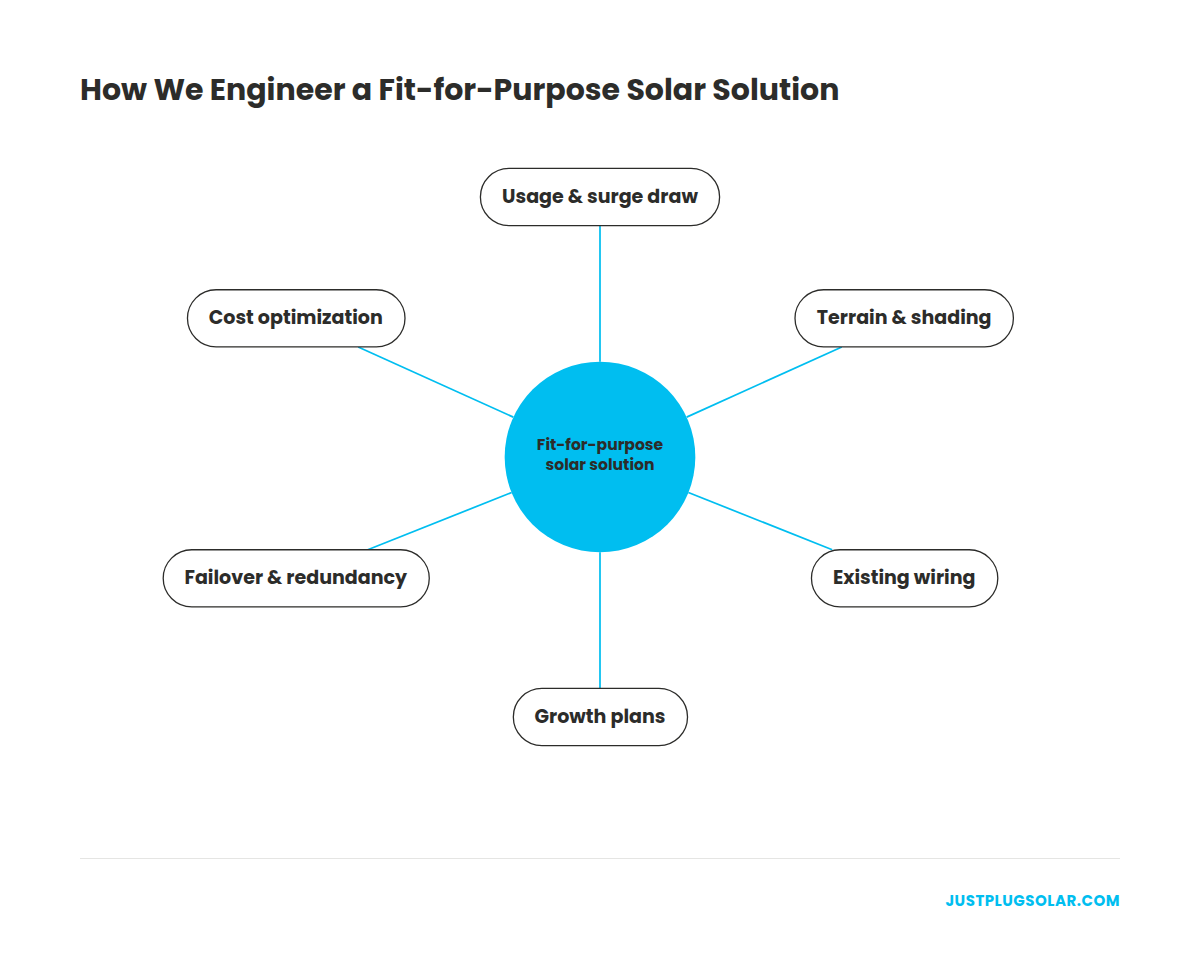
What we address in the engineering phase
Here are some examples of what we cover to design a fit-for-purpose off-grid or grid-independent solar solution:
For an existing ranch house that’s already on the grid, we may analyze the power bills, surge and startup draw, continuous load, seasonality and periodicity, and more.
For a blank-slate off-grid development, we may discuss with the client the location of various structures, their usage, lifestyle preferences/business goals, and more.
For a property with existing solar, we evaluate the equipment and setup to identify the most cost-effective way to achieve the project’s objective.
We may discuss the client’s vision for the property and their growth plan to design an expandable system and a phased approach to meet current and future needs.
We evaluate existing electrical wiring and weigh potential trade-offs to minimize electrical and construction work (e.g., trenching).
We consider the system holistically, balancing production, storage, and conversion capacities to maximize component longevity and ROI.
We calculate the site’s solar trajectory, evaluate the terrain, and consider shading from buildings and vegetation. Then, we determine panel count based on annual and seasonal production requirements.
We may measure a client’s usage patterns in detail to identify opportunities to lower system cost without compromising the project’s objectives.
We may evaluate the client’s proposed location for housing the solar equipment and provide recommendations to ensure a safe and effective operating environment.
We evaluate the property’s “plan B” setup (e.g., grid connection or a generator) to incorporate automatic failover and redundancy into our solution.
In part 2 of this series, we examine these activities in detail to show you what’s involved.
You can also take the plan and run with it
Our clients receive a detailed plan to inform implementation. Those who have us implement the solution will also get a no-surprise fixed-fee scope.
But what if you’re not in our service area? The document has the information you need to hire a local technician or go the DIY route. We can provide guidance at every step to ensure a smooth implementation. Learn more about our remote consultation services or get in touch to see how we can help.