Client Success Story: A Phased Off-Grid Solar Solution Built to Scale
Buying raw land and building a dream property from scratch is exciting and empowering — but also intimidating. Basics we take for granted, such as water and power, aren’t there.
However, a property with no grid connection doesn’t have to be a liability. On the contrary, it may actually be the cleanest starting point for a resilient energy infrastructure because you don’t have to work around legacy components, untangle grid contracts, or jump through hoops to get a utility company’s permission.
When this client bought their property, being fully off-grid didn’t scare them. They got to work and contacted us to design and implement an off-grid solar solution that will support their interim arrangement and scale when their house is in place.
A phased approach prioritizing the total cost of ownership (TCO)
The client lives in a fifth-wheel RV on the property part-time as they build their ranch. They wanted a standalone off-grid solar solution to run their well pump, tools, and trailer. The system should provide the flexibility to accommodate future expansion (e.g., a house) without costly overhauls or redesign.
Most importantly, they want to do it right so that when the house is done, they can build on their investment rather than tearing things down and starting all over.
We proposed a 48V system from the get-go. While it costs more than a 24V one, it sets the stage for a whole-house solution, allowing the client to reuse most components and come out ahead in the long run.
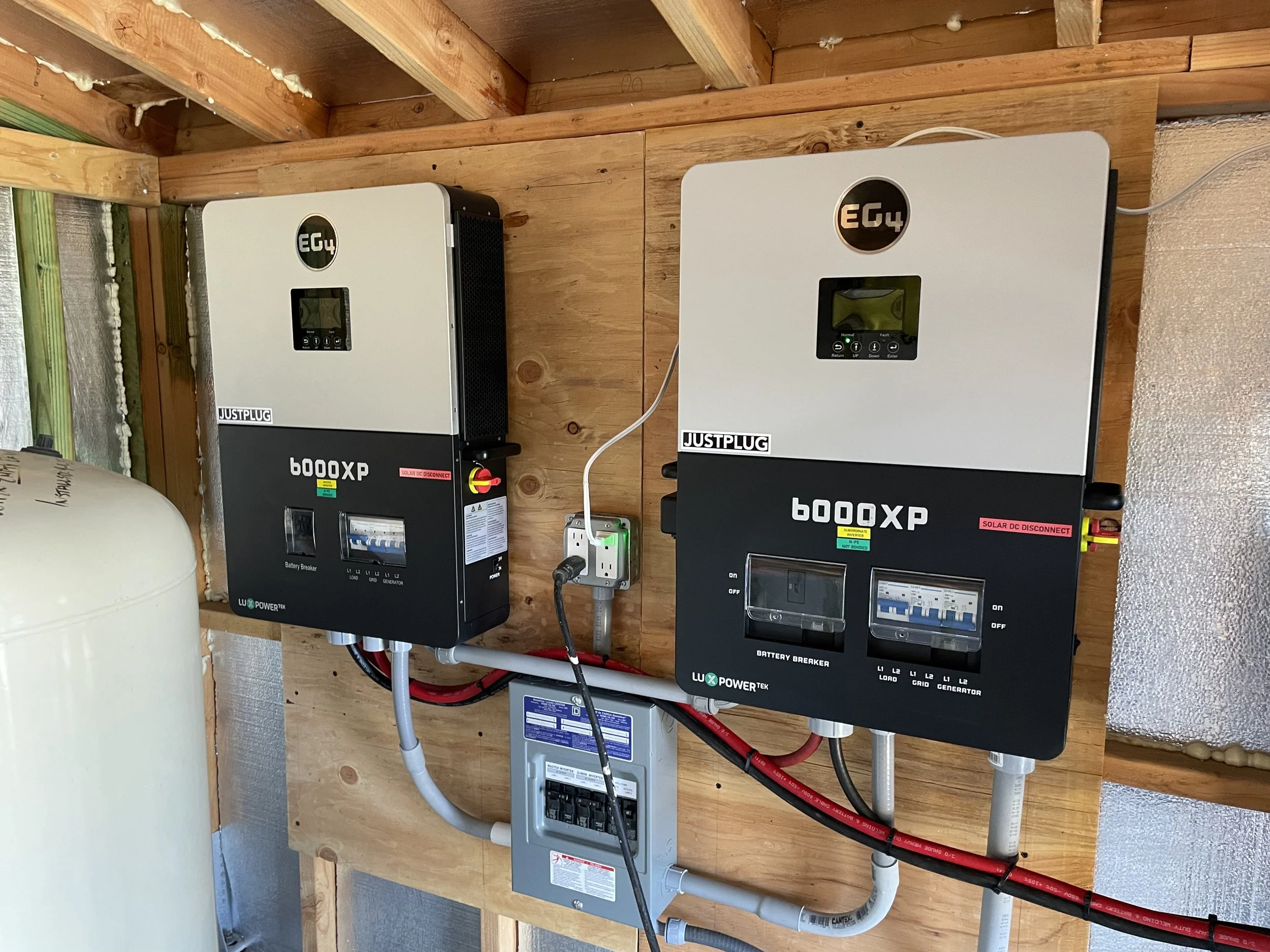
The initial proposal for phase one included eight utility-grade solar panels, two 6,000W inverters with built-in solar charge controllers (SCCs), and a cold-tolerant lithium cobalt battery pack (~ 7.1 kWh) custom-built with our proprietary battery technology. The batteries and inverters will be wired in parallel for additional resiliency.
Phase 1.5: Rolling with it when the client is ready
The client turned out to be a rock star in the construction department. They not only built one of the best pump houses/solar equipment sheds we’ve seen, but also ran the cables from where they planned to mount the solar panels permanently to the shed.
Instead of temporarily securing the solar panels next to the pump house as initially planned, they’re ready to build the panel frame. With their future expansion in mind, we provided them with a ground-mount solar frame blueprint and a custom-fabricated mounting kit for 22 panels. While they were at it, the client purchased 14 more panels and completed their array.
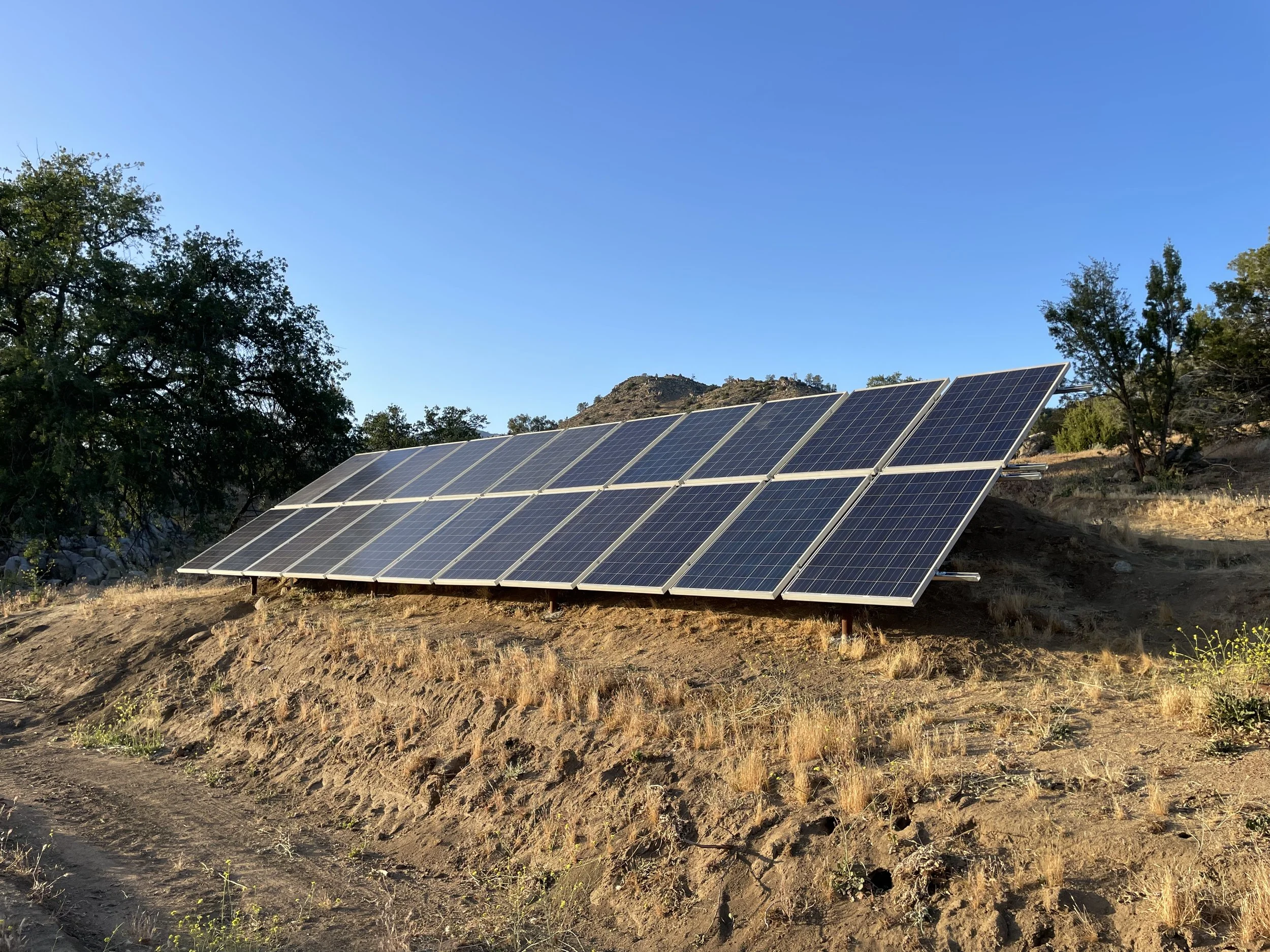
This addition brought the initial implementation to 22 panels, two 6,000W inverters, and ~ 7.1 kWh of battery capacity.
Wait, aren’t the production and inverter capacities out of proportion with the storage capacity?
Fair question. And the answer is “yes” if this were a typical, less dynamic situation. However, since the client is in building mode, the imbalance actually makes sense.
Building a frame for 22 panels costs more time, effort, and money than building one for 8 — but only marginally. It’s more cost-efficient to have all the panels mounted in one go.
Panels, especially utility-grade ones, have a long lifespan. The extra year on the frame doesn’t materially affect the system’s big-picture longevity.
Using one 6,000W inverter for now and adding another one later is theoretically possible. However, if the manufacturer discontinues the equipment or launches a version incompatible with the existing one, expanding inverter capacity could become a nightmare.
22 panels and 12,000W inverter capacity (with a 24,000W surge rating) will allow the client to run most power tools during the day. The extra capacity that’s disproportional for typical household usage may just be what they need at the moment.
~7.1 kWh of storage capacity is modest, but more than enough for current nighttime use. Batteries are the most time-sensitive asset as they degrade/depreciate over time. Buying excessive capacity is a poor use of resources.
Our proprietary battery software enables us to mix cells of different ages and chemistries. When the house is ready, the client can add storage capacity without tossing out the existing pack.
Rather than a piecemeal or one-size-fits-all implementation, our solution meets current requirements and sets the stage for expansion with minimal waste, optimizing the client’s long-term TCO.
Get an energy partner, not just a “solar installer,” in your corner
Your energy infrastructure should grow with you. However, most solar installers have a “schlep solar panels on your roof (doesn’t matter which way it points), take your money, and never see you again” one-off approach. They don’t talk about your plan or TCO.
We do solar differently — from the ground up, based on your needs, and be there with you every step to build energy resilience in a rural environment we love. Our whole-property off-grid solar solutions support full-capacity living and infrastructure-level performance for homeowners who want to do it once and do it right.