Reliable Power for Every Corner of Your Ranch
Ranchers are a tough bunch. Many have been making things work with limited resources for generations — but it doesn't mean you have to put up with frustrations, inefficiencies, and externally imposed limitations when you don't have to.
For example, hauling a generator to remote well pumps or handling pens was the cost of doing business, but it doesn’t have to be anymore.
“We’ve looked at off-grid solar a decade ago. The systems were clumsy, expensive, and unreliable. So-and-so down the road installed one in their shed — the batteries died two years later, and it cost them several thousand dollars for new ones. We decided to stick with a generator and the good old extension cord,” you may say.
But things have evolved. Off-grid solar technology has advanced by leaps and bounds, and setting up a reliable system makes financial sense even for smaller operations.
Meanwhile, the grid-power equation has changed. With frequent, prolonged outages in rural areas, being on the grid doesn’t mean you’re in control. When the grid goes down, it takes all the equipment down with it — and you’re hauling a generator around all day just to keep things running.
The good news is that you don’t have to cut the cord. Grid-independent solar slashes power bills and protects grid-tied operations from outages. The solution operates independent of the grid while using it as a backup option (e.g., to run an occasional large load so you don’t have to pay for that solar capacity) — giving you the best of both worlds.
Let’s see how off-grid and grid-independent solar addresses specific challenges that ranchers may face when neither a generator nor grid power is the ideal solution.
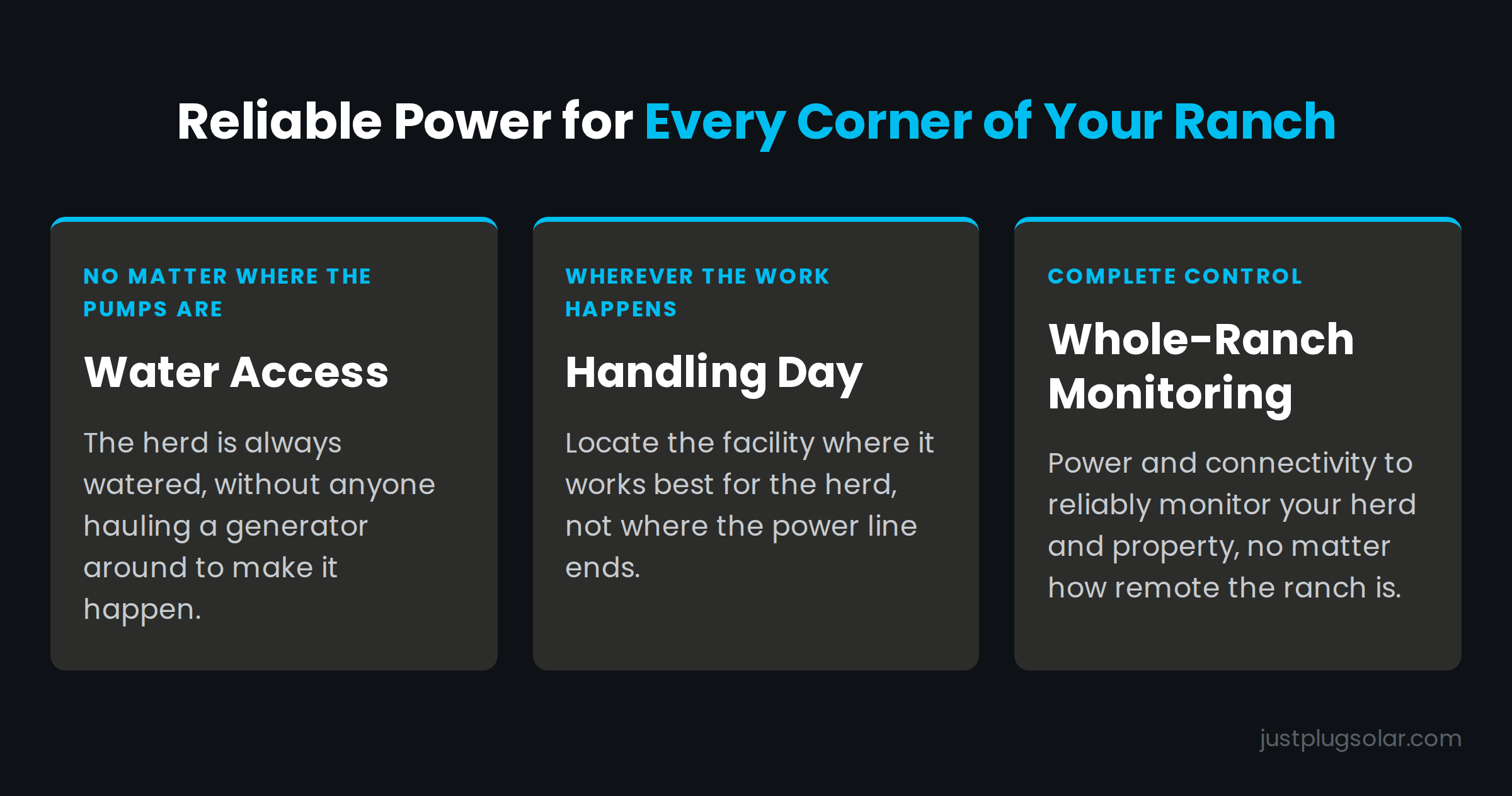
Reliable water supplies no matter where the herd is
A well pump out in the pasture needs a power source. You might have a ranch hand making the rounds every day with a generator to get water into the stock tank. Let’s say a ranch hand makes an average of $40,000 per year, and they spend half their time hauling and babysitting the generator. That’s $20,000 per year of labor before fuel, hardware, and maintenance costs.
An off-grid solar system keeps a pump running. But there’s a caveat. Many “solar pump kits” on the market aren’t battle-tested for reliability and longevity, and we generally don’t recommend them for business-critical applications. Read on to see how best to build a solution you can count on.
What about the pumps wired to the grid? During an outage — Public Safety Power Shutoff (PSPS) events in California average 41 hours and happen mostly on hot, dry days — everybody could spend the whole day hauling generators around the ranch to keep the herd watered. That gets old real quick.
Moreover, consider the cost of running a 2- or 3- horsepower pump round the clock. The electricity bill is no fun, especially since the time of day you need water most is when the rates are the highest. Combine the high cost with frequent rate hikes that sneak up on you, and your bottom line is at the mercy of the utility company.
A grid-independent solar solution solves both recurring expenses and frequent outages. It’s an owned energy infrastructure that you control. You use the power you generate for day-to-day operations, and the system works regardless of the grid’s status. When the grid goes down, your ranch runs uninterrupted without anyone yanking a cord or flipping a switch.
Optimal conditions and reliable power for handling day
Electric branding irons, dehorners, clippers, refrigeration for medicine all need power. Yet, chutes, scales, and livestock corrals are best located where the herd is worked, not where the power line ends. Often, ranchers are back to the good old “hauling the generator” method. That works, but with a caveat.
Research found that cattle agitated in the chute have significantly lower weight gains, tougher meat, and more carcasses downgraded at the plant. Something as simple as a loud clanging bell was enough to raise a calf's heart rate by 50 to 70 beats per minute — imagine the impact of generator noise, even with an extension cord (which also reduces efficiency and poses fire hazards).
Off-grid solar allows you to locate your handling facility wherever works best for your operations. Not to mention, it’s quiet — the low hum of the equipment is negligible compared with a generator, and virtually imperceptible if you house it in an equipment shed.
Whole-ranch internet, security, and herd monitoring for complete control
Advanced monitoring technologies allow ranchers to keep an eye on their herds and properties, but they still require reliable connectivity to deliver on their promises. On remote ranches where cell service is sparse or nonexistent, you need power to run a Starlink dish, routers, and access points for wide-area coverage.
Then, you also need power for the cameras. “What about solar security cameras?” Affordable ones are designed for a suburban customer base, with an electrical outlet nearby and a WiFi router within 50 feet. Plus, most aren’t built for the rural environment where heat, dust, and wind are the norm.
So, there comes the tradeoff between reliability and cost. Yet, a temperamental setup is, at best, a poor use of money and, at worst, gives you a false sense of security.
This is where establishing a holistic strategy truly pays off. Our whole-ranch, engineering-first approach can help you align power generation and internet connectivity, with the off-grid solar solution doing multiple duties to maximize your investment.
Let’s see how we set a solid foundation for building a fit-for-purpose solution for every client.
Do it once, do it right with an engineering-first approach
We sometimes hear people say, “I can just put a solar well pump there, install a DIY solar kit on that shed, and put another solar kit over there.”
The reality is that these lower-cost, piecemeal solutions often aren’t reliable or designed for longevity. For example, many solar well pump kits use lead-acid batteries that last three to five years max (if they’re pampered… and what are the chances when they’re in the pasture?), while “off-grid solar kits” limit what you can do with a predetermined capacity.
Additionally, a poor operating environment susceptible to heat, dust, and rodent intrusion accelerates equipment deterioration. A couple of years in, things start to break, and you find yourself plugging 13 holes with 10 fingers.
We’ve done the math: A larger, well-designed system that serves multiple applications is more cost-efficient than several smaller, less thought-through ones. A reliable solution doesn’t come cheap, but you will make your money back many times over when you plan it right to make the most of your investment.
For example, instead of building several low-cost systems, we help our clients explore opportunities to consolidate their energy infrastructure and achieve the lowest total cost of ownership (TCO) over a long-term time horizon (e.g., 10 to 20 years).
Learn more and get in touch to see what an owned energy infrastructure can do for your ranch.