When Heat Waves, Peak Rates, and Outage Risks Hit All at Once... Are You Ready?
Running a farm isn’t a stroll in the park. Take almond growers as an example: they need to bring in roughly $2.30 per pound (about $5000 per acre) to break even. However, the 5-year price back to growers only averages $1.77 per pound. And that’s assuming you have good water and no debt.
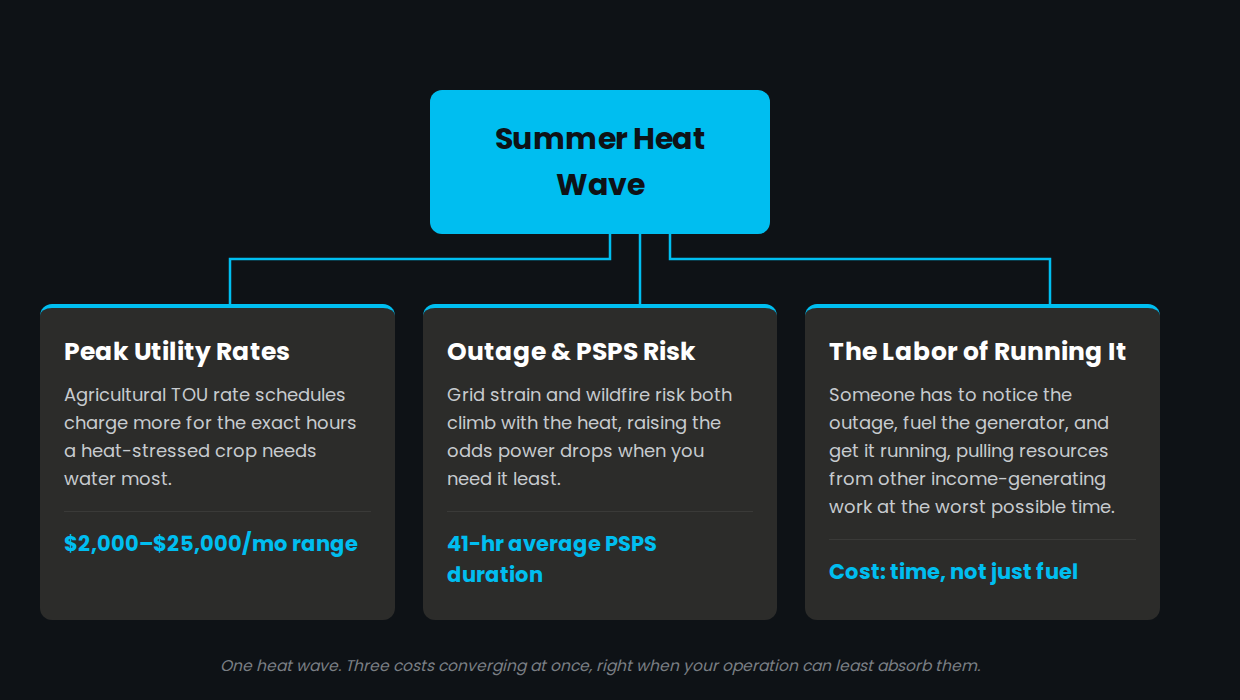
A power outage at the wrong time can cause substantial damages, destroying what thin margin you already have. That wrong time, for most Kern County and Central Valley operations, is a summer heat wave — exactly when peak utility rates, outage risks, and high refrigeration demand converge.
Grid demand and irrigation overlap during a heat wave
Heat waves push the entire regional grid toward its limit, increasing the risks of outages or brownouts. Meanwhile, farms must run their pumps harder and longer to meet irrigation demand caused by the extreme heat.
Adding insult to injury, farms in Central and Southern California must contend with frequent, prolonged Public Safety Power Shutoffs (PSPSs) during the same period. These outages average 41 hours, and the consequences can be devastating if irrigation stops.
The utility rate structure works against you in the same window
Even if the power stays on, irrigation during extreme heat is costly. Both major California utilities run agricultural rate schedules built around time-of-use (TOU) pricing — PG&E's AG-4 and AG-5 options, for example, reward shifting irrigation to off-peak hours, typically before 8 am or after 9 pm.
But what about the time when heat-stressed crops need water most? Power costs a lot more during these peak hours. Ouch.
Farms, vineyards, and agricultural operations with irrigation and processing loads can see monthly power bills from $2,000 to $25,000, depending on operation size and demand, with peak-hour usage doing outsized damage. Running a single irrigation pump during a summer peak period can rack up several thousand dollars a month in energy and demand charges, at blended rates well above the national average per-kWh cost.
Bottom line: the same heat wave that spikes your irrigation needs also skyrockets your power bills. And you still need to worry about PSPSs.
Then, you have to worry about cold storage interruption
Irrigation has some flex, but cold storage doesn't work that way. For produce growers, the same heat wave that drives up utility rates and irrigation demand is also the moment your walk-in cooler or packing shed can least afford to lose power.
While the thermal mass of farm-scale cold storage can give you a few more hours of leeway than a home fridge (with a safe window of about 4 hours unopened), it is unlikely to tide you over an average PSPS, which could last 41 hours. When cooling stops, the clock starts ticking in the summer heat.
The fallacy of relying on a generator when heat waves and outages are a fact of life
Most farms have a generator to keep the essentials running during an outage. However, with the increasing frequency of heat waves and outages, that backup strategy makes less and less financial and operational sense.
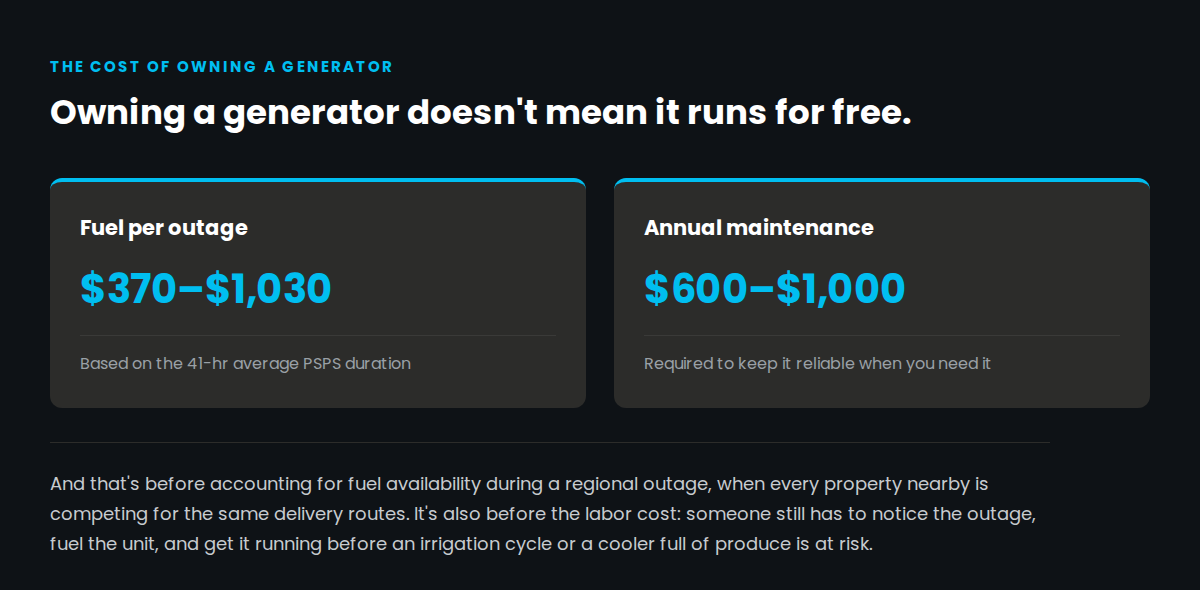
First, let’s look at the cost of running a 30kW propane generator. Propane costs $2.51–$3.42 per gallon, and rural delivery routes typically cost $0.60–$1.20 more per gallon. At a realistic delivered rate of $3.10–$4.70 per gallon for rural properties, fuel for a single 41-hour outage costs roughly $370–$1,030.
Even if you’re willing to pay, you’re competing with other businesses and residences in the area for the same supply and delivery schedule. Whether you can get the fuel you need when you need it is a question mark. Moreover, to ensure a generator runs when you need it, you must perform annual maintenance that costs $600–$1,000 per year.
Then, there’s the labor involved in running a generator. When an outage hits, someone has to notice the outage, drop what they’re doing, fuel the generator, and get it running. If the outage occurs during a busy time at the farm, you’re pulling resources from other income-generating activities. And if someone doesn’t react promptly, food preservation and irrigation could be at stake.
A permanent solution for the heat wave + peak rates + outage risks triple whammy
We’ve been conditioned to accept the tangible and intangible costs of using generators as backup as a fact of life, but that’s no longer the case. When you set up your solar system as a grid-independent solution, it slashes utility bills and protects your operations against outages.
Grid-independent solar isn’t a backup solution, unlike a generator. The system runs your operations 24/7 and works regardless of the grid’s status. The summer clear skies and long days in California’s Kern County and Central Valley are particularly advantageous for solar production when cooling needs and utility rates are the highest.
Our 9-step engineering methodology tailors every solution to each property’s requirements. We consider your equipment’s power consumption, irrigation cycles, cold storage requirements, peak season demand, and more to design a solution that meets your needs.
Learn more about our farm-specific solution or get in touch to see what energy resilience can look like for your farm.