The Nuances of Engineering a Whole-Ranch/Whole-House Off-Grid Solar Solution
Off-grid solar has many applications. We’ve implemented solutions for anything from an RV and a shed to an entire ranch with multiple buildings. The common misconception we’ve seen/heard is that “This setup works for my shed. If I just double/triple/quadruple everything, it will work for my house.”
That’s a disaster waiting to happen.
A whole-property solar solution not only uses different equipment and components. It must also consider how the constraints, priorities, and risks change dramatically as a system scales.
For one, you can’t say, “I’ll wait till I get home to do X.” Nor is a hiccup that causes everything in the fridge(s) to rot anywhere close to acceptable. What’s somewhat okay in a temporary setup, such as an RV, may not work for a home.
Additionally, oopsies multiply and amplify when you scale (anything). A mistake that doesn’t impact a smaller system could cause issues in a large one.
Here’s what we consider when designing a whole-ranch/whole-house off-grid solar solution and how it differs from smaller systems:
Whole-house off-grid solar solutions require a different design + engineering mindset
In a shed, RV, or weekend cabin, temporary outages are manageable. You can delay usage, restart equipment, or just wait for the sun: call it a nature experience or roughing it (a bit). However, when you scale up to a full-time residence or multi-building ranch, the design objective changes completely.
The system must handle continuous loads, demand spikes, seasonal variations, and real-world contingencies automatically without a hiccup. It should also have built-in redundancy and resilience to eliminate single points of failure wherever possible.
Here’s the straight talk: Scaling off-grid solar isn’t linear. Doubling panel count doesn’t double capability, and system complexity grows faster than power demand. Here’s what happens when loads increase in a whole-ranch situation:
Simultaneous usage rises.
Surge events multiply.
Storage needs grow disproportionately.
Failure consequences become costly.
Strict safety protocols are not optional.
Everything must be carefully dimensioned based on specific loads and usage patterns. You can’t solve that by stringing together ten DIY kits from Amazon.
Additionally, the currents involved in a large off-grid system are much higher than what a typical electrician encounters. For example, this implementation can draw up to 1,000 amps under normal operations. A mistake is not just an oopsie… It’s a flash bang and a trip to the hospital.
Critical design considerations for whole-property off-grid solar solutions
Here’s what we consider when designing whole-ranch off-grid solar systems, and how they differ from smaller setups.
A complex load profile goes beyond total watts
It’s often enough to consider total daily watts in smaller systems. However, for larger properties, simply adding up the total watts from all the appliances isn’t practical.
For example, there’s a close-to-zero chance that an electric clothes dryer, five air conditioners, three electric ovens, four power tools, and the well pump will be turned on simultaneously. If you dimension a system for that level of continuous power, you’d have tens of thousands of dollars’ worth of idle capacity doing nothing 99.9% of the time.
Doable, of course, but not smart at all.
Instead, we model load behaviors in three dimensions:
Continuous load. Always-on appliances and devices, such as refrigerators, Starlink, routers, HVAC systems, etc. These form the system’s baseline demand.
Surge load. Motors, pumps, compressors, and power tools draw several times their running wattage at startup. Large properties may run multiple motor loads simultaneously, and surge capacity becomes a primary engineering constraint.
Periodicity. Loads don’t occur evenly throughout the day. Kitchens spike mornings and evenings. Irrigation runs at set times. Workshops may create short but intense demand windows. Designing around when power is needed is just as important as how much.
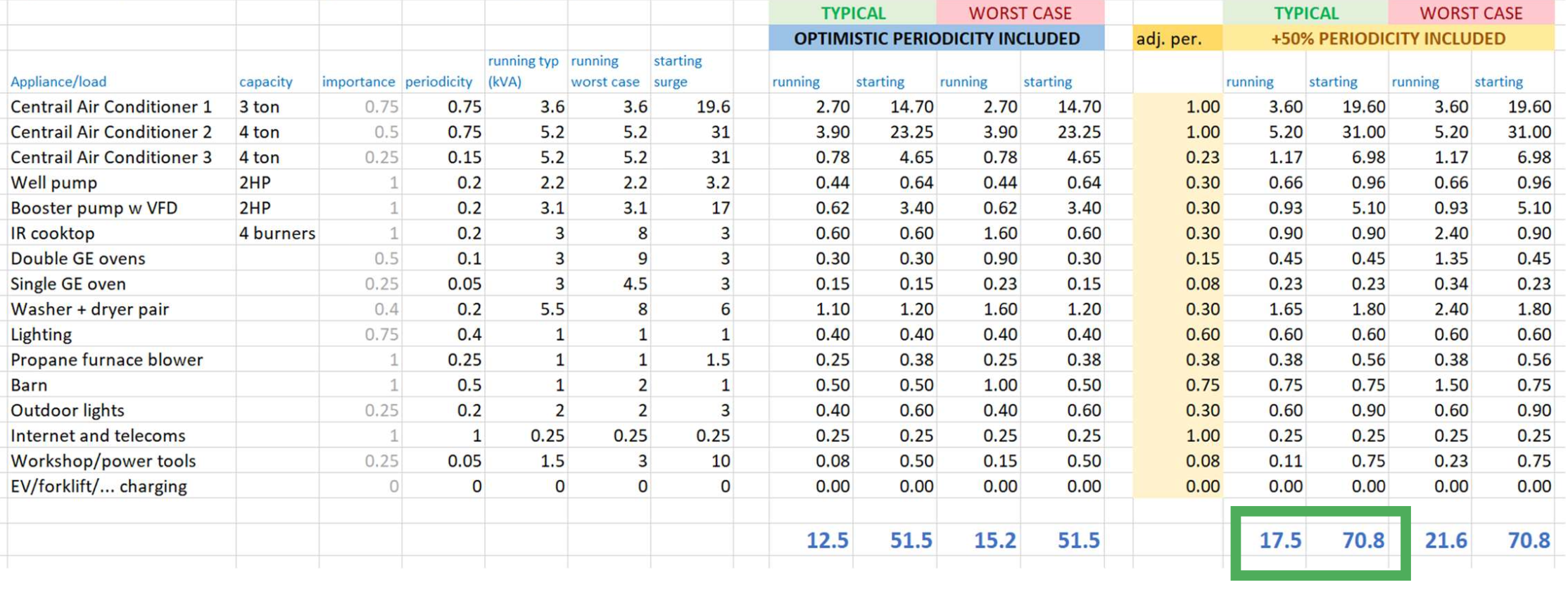
Load analysis example, including periodicity calculation.
Hardware class changes as you scale
One of the biggest misconceptions we encounter is the assumption that scaling an off-grid system (e.g., from cabin to whole-house) simply means buying more of the same equipment. In reality, once you cross into whole-property power territory, you need entirely different classes of hardware.
Large systems require equipment designed for higher power throughput, longer duty cycles, and continuous operation. That means stepping up to stacked or parallel inverter systems, larger conductors and busbars, right-sized safety components, and advanced monitoring and control platforms.
All these measures are critical because electrical stress increases nonlinearly as power scales. Heat, current, and fault risk all rise: hardware that performs perfectly in a small system can become a failure point in a large one.
Additionally, everything must scale proportionally. For example, if you install a powerful inverter but your batteries can’t support its surge capacity, the system may trip. If you have a sizable battery bank but are short on solar panels, the batteries may often go hungry, increasing wear and impacting their longevity.
Batteries should be treated as assets
Battery sizing focuses on storage volume in smaller systems. However, batteries are expensive and should be treated as an asset. That means in larger systems, battery design should prioritize lifespan and resilience.
So, we ask these key questions: What’s the tradeoff between cycle life vs. depth of discharge? What are the maintenance requirements? How much should you invest in upgrading the operating environment to extend battery longevity (e.g., insulation, yes; air-conditioning/heating, probably no)? How does the architecture provide redundancy while isolating failures?
Smaller systems often use a single battery bank. Such a single point of failure could result in total power loss across a property. That’s why we use modular battery banks and wire them so that one failed module doesn’t shut down the entire system.
Then, we consider battery longevity to lower the system’s total cost of ownership (TCO). Deep daily cycling, poor charge programming, or undersized storage can dramatically shorten battery lifespan.
Designing for durability often means intentionally oversizing storage capacity and carefully tuning charge parameters. For example, reducing the depth of charge and discharge each by 25% can quadruple a battery pack’s lifespan.
Intelligent inverters require programming kung fu
Smaller systems often use “dumb” inverters that don’t require any programming. However, whole-property solutions greatly benefit from intelligent inverter platforms that can monitor battery status, manage charging sources, support remote parameter adjustments and monitoring, and more.
These intelligent inverters provide visibility and control, which is essential for reliability, but they also introduce programming complexity. Proper provisioning and configuration require understanding power flow logic, battery chemistry requirements, and failover behaviors.
Additionally, we consider various use cases and scenarios, such as intentional hysteresis:
Let’s say you have off-grid solar with grid power as backup. One early morning, your battery just charged up from 0% to 1%. Right at that moment, you plug in the waffle iron, start the dishwasher, and as luck has it, the well pump kicks in. Under that load, the battery voltage sags, and the grid takes over again. Then, the battery recovers briefly and thinks it can pick up some load again!
If the inverter is programmed to switch back to solar too quickly, the battery will collapse again, and the system will switch to the grid. All these could happen in about 0.1 seconds, creating an endless loop of back-and-forth chatter that eventually damages the inverter. To prevent this scenario, we program inverters to give batteries a “mandatory timeout” until they’ve recovered enough to carry the expected load.
Moreover, we may wire two inverters in parallel (instead of using one with higher capacity) to add redundancy to our solutions. Complex software programming is required to ensure that they work in synch and perform as intended.
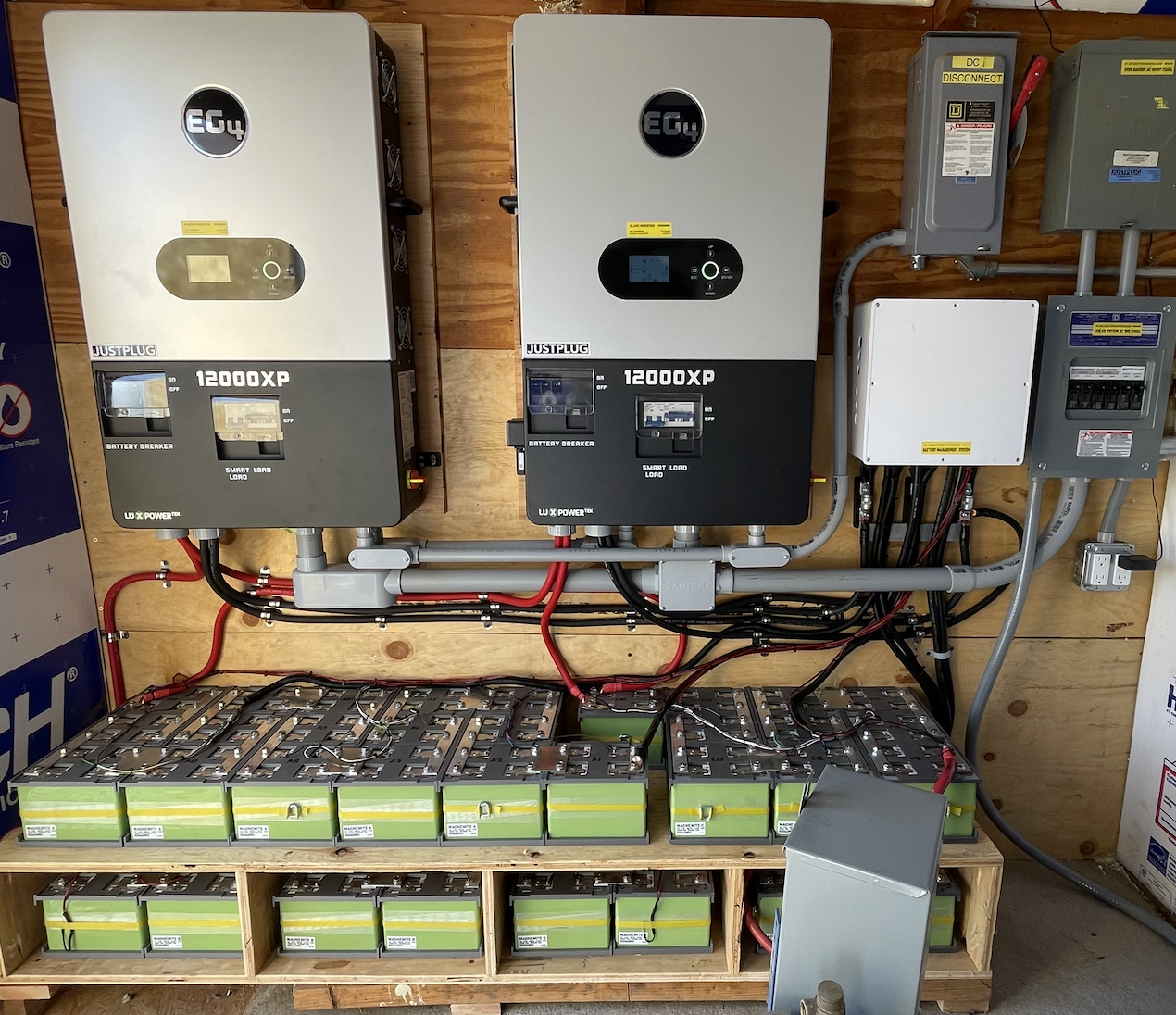
This solution has two inverters and three battery modules for redundancy.
Energy efficiency is a core design lever
Energy efficiency may not make a substantial difference in smaller systems. However, inefficiencies add up — translating into thousands, even tens of thousands, of dollars’ worth of unnecessary capacity in whole-property solutions.
On more than one occasion, we did the math to demonstrate to our clients that investing in a modern, energy-efficient fridge or mini-split means saving thousands on solar panels, inverter capacity, and battery storage.
That’s why our design process includes an energy efficiency audit/conversation to discuss appliance selection, HVAC strategy, water-heating method, insulation performance, and user behavior patterns. In many cases, upgrading a few appliances or shifting usage timing can reduce required system size and cost without impacting the quality of life.
Resilience means you can’t be a one-trick pony
Our goal is to help our clients implement a resilient energy strategy that makes sense holistically. As such, we consider other means for generating power, not just solar, to ensure reliability and continuity.
For example, if you only use an oven twice a year, dimensioning solar to power it probably doesn’t make financial sense. In that case, using a propane oven or putting it on grid power (if you use our Resilience solution) will not impact your lifestyle but save you thousands.
Additionally, we discuss plans B, C, and D. For clients with a grid connection, keeping it is often the most cost-efficient backup strategy. For those who are completely off-grid, we often include an auto-start generator in the solution design for resilience.
Why a custom-designed whole-property off-grid solar solution comes out ahead
A properly dimensioned and engineered whole-ranch/whole-house off-grid solar solution must address many moving parts. Nailing it requires having an in-depth conversation with the client and days of design and engineering work.
To cover most use cases without the complex calculations so that they can sell more and faster, most installers push grossly over-dimensioned, one-size-fits-all solutions. But that’s not how we do it.
We don’t start with what’s on the shelf. We begin each project by understanding the client’s property, mindset (e.g., risk tolerance), requirements, acceptable tradeoffs, and plans to design a fit-for-purpose solution. Then, we identify the hardware solution suitable for the use case.
The result? You get a solution that meets your needs without paying for capacity you don’t need.
Learn more about our whole-ranch/whole-house off-grid solar solution and get in touch to discuss your grand plan.