The Dirty Little Secrets of Amazon Lithium Battery Sellers
We lived in New York City for a while. There’s a row of Indian restaurants on 6th Street and First Avenue in Manhattan. They have different storefronts, but most offer very similar menus, and the food tastes rather similar.
We joked that they must have one big kitchen in the basement, preparing food for most of the restaurants on the street level. (There was actually a good one at the corner…)
Now, we say the same about cheap lithium batteries on Amazon.
Building batteries isn’t for the faint of heart
Battery engineering is challenging and dangerous💥. Seriously. The typical brands selling batteries on Amazon lack the expertise and facilities to develop and build batteries. Most sell white-label battery packs manufactured by a handful of suppliers.
No-name brands don’t care about longevity
Many Amazon sellers use brand names that look like someone let their cat loose on the keyboard. They probably didn’t exist three months ago and may not be there four months from now. That may be ok if you’re getting a pair of shorts, but not so much if you spend a pretty penny on assets that promise to work for five, seven, or even ten years.
Yet, that's exactly the strategy sellers use to maximize profits. They create a bunch of fly-by-night LLCs to sell dubious packs. They delist a product and change the brand name after a year or two, leaving consumers with no way to complain or submit warranty claims.
These sellers’ only goal is to generate as much profit as possible. They aren’t incentivized to ensure reliability and longevity because they don't have a reputation to protect. They use fewer cells and/or set an aggressive depth of discharge (DoD) to meet specs at the lowest possible cost.
<< Sidebar: DoD refers to how deep you discharge a cell. The deeper you drain a cell, the shorter its lifespan. For example, for clients requesting ultra-long-life batteries, we set the DoD to 70-75%. Meanwhile, a typical commercial pack is set at 90% DoD or higher. Amazon ones are often set at 99%. >>
Then, there’s the Amazon profit machine
Now you may say, “But I see YouTube videos of people testing these batteries, and they hit the numbers!”
Many of these YouTubers/influencers/testers are incentivized by affiliate programs. The more brands they can test, the more revenue opportunities. So, sellers keep churning out new brands testers can link to — even if the packs come from the same factory.
These testers only evaluate “fresh out of the box” performance without putting the batteries through the wringer. What’s the deterioration rate under various operating conditions? If you push these batteries very hard, how long do they last? They don’t care.
These reviewers won’t wait three or five years before they report back to cash in! They just say, “Yeah, they meet what it says on the tin. Here’s the link. Go buy it.”
By the time buyers realize that the “10 years, 10,000 cycles” claim is false, the brand has already folded. (Or, the seller would say, the batteries meet specs if you treat them very, very nicely — warm blanket and hot cocoa every night! It’s in the instructions, printed in a convenient 5-point font.)
Meanwhile, Amazon’s affiliate program structure fuels this gravy train by encouraging companies to create unique brands (for Google-able reviews). So, everybody wins except the long-term owner of these battery packs.
What about brand-name solar batteries?
Those are better because these brands have a reputation to protect. For example, we do offer commercial battery packs as an option for some clients based on our evaluation of the operating conditions.
However, the product description of these batteries can still be deceiving.
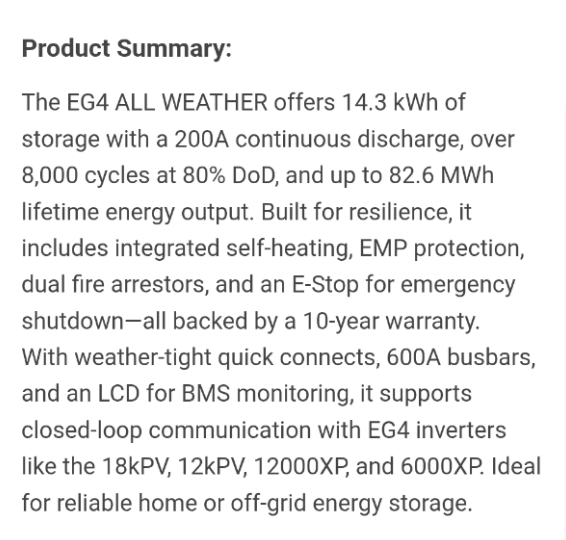
A battery pack product description from a brand with a decent reputation.
The numbers claimed by the brand are all true — but they can’t happen simultaneously. For example, if you push the pack to empty twice a day, the cells will wear out much faster, and you won’t get 8,000 cycles out of it. The specs are also based on tests performed under ideal conditions, which are challenging to achieve in most rural settings (e.g., heat, cold, dust).
Treat battery specs like those of vehicles:
Say, you’re reading the specs of a Ford F-150 XL. It can do ~25 MPG (highway), carry up to 8,400 lb, and go from 0 to 60 in 6.5 - 7.5 seconds. But you won’t expect the truck to do 25 MPG while carrying 8,000 lb and accelerating and stopping frequently.
The same goes for batteries. They can meet the specs under the ideal operating conditions, but one number at a time.
What about the 10-year warranty? Keep in mind that most warranties have exclusions and often don’t cover failure from typical or expected use, such as normal wear and tear. Many packs "die" from usage not covered by warranty before any manufacturing fault appears.
“Can I change parameters, like DoD, when I buy a commercial pack?
Unfortunately, no. These packs are black boxes — you get what you get, and you don’t get upset. But for good reasons: The typical consumer doesn’t have the knowledge to adjust battery parameters safely. A single mistake could cause fires and explosions.
That’s why we build our own batteries using cells from trusted suppliers. We tune cell behaviors to meet each client’s needs with our proprietary software and custom battery management system (BMS). We also use more cells than a commercial pack to achieve the same output, so that each cell doesn’t have to work as hard, thereby increasing a pack’s longevity — e.g., reducing the DoD from 90% to 70% can double the battery lifespan.
Read more about our approach to solar batteries or get in touch to see how we can tailor your battery solution.